
Multi-Release · U.S. Department of War
PURSUE Declassified Archive
The Presidential Unsealing and Reporting System for UAP Encounters — a rolling declassification series from the U.S. Department of War. The archive includes the FBI 62-HQ-83894 case file, NASA Apollo / Mercury audio and lunar photography, DoE and CIA / ODNI records, and unresolved infrared sensor footage from CENTCOM, EUCOM, INDOPACOM, AFRICOM, and NORTHCOM. Originally released at war.gov/UFO.
Release
Agency
Showing 298 of 478 records.
Released October 23, 2026 · U.S. Department of War
28 records in this release
 PDF
DoD / AARO · Washington, D.C.
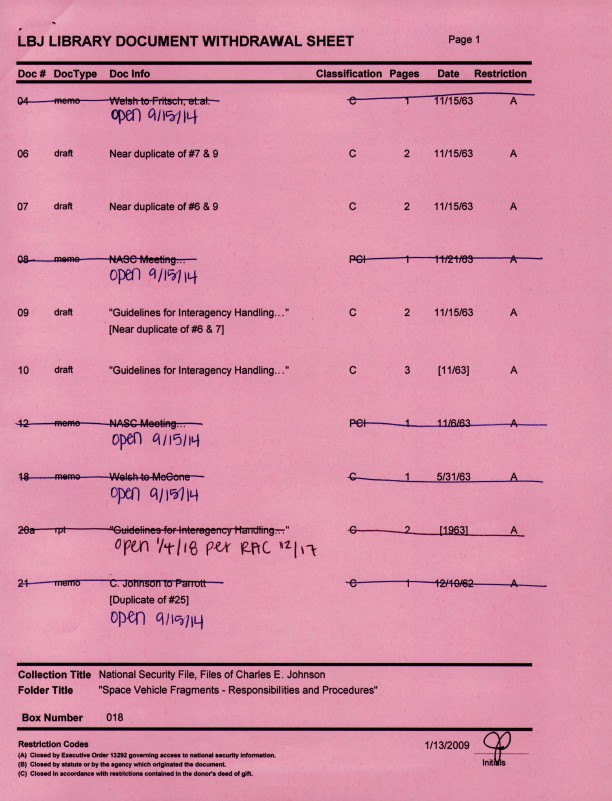
USG-UAP-D002, Interagency Correspondence Concerning Space Fragments, 1962-1964
This file contains a series of memoranda and correspondence exchanged among senior Executive Branch officials between October 2, 1962, and May 26, 1964, concerning the development of a policy framework and communications strategy for the recovery, handling, analysis, and disposition of materials associated with U.S. and foreign activities in space. Over the course of multiple drafts and revisions spanning nearly two years, the file documents efforts to establish jurisdictional boundaries based on the suspected origin and character of recovered material. In general, the proposed framework contemplated that material associated with a U.S. Department of Defense mission or equipment would be received, analyzed, and disposed of by the Department; that foreign space material would be turned over to the Department of Defense or the National Aeronautics and Space Administration (NASA), depending on the circumstances; and that the Department of State would coordinate with foreign governments to secure access to such material when recovered abroad. The correspondence also reflects efforts to assign responsibility for hazardous or radioactive materials to the Atomic Energy Commission. Various drafts alternated between assigning responsibility for handling materials whose origin could not be readily determined to the Department of Defense or to NASA. The correspondence also reflects concern with public perception regarding recovery activity and includes draft public statements describing the proposed framework. This public messaging included language designating NASA as the holding authority for foreign materials, while private correspondence described a parallel plan to exploit such materials for technical analysis. Ultimately, although these negotiations did not produce a settled policy framework, the correspondence illustrates interagency deliberations between senior officials in the context of the Space Race and the broader Cold War between the United States and the Soviet Union.
 PDF
FBI · Western United States
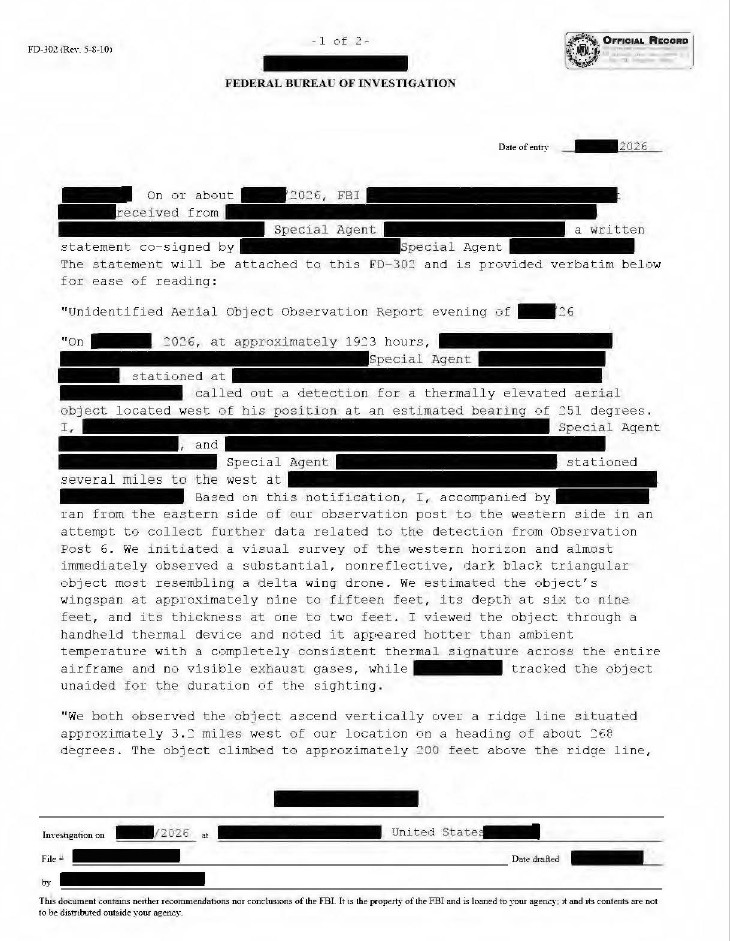
FBI-UAP-D043, FD-302, Unidentified Aerial Object Observation Report, 2026
This document is an FBI FD-302, a form the Federal Bureau of Investigation (FBI) uses to record interviews. This FD-302 records a 2026 interview with two Federal Special Agents, in which the interviewees describe an incident reported as involving unidentified anomalous phenomena (UAP) at a national security site in 2026.
 PDF
White House / EOP · Washington, D.C.
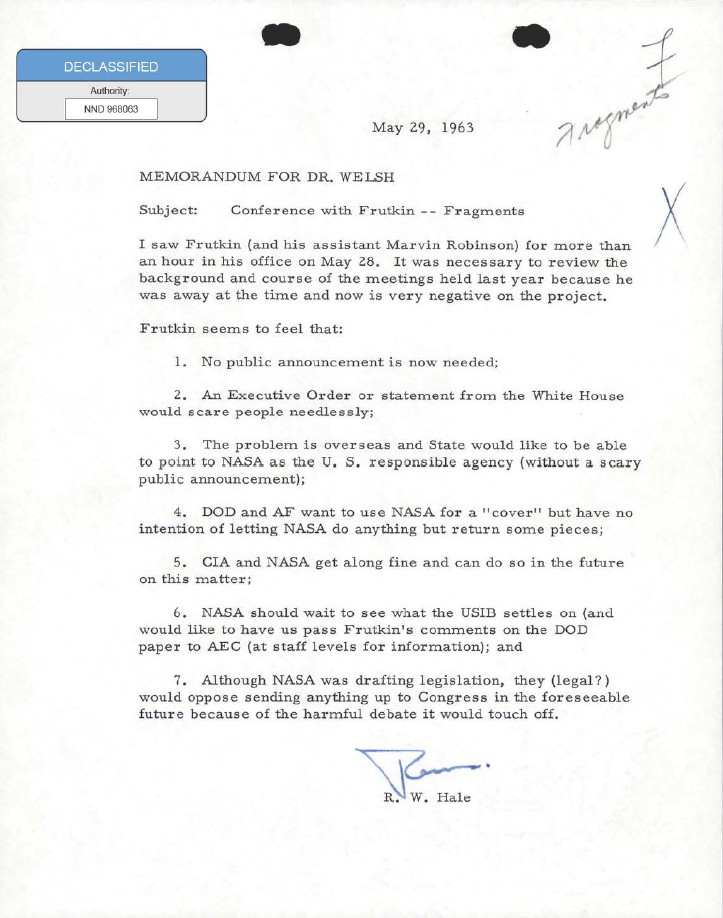
EOP-UAP-D002, Memorandum on Interagency Coordination for the Recovery of Foreign Materiel, May 1963
This document is an internal National Aeronautics and Space Council (NASC) memorandum from staff member R.W. Hale to Executive Secretary Edward C. Welsh. NASC was a 1958–1973 body within the Executive Office of the President responsible at the time for coordinating U.S. space policy. The memorandum records a May 28, 1963, meeting with Arnold Frutkin, Director of International Programs at the National Aeronautics and Space Administration (NASA), concerning the development of a coordinated interagency policy for recovering reentering U.S. and Soviet space debris and satellite fragments that might land on foreign soil. This memorandum is associated with a larger body of interagency correspondence included in this collection under the title “USG-UAP-D002.” The memorandum highlights an interagency policy debate over organizational jurisdiction during the early Space Race. It states that the Department of State and Department of War sought to leverage NASA’s standing as a civilian scientific agency to help facilitate discreet recovery of sensitive space hardware while publicly returning non-sensitive components to the country of origin. As described in the memorandum, the proposed arrangement would have served several purposes: enabling access to adversary technologies, protecting U.S. technologies, preserving diplomatic goodwill, and obscuring the intelligence gathering dimension of technology recovery operations. The memorandum also presents Director Frutkin’s reaction to the proposed arrangement as “very negative.”
 PDF
DoD / AARO · Catalina Island, California
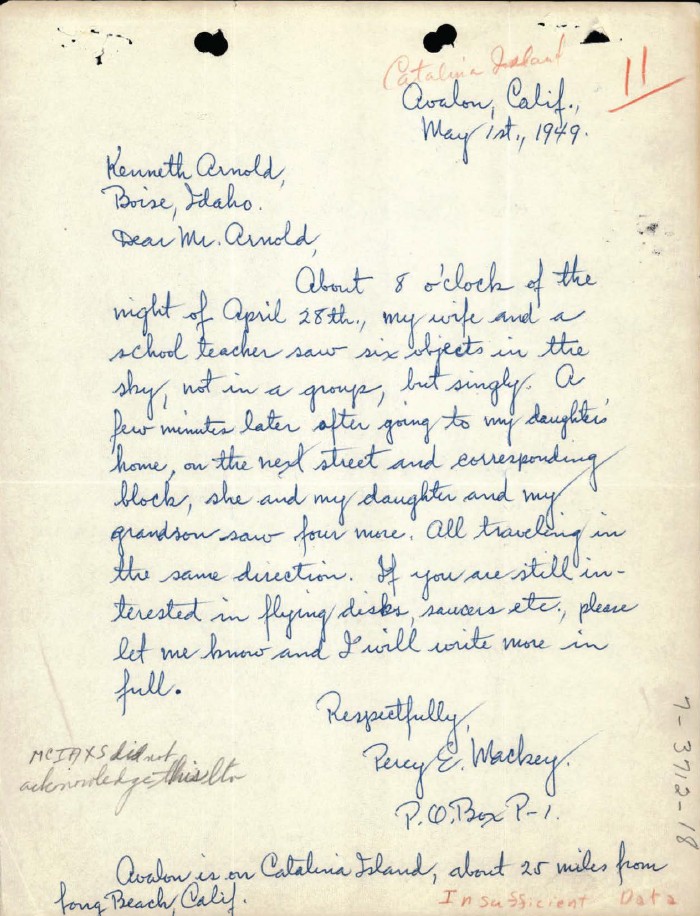
DOW-UAP-D181, Unresolved UAP Report, Catalina Island, 1949
This file contains correspondence from Mr. Percy Wackey of Avalon, California to Mr. Kenneth Arnold of Boise, Idaho. Mr. Wackey relayed that his wife and another individual reported observing six objects over Catalina Island on the night of April 28, 1949. A handwritten annotation and contemporary documentation associated with the letter indicate a conclusion by the U.S. Air Force that the incident lacked sufficient data for evaluation.
 PDF
DoD / AARO
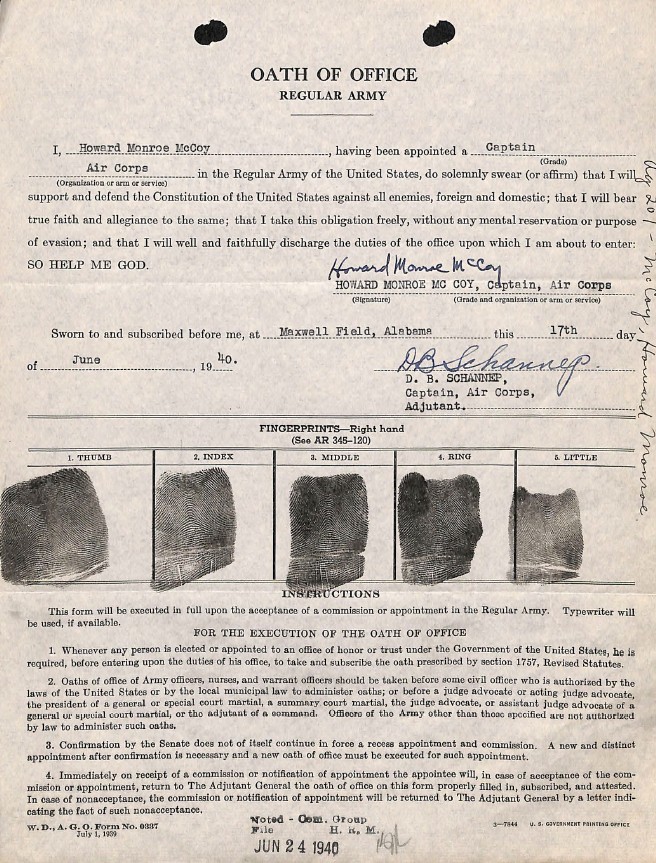
DOW-UAP-D180, Final Personnel Record for McCoy, Howard M., U.S. Air Force, 1954
This file contains the final personnel record of U.S. Air Force officer Howard M. McCoy, who left service as a Colonel, a senior field-grade officer responsible for significant operational and administrative duties. From December 1946 to August 1949, Colonel McCoy served as Deputy Commanding General for Intelligence (T-2), and later as Chief of the Intelligence Department, Headquarters, Air Materiel Command, at what is now known as Wright-Patterson Air Force Base. During his tenure, the Air Force initiated two significant studies centering on unidentified anomalous phenomena: Project SIGN and Project GRUDGE. He was among the senior Air Force intelligence officers involved in the early design, administration, and execution of those programs.
 PDF
DoD / AARO · Catalina Island, California
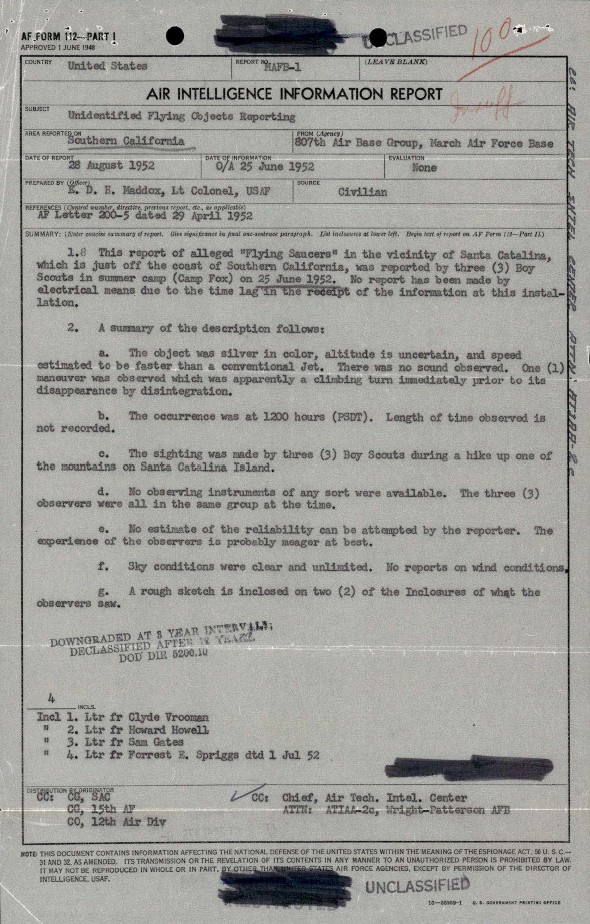
DOW-UAP-D179, Air Intelligence Information Report, Catalina Island, 1952
This file contains an Air Intelligence Information Report (AIIR), a standardized U.S. Air Force reporting form used to record raw information of potential intelligence value for later analysis. The form served as a primary vehicle for U.S. Air Force field intelligence collection throughout the early Cold War, until defense-wide reporting standards were established in the early 1960s. This AIIR records a June 25, 1952, incident over Catalina Island, California, in which three Boy Scouts attending a summer camp at Camp Fox reported observing silver “flying saucers” moving at an estimated speed faster than that of a conventional jet. The report also describes the object as climbing quickly before apparently disintegrating. A comment by the preparing officer indicated that no attempt was made to establish the reliability of the report and characterized the experience of the observers as “probably meager at best.” All descriptive and estimative language contained in this report reflects the reporter’s subjective interpretation at the time of the event. Such characterizations should not be interpreted as a conclusive indication of the presence or absence of any intrinsic object features or performance characteristics.
 PDF
DoD / AARO · Catalina Island, California
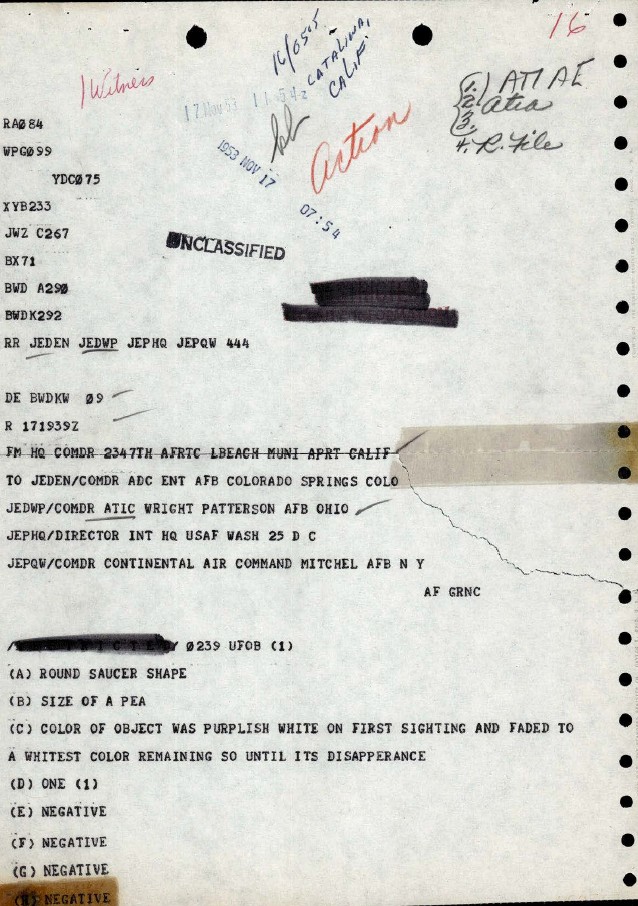
DOW-UAP-D178, Unresolved UAP Report, Catalina Island, 1953
The file contains a report of a round, purplish-white object above Catalina Island on November 16, 1953. The report describes the object as remaining stationary, then moving northwest toward Los Angeles over approximately 10 minutes on a level flight path. The report characterizes the observer as fairly reliable due to his association with military jet aircraft activities while stationed at Long Beach Air Force Base, Los Angeles, CA. The report refers to an assessment by local astronomers that Jupiter provided a possible explanation.
 PDF
DoD / AARO · Catalina Island, California
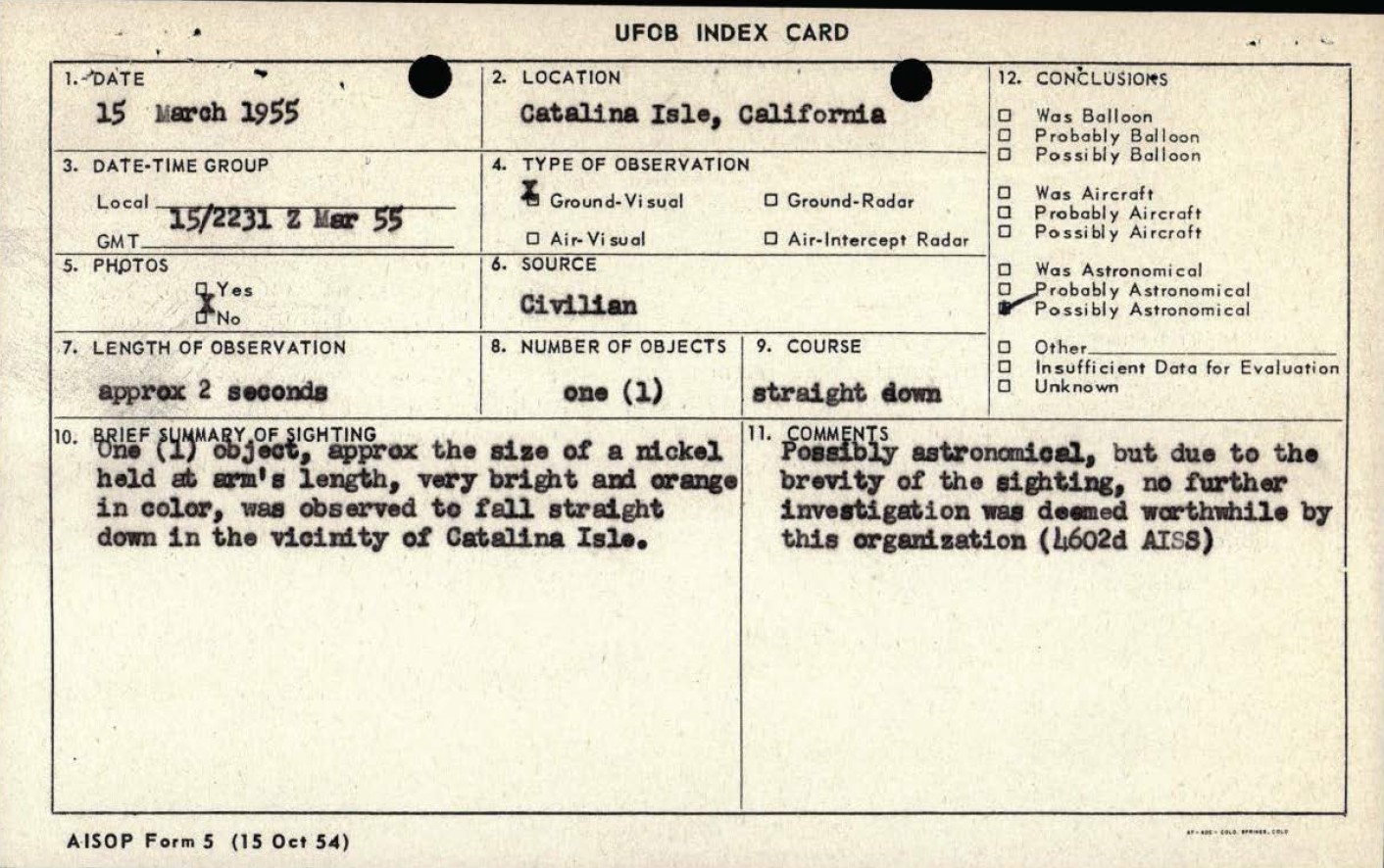
DOW-UAP-D177, Unresolved UAP Report, Catalina Island, 1955
The file contains a report by Paul J. Carr of Avalon, California, who reported observing a bright orange object, approximately the size of a nickel held at arm’s length, on the evening of March 15, 1955. The provisional assessment associated with the report includes a comment from the preparing officer that the sighting is possibly astronomical, and that the incident did not warrant further investigation.
 PDF
DoD / AARO · Western United States
DOW-UAP-D176, Triangular UAP AARO Memorandum for Record, 2026
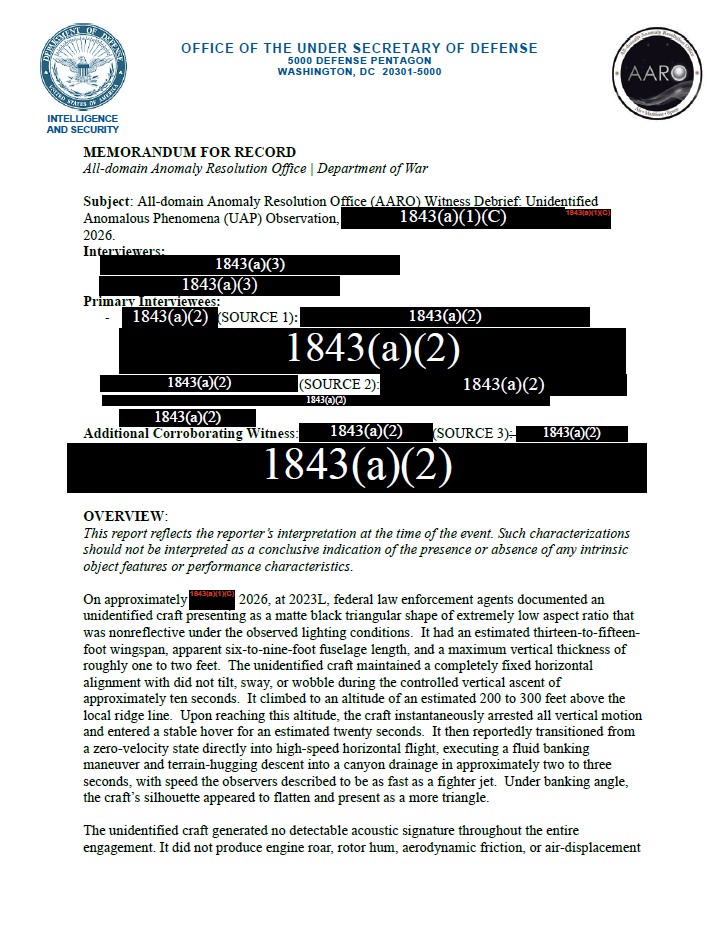
This document is a memorandum for record documenting an AARO witness debrief concerning reported unidentified anomalous phenomena (UAP) observations at a sensitive national security site in the western United States over two days in 2026. AARO considers this incident to warrant further investigation due to the close alignment of the phenomena’s reported morphological features and kinematic profiles with those of other reported incidents in the western United States region. The memorandum records an interview with two Federal Special Agents and incorporates a corroborating account from a third official positioned at a separate observation post. The memorandum describes a primary event in which the reporting individuals stated that a triangular object rose vertically, remained stationary, and then banked and descended into a canyon. It records their descriptions of the object’s shape, color, apparent thermal signature, perceived lack of conventional propulsion features, and absence of an associated audible signature. The memorandum further records a secondary observation on the following evening, and a subsequent ground search that found no visible debris or evidence of an impact in the accessible survey area. The file is an investigative record preserving witness accounts, chronology, and associated analytic support material developed by the All-domain Anomaly Resolution Office (AARO) and does not present a conclusive finding regarding the nature or origin of the reported object or objects. All descriptive and estimative language reported by the individuals interviewed reflects their subjective interpretations at the time of the event. Such characterizations should not be interpreted as a conclusive indication of the presence or absence of any intrinsic object features or performance characteristics.
 PDF
DoD / AARO · Las Vegas, Nevada
DOW-UAP-D175, BAASS Self-Assessment of UAP Analysis Capabilities, November 2010
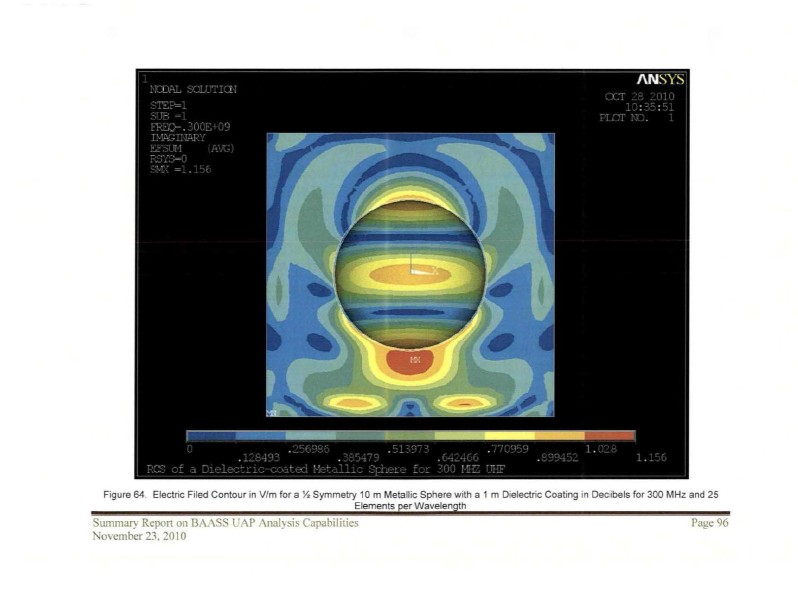
This document is an administrative, programmatic, or contractor-produced record related to the Advanced Aerospace Weapon System Applications Program (AAWSAP), a Defense Intelligence Agency (DIA)-administered program active from 2008 to 2012. AAWSAP’s official scope of work identified 12 technical research areas relating to potential aerospace threats over a time horizon of more than 40 years. As part of the broader program record, the file documents how AAWSAP was scoped, organized, tasked, funded, executed, or described at a particular point in time. This November 2010 Bigelow Aerospace Advanced Space Studies (BAASS) contractor-authored capability statement presents BAASS’s analysis as technically rigorous and strategically valuable. The document appears intended not only to describe BAASS’s analytical capabilities but also to reinforce the case for the organization’s continued relevance and for the continuation of AAWSAP. The document summarizes the company’s self-assessment of the suitability of its personnel, software, equipment, field sensor, and data warehousing capabilities for analyzing unidentified aerial phenomena (UAP) and unidentified submerged objects (USOs). It includes excerpted case findings and uses selected case studies and modeling exercises as demonstrations of BAASS’s analytical capabilities. The report describes BAASS as combining field collection resources, historical databases, and computational tools such as ANSYS Multiphysics to model UAP incidents through engineering and physics analysis, including work on radar cross section, fluid behavior, acoustics, and aerodynamic performance. It also presents BAASS’s in-house capabilities as supporting both threat assessment and the study of advanced aerospace technologies, while asserting that analysis of UAP performance characteristics could inform future developments in propulsion, stealth, detection, and weapons systems.
 PDF
DoD / AARO · Las Vegas, Nevada
DOW-UAP-D174, Utah Ranch Investigation Report, April 2010
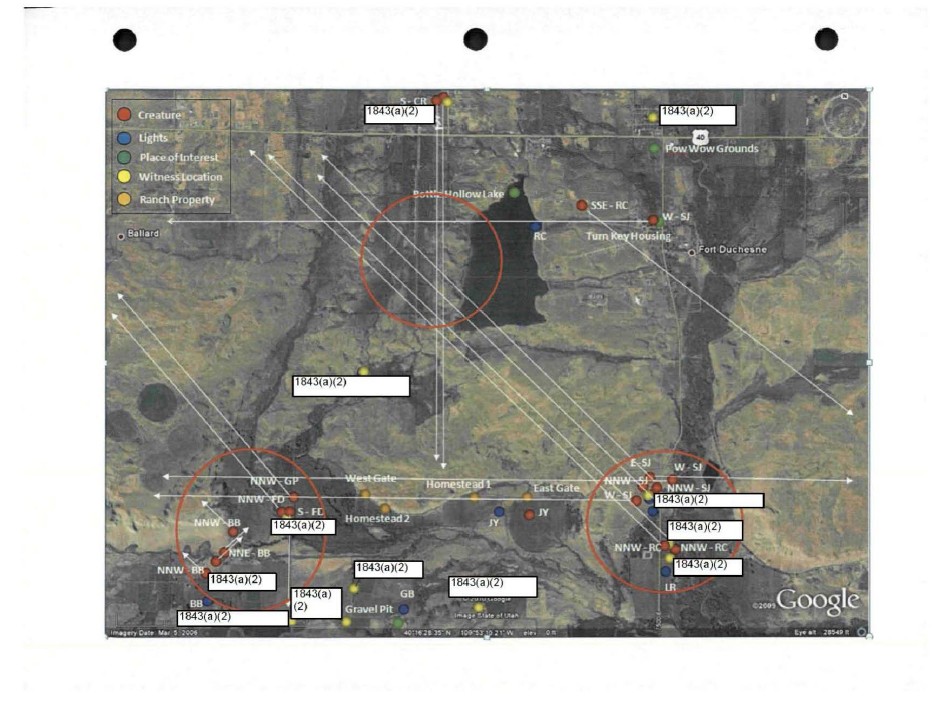
This document is an administrative, programmatic, or contractor-produced record related to the Advanced Aerospace Weapon System Applications Program (AAWSAP), a Defense Intelligence Agency (DIA)-administered program active from 2008 to 2012. AAWSAP’s official scope of work identified 12 technical research areas relating to potential aerospace threats over a time horizon of more than 40 years. As part of the broader program record, the file documents how AAWSAP was scoped, organized, tasked, funded, executed, or described at a particular point in time. This April 2010 Bigelow Aerospace Advanced Space Studies (BAASS) investigation report documents field deployments to a Utah property and surrounding communities during March and April 2010. The report states that BAASS personnel interviewed local residents, law enforcement officers, ranchers, business owners, and tribal community members about reported anomalous events; used handheld sensors to collect environmental measurements; planned plant-based biosensor experiments; and sought photographic, acoustic, and chemical evidence of purported anomalous phenomena. It also records extensive reported accounts involving “dog-like bipedal creatures,” orbs of light, “little people,” “prehistoric-looking” birds, among other phenomena, and states that BAASS intended to use interactive methods to attempt communication with the presumed source of reported anomalous activity.
 PDF
DoD / AARO · Las Vegas, Nevada
DOW-UAP-D173, BAASS Monthly Report, November 2009
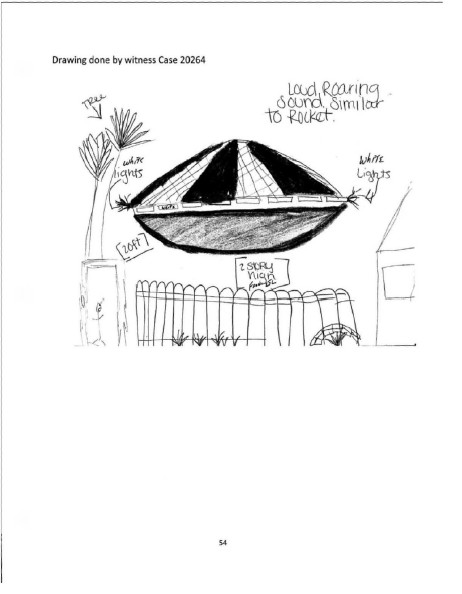
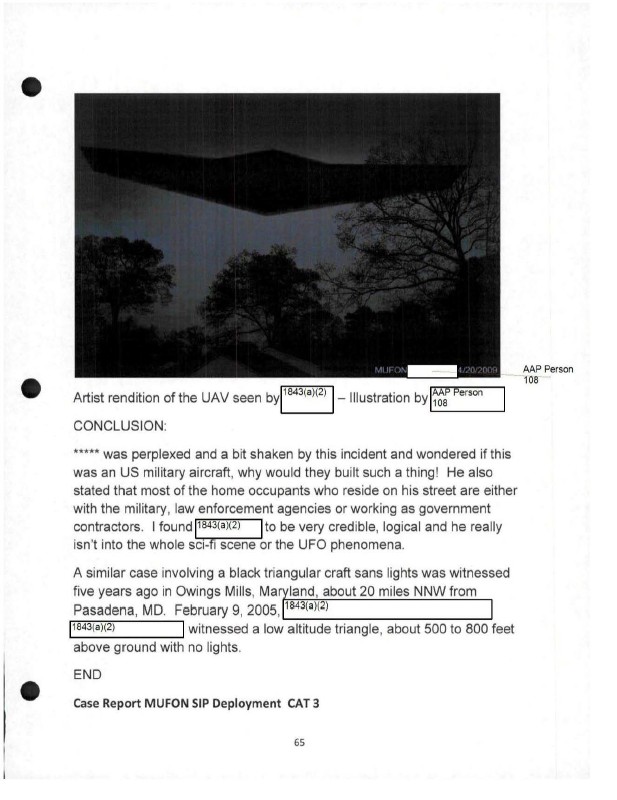
This document is an administrative, programmatic, or contractor-produced record related to the Advanced Aerospace Weapon System Applications Program (AAWSAP), a Defense Intelligence Agency (DIA)-administered program active from 2008 to 2012. AAWSAP’s official scope of work identified 12 technical research areas relating to potential aerospace threats over a time horizon of more than 40 years. As part of the broader program record, the file documents how AAWSAP was scoped, organized, tasked, funded, executed, or described at a particular point in time. This November 2009 Bigelow Aerospace Advanced Space Studies (BAASS) progress report summarizes contractor activities for the period November 1–30, 2009. The report focuses on AAWSAP investigative activity based on information received via the Mutual UFO Network (MUFON), progress on investigations centering on a ranch in Utah, and a preliminary report on a “blue orb” incident. It also records BAASS’s continued emphasis on field investigation, case database expansion, and focused inquiry into events at the Utah ranch and surrounding area, including creation of a separate database for those incidents.
 PDF
DoD / AARO · Las Vegas, Nevada
DOW-UAP-D171, BAASS Monthly Report, June 2009
This document is an administrative, programmatic, or contractor-produced record related to the Advanced Aerospace Weapon System Applications Program (AAWSAP), a Defense Intelligence Agency (DIA)-administered program active from 2008 to 2012. AAWSAP’s official scope of work identified 12 technical research areas relating to potential aerospace threats over a time horizon of more than 40 years. As part of the broader program record, the file documents how AAWSAP was scoped, organized, tasked, funded, executed, or described at a particular point in time. This June 2009 Bigelow Aerospace Advanced Space Studies (BAASS) progress report summarizes contractor activities for the period June 1–30, 2009. The report addresses staffing growth, expansion into new facilities, progress on contracted technical papers, investigative activity based on information received via the Mutual UFO Network (MUFON), a BAASS deployment to Brazil, an update on “Project Northern Tier,” and continued review of UAP-related materials released by foreign governments. It also documents BAASS’s continued investment in field investigation capacity, foreign liaison-building, and UAP case acquisition, while recording BAASS’s proposal to reduce MUFON’s monthly stipend pending further performance review. Overall, the file reflects program activity, particularly in UAP reporting intake, foreign case investigation, and organizational expansion in support of those functions.
 PDF
DoD / AARO · Las Vegas, Nevada
DOW-UAP-D170, BAASS Monthly Report, April 2009
This document is an administrative, programmatic, or contractor-produced record related to the Advanced Aerospace Weapon System Applications Program (AAWSAP), a Defense Intelligence Agency (DIA)-administered program active from 2008 to 2012. AAWSAP’s official scope of work identified 12 technical research areas relating to potential aerospace threats over a time horizon of more than 40 years. As part of the broader program record, the file documents how AAWSAP was scoped, organized, tasked, funded, executed, or described at a particular point in time. This April 2009 Bigelow Aerospace Advanced Space Studies (BAASS) progress report summarizes contractor activities for the period April 1–30, 2009. The report addresses staffing and clearance processing, progress on contracted technical papers, BAASS’s purchase of unidentified anomalous phenomena (UAP) information from the Mutual UFO Network (MUFON), work on “Project Northern Tier,” and review of UAP-related materials released by several foreign governments. It also describes BAASS’s development of investigative and laboratory support capabilities, including a small deployable field investigation team and arrangements for potential future forensic and scientific analyses of materials obtained through MUFON reporting. Overall, the file documents ongoing program activity, particularly in UAP case acquisition, field investigation, and archival research.
 PDF
DoD / AARO · Las Vegas, Nevada
DOW-UAP-D169, BAASS Monthly Report, March 2009
This document is an administrative, programmatic, or contractor-produced record related to the Advanced Aerospace Weapon System Applications Program (AAWSAP), a Defense Intelligence Agency (DIA)-administered program active from 2008 to 2012. AAWSAP’s official scope of work identified 12 technical research areas relating to potential aerospace threats over a time horizon of more than 40 years. As part of the broader program record, the file documents how AAWSAP was scoped, organized, tasked, funded, executed, or described at a particular point in time. This March 2009 Bigelow Aerospace Advanced Space Studies (BAASS) progress report summarizes contractor activities for the period March 1–31, 2009. The report addresses staffing and clearance processing, progress on contracted technical papers, development of advanced aerial phenomena databases, BAASS’s purchase of unidentified anomalous phenomena (UAP) information from the Mutual UFO Network (MUFON), efforts to become the Federal Aviation Administration’s official reporting point for unidentified anomalous phenomena (UAP), and review of UAP-related materials released by foreign governments. It also documents BAASS’s broader effort to establish centralized UAP collection and analysis capabilities, including database development, and external reporting pipelines. Overall, the file reflects ongoing program activity, particularly its emphasis on UAP reporting intake, reporting infrastructure, and archival or case-based analysis.
 PDF
DoD / AARO · Las Vegas, Nevada
DOW-UAP-D168, BAASS Project Management Plan, December 2008
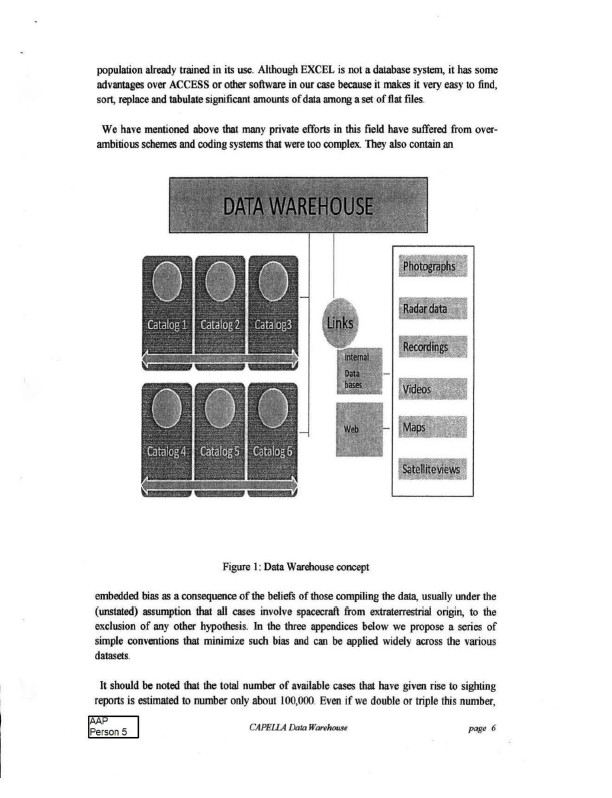
This document is an administrative, programmatic, or contractor-produced record related to the Advanced Aerospace Weapon System Applications Program (AAWSAP), a Defense Intelligence Agency (DIA)-administered program active from 2008 to 2012. AAWSAP’s official scope of work identified 12 technical research areas relating to potential aerospace threats over a time horizon of more than 40 years. As part of the broader program record, the file documents how AAWSAP was scoped, organized, tasked, funded, executed, or described at a particular point in time. This December 2008 Bigelow Aerospace Advanced Space Studies (BAASS) Project Management Plan is an overview paper setting out the contractor’s proposed strategy, priorities, and milestones for executing contract HHM402-08-C-0072 (AAWSAP). The plan states that BAASS would address the program’s 12 technical areas through a smaller number of selected projects, including initiatives focused on physics research, project cooperation with government-held information, academic engagement, database development, oral-history interviewing, and collection or review of materials described as excluded from Project Blue Book. The plan argues that the most productive approach would be to study “craft” or events already believed by BAASS to demonstrate novel behavior across the 12 technical areas, rather than concentrating primarily on then-current academic or industrial state-of-the-art research.
 PDF
DoD / AARO · San Fransisco, California
DOW-UAP-D167, Project Capella, December 2008
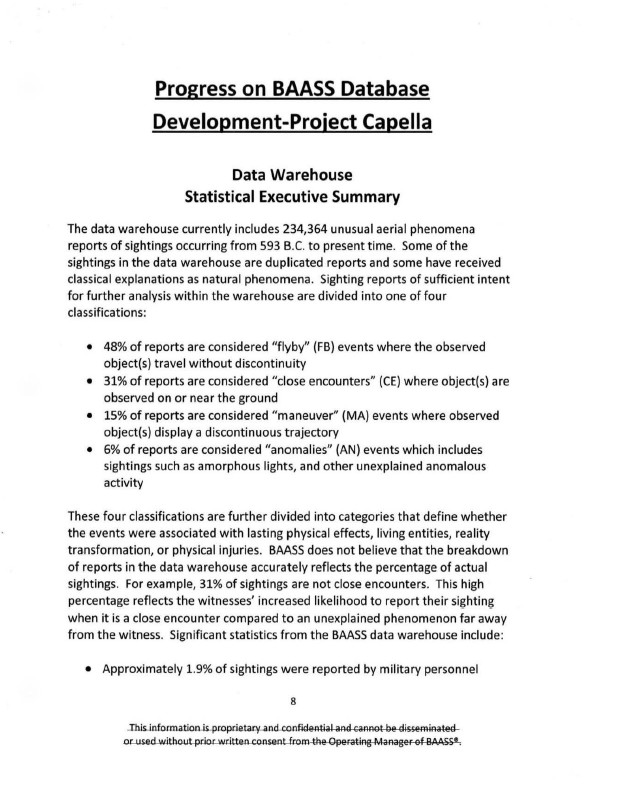
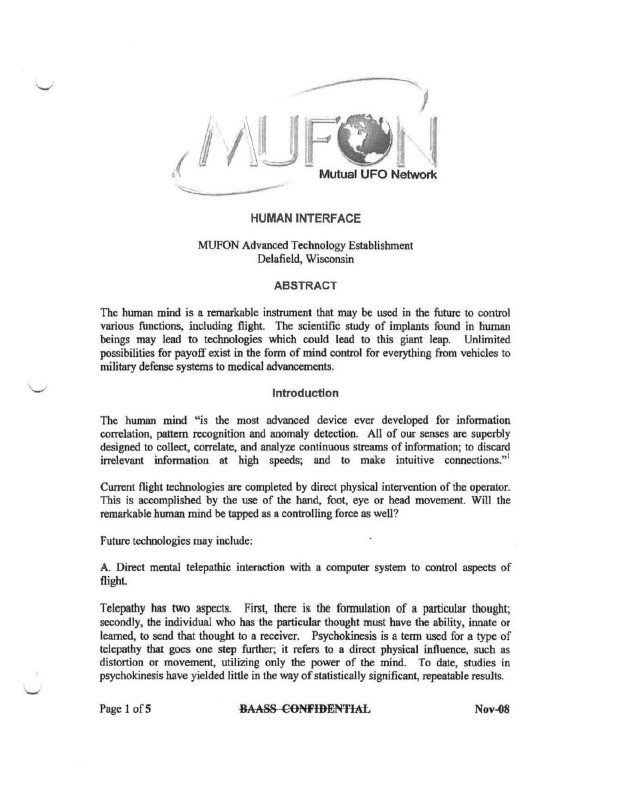
This document is an administrative, programmatic, or contractor-produced record related to the Advanced Aerospace Weapon System Applications Program (AAWSAP), a Defense Intelligence Agency (DIA)-administered program active from 2008 to 2012. AAWSAP’s official scope of work identified 12 technical research areas relating to potential aerospace threats over a time horizon of more than 40 years. As part of the broader program record, the file documents how AAWSAP was scoped, organized, tasked, funded, executed, or described at a particular point in time. This December 2008 report developed for Bigelow Aerospace Advanced Space Studies (BAASS) outlines Project Capella, a proposed data warehouse framework for the capture, processing, classification, and retrieval of information relating to “unusual” aerial phenomena and related anomalies. The report describes a methodology for integrating existing catalogues, standardizing classification and reliability measures, reviewing foreign and private databases, and building personnel and software capacity to support analysis, literature review, and potential future field investigations. It presents the project as a means of consolidating disparate historical and contemporary case materials into a structured research system capable of supporting multiple BAASS initiatives. By proposing a data architecture centered on unusual aerial phenomena and related anomalies, the document helped lay the groundwork for later BAASS efforts, seeking to formalize UAP-oriented data collection and analysis within BAASS’s execution of AAWSAP.
 PDF
DoD / AARO · Las Vegas, Nevada
DOW-UAP-D166, MUFON Reports Prepared for BAASS, November 2008
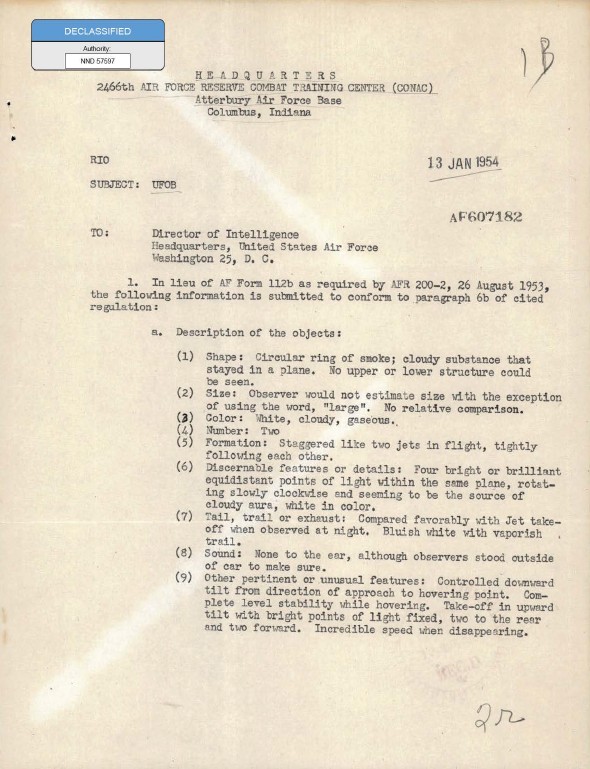
This document is an administrative, programmatic, or contractor-produced record related to the Advanced Aerospace Weapon System Applications Program (AAWSAP), a Defense Intelligence Agency (DIA)-administered program active from 2008 to 2012. AAWSAP’s official scope of work identified 12 technical research areas relating to potential aerospace threats over a time horizon of more than 40 years. As part of the broader program record, the file documents how AAWSAP was scoped, organized, tasked, funded, executed, or described at a particular point in time. This November 2008 compilation appears to be a set of technical materials prepared by the Mutual UFO Network (MUFON) for Bigelow Aerospace Advanced Space Studies (BAASS) under a separate supporting contract. The file presents MUFON-produced topical papers framed around AAWSAP’s technical research areas, including at least a paper on “Lift,” while treating historical and contemporary unidentified flying object or unidentified anomalous phenomena (UAP) reporting as a relevant source base for evaluating advanced aerospace capabilities.
 PDF
DoD / AARO
DOW-UAP-D164, Flying Object Report, Indiana, 1953
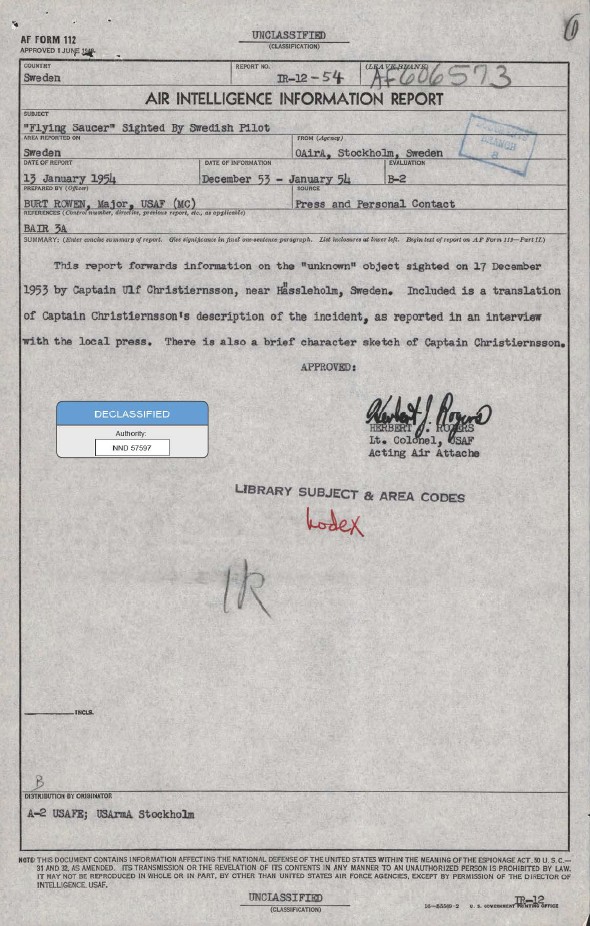
This document is a Flying Objects Report prepared in accordance with Air Force Regulation 200-2, which established guidance for reporting unidentified flying objects. The report records an incident near Seymour, Indiana, in which two civilian reporters stated that they observed two airborne objects while traveling by car. The report does not identify an exact event date; its weather assessment addresses conditions during the period December 8–15, 1953. The report describes the incident as consisting of a “brilliant moving light” and two large, white, cloudy or gaseous objects in a staggered formation. It further describes four bright points of light within each object and a bluish-white, vapor-like trail. The report describes the object kinematics as an in-line approach with a steady descent, a stationary interval of unreported duration, and a rapid departure along an abrupt upward angle toward the southwest. It records an estimated direct observation period of three to four minutes, with a total elapsed period of five to six minutes that included changes in the vehicle’s route. All descriptive and estimative language contained in this report reflects the reporter’s subjective interpretation at the time of the event. Such characterizations should not be interpreted as a conclusive indication of the presence or absence of any intrinsic object features or performance characteristics.
 PDF
DoD / AARO · Sweden
DOW-UAP-D163, Air Intelligence Information Report, Sweden, 1953
This document is an Air Intelligence Information Report (AIIR), a standardized U.S. Air Force reporting form used to record raw information of potential intelligence value for later analysis. The form served as a primary vehicle for U.S. Air Force field intelligence collection throughout the early Cold War, until defense-wide reporting standards were established in the early 1960s. This AIIR records a December 17, 1953, incident near Hässleholm, Sweden, translated from a local media report. At 1437 hours, Transair chief pilot Captain Ulf Christiernsson and crew chief Olle Johansson reported observing an object approaching their DC-3 from the opposite direction, approximately 600 meters (1,969 feet) below their aircraft, which was flying at about 2,150 meters (7,054 feet). The aircrew described a “shining metal spherical elliptical object” and estimated its speed as approximately the speed of sound. Christiernsson described the object as strongly metallic, nearly round, and slightly elliptical. He reported that it remained visible for six to seven seconds, produced no visible exhaust or condensation trail, and initially appeared to him to be a jet or possibly an unmanned “robot.” The Swedish Defense Staff reportedly identified no Swedish aircraft in the area at that time and stated that it would examine possible radar observations. The report also includes a brief character sketch of Christiernsson based on the account of a personal contact, who characterized him as “most untrustworthy,” and notes that Swedish authorities had begun an investigation into the incident. All descriptive and estimative language contained in this report reflects the reporter’s subjective interpretation at the time of the event. Such characterizations should not be interpreted as a conclusive indication of the presence or absence of any intrinsic object features or performance characteristics. AARO Comment: Based on the reported aircraft altitude and relative separation, the object’s reported altitude was approximately 1,550 meters (5,085 feet). Under standard atmospheric conditions, the speed of sound at that altitude is approximately 748 mph.
 PDF
DoD / AARO · Alaska
DOW-UAP-D162, Air Intelligence Information Report, Alaska, 1953
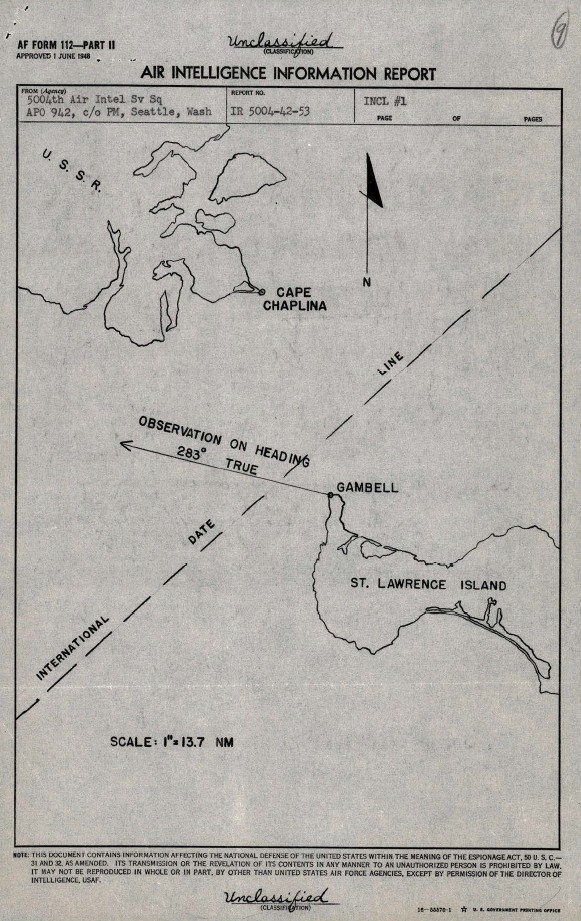
This document is an Air Intelligence Information Report (AIIR), a standardized U.S. Air Force reporting form used to record raw information of potential intelligence value for later analysis. The form served as a primary vehicle for U.S. Air Force field intelligence collection throughout the early Cold War, until defense-wide reporting standards were established in the early 1960s. This AIIR records a December 1, 1953, incident near St. Lawrence Island, Alaska, in which an Alaska National Guard sergeant residing on the island reported observing a stationary light on the horizon west of Gambell for approximately five minutes. The report states that the light was observed at a true heading of 283 degrees, appeared similar in color to a flashlight, and disappeared as though it had been turned off. The preparing officer further noted that an unidentified ship may have been the source of the light, though no definite conclusion could be reached as to its nature or origin. All descriptive and estimative language contained in this report reflects the reporter’s subjective interpretation at the time of the event. Such characterizations should not be interpreted as a conclusive indication of the presence or absence of any intrinsic object features or performance characteristics.
 PDF
DoD / AARO · Alaska
DOW-UAP-D161, Air Intelligence Information Report, Alaska, 1953
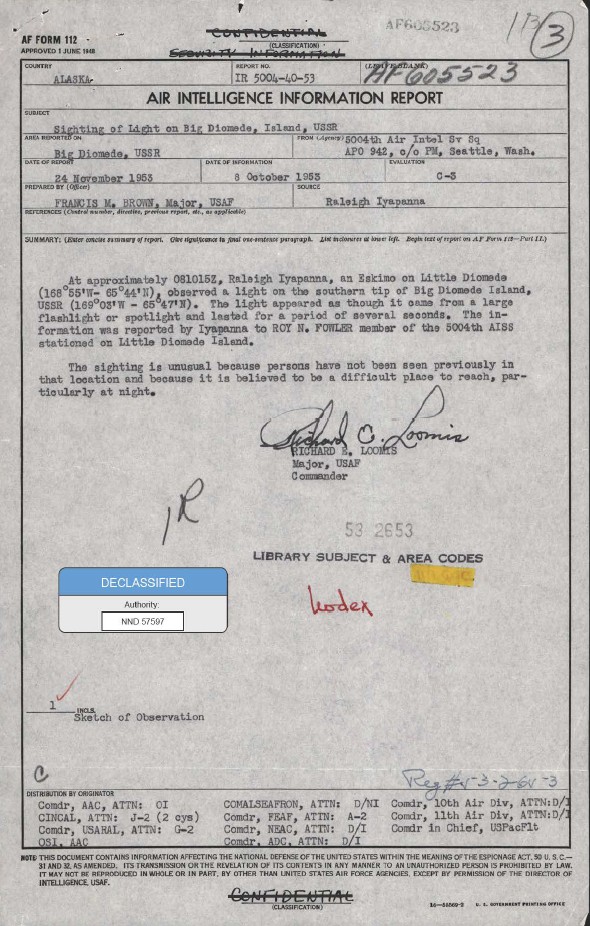
This document is an Air Intelligence Information Report (AIIR), a standardized U.S. Air Force reporting form used to record raw information of potential intelligence value for later analysis. The form served as a primary vehicle for U.S. Air Force field intelligence collection throughout the early Cold War, until defense-wide reporting standards were established in the early 1960s. This AIIR records an October 6, 1953, incident on Little Diomede, Alaska, in which a resident of the island reported observing a light on the southern tip of Big Diomede, U.S.S.R. The report states that the light lasted for several seconds and appeared as though it came from a large flashlight or spotlight. It further describes the light as about the size of a nickel coin held at arm’s length and about the same color as a burning match or dim flashlight. All descriptive and estimative language contained in this report reflects the reporter’s subjective interpretation at the time of the event. Such characterizations should not be interpreted as a conclusive indication of the presence or absence of any intrinsic object features or performance characteristics. AARO Comment: The Diomede Islands are situated in the Bering Strait between Alaska and Siberia and constitute the nearest point of territorial proximity between the United States and the former Soviet Union.
 PDF
DoD / AARO · Morocco
DOW-UAP-D160, Air Intelligence Information Report, Morocco, 1953
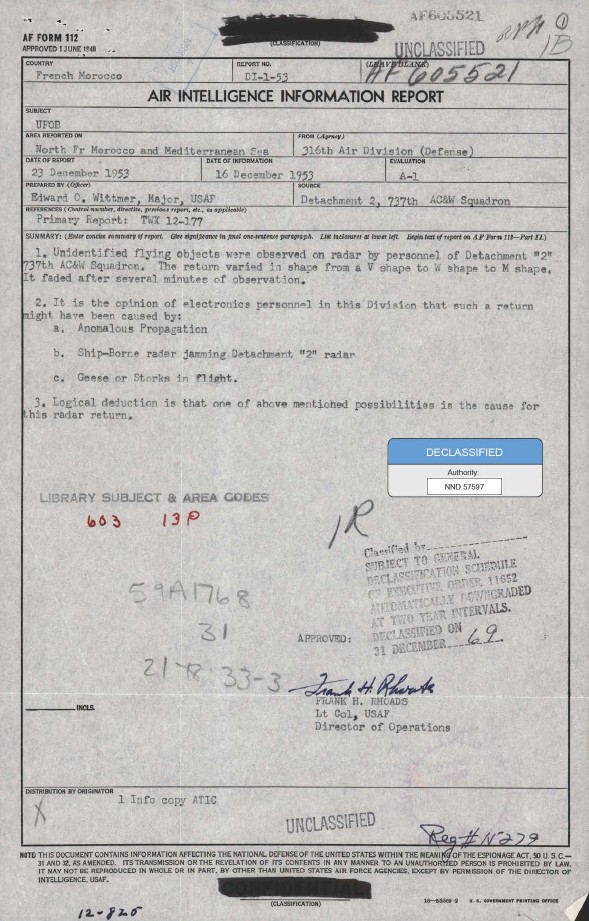
This document is an Air Intelligence Information Report (AIIR), a standardized U.S. Air Force reporting form used to record raw information of potential intelligence value for later analysis. The form served as a primary vehicle for U.S. Air Force field intelligence collection throughout the early Cold War, until defense-wide reporting standards were established in the early 1960s. This AIIR records a December 16, 1953, incident in northern French Morocco and the Mediterranean Sea area in which personnel of Detachment 2, 737th AC&W Squadron reported an unidentified radar return. The report states that the return varied in shape between “V,” “W,” and “M” configurations and faded after several minutes of observation. It further states that electronics personnel in the 316th Air Division believed the return might have been caused by anomalous propagation, ship-borne radar jamming, or geese or storks in flight, and concludes that one of those possibilities was the most likely explanation for the return. All descriptive and estimative language contained in this report reflects the reporter’s subjective interpretation at the time of the event. Such characterizations should not be interpreted as a conclusive indication of the presence or absence of any intrinsic object features or performance characteristics. AARO Comment: The 737th AC&W Squadron was a U.S. Air Force radar unit stationed in Saidia, Morocco, where it supported airborne early warning and air defense surveillance in coordination with French military forces.
 PDF
DoD / AARO · Germany
DOW-UAP-D159, Air Intelligence Information Report, Germany, 1953
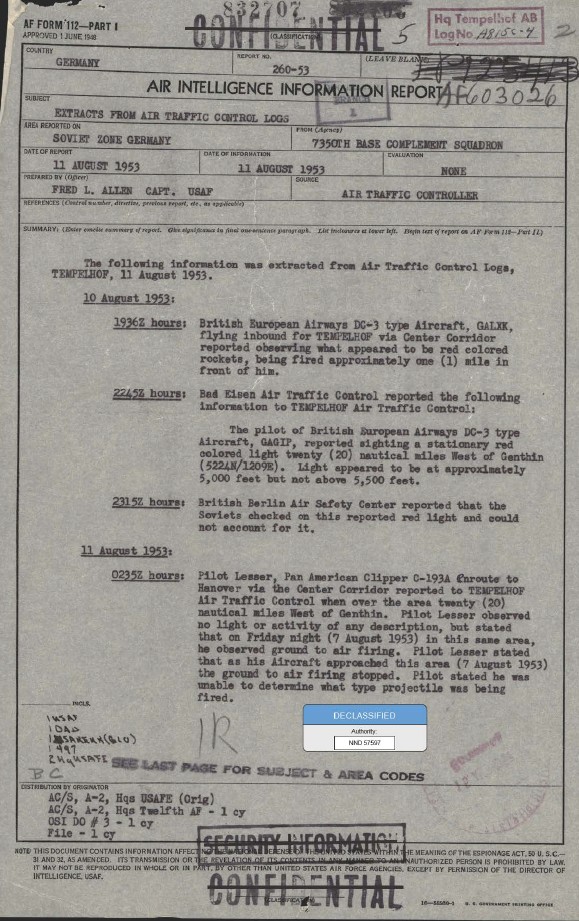
This document is an Air Intelligence Information Report (AIIR), a standardized U.S. Air Force reporting form used to record raw information of potential intelligence value for later analysis. The form served as a primary vehicle for U.S. Air Force field intelligence collection throughout the early Cold War, until defense-wide reporting standards were established in the early 1960s. This AIIR records a series of entries extracted from Tempelhof Airport air traffic control logs dated 10–11 August 1953 concerning aerial reports in the Soviet-occupied zone of Germany. The report states that a British European Airways DC-3 aircraft reported observing what the pilot described as red-colored rockets being fired approximately one mile in front of the aircraft while inbound to Tempelhof via the Center Corridor. It further states that the pilot of a second British European Airways DC-3 later reported a stationary, red-colored light approximately 20 nautical miles west of Genthin at an altitude of approximately 5,000 feet. The report also notes that British Berlin Air Safety Center stated that Soviet authorities had investigated the reported red light and could not account for it. A later Pan American pilot reported no corresponding light or activity when passing through the same area. All descriptive and estimative language contained in this report reflects the reporter’s subjective interpretation at the time of the event. Such characterizations should not be interpreted as a conclusive indication of the presence or absence of any intrinsic object features or performance characteristics.
 PDF
DoD / AARO · Canada
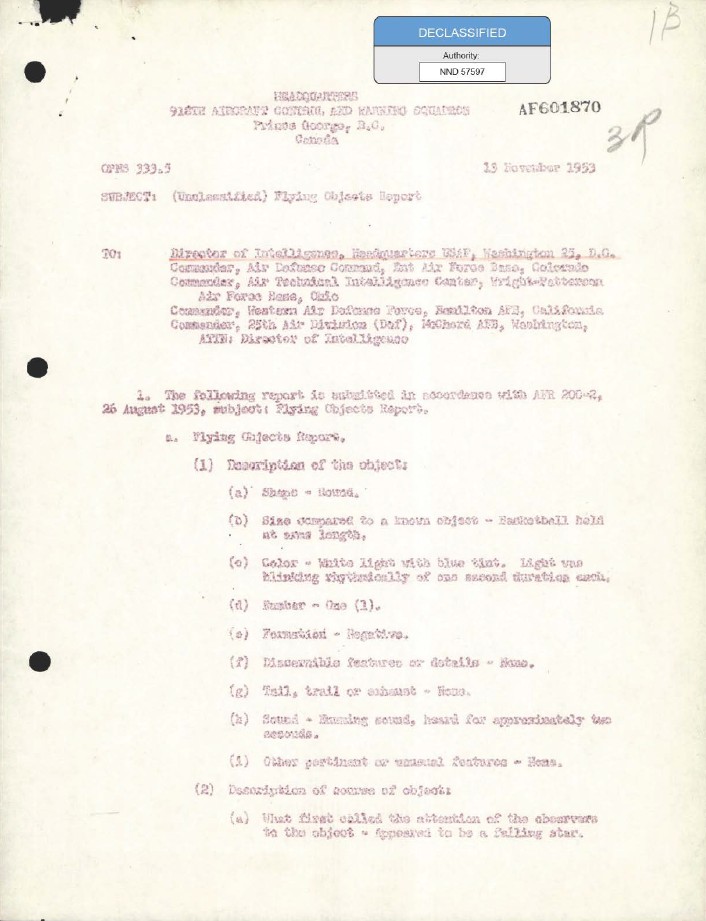
DOW-UAP-D158, Flying Object Report, Canada, 1953
This document is a Flying Objects Report prepared in accordance with Air Force Regulation 200-2, which established guidance for reporting unidentified flying objects. This report records a November 13, 1953, incident in British Columbia, Canada, in which three U.S. Air Force servicemembers reported observing a round, blinking white light with a blue hue, initially described as resembling a falling star. The report describes the object’s motion as descending to an estimated altitude of 150 feet, remaining stationary for approximately 30 seconds, ascending vertically to an estimated altitude of 300 feet, remaining stationary for approximately 10 seconds, and then departing the observers’ field of view in a westerly direction while gaining altitude. All descriptive and estimative language contained in this report reflects the reporter’s subjective interpretation at the time of the event. Such characterizations should not be interpreted as a conclusive indication of the presence or absence of any intrinsic object features or performance characteristics.
 PDF
DoD / AARO · Italy
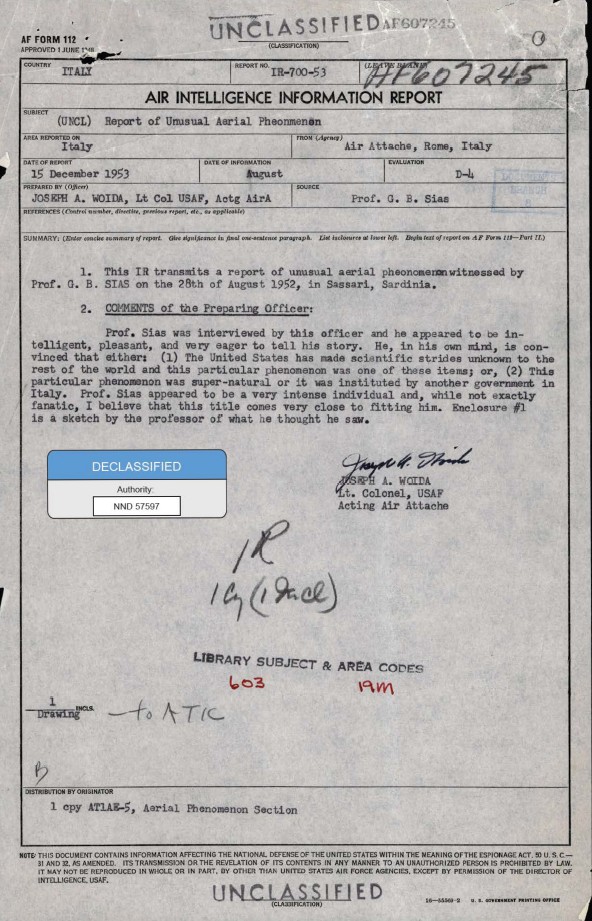
DOW-UAP-D157, Air Intelligence Information Report, Italy, 1952
This document is an Air Intelligence Information Report (AIIR), a standardized U.S. Air Force reporting form used to record raw information of potential intelligence value for later analysis. The form served as a primary vehicle for U.S. Air Force field intelligence collection throughout the early Cold War, until defense-wide reporting standards were established in the early 1960s. This AIIR records an August 27, 1952, incident near Sassari, Italy, that was reported in the local Italian press the following day. The U.S. Air Attaché in Rome relayed the translated newspaper account to the Air Force in November 1953 and later interviewed the individual who made the initial report, Professor Giovanni Battista Sias. Sias described observing a brilliantly luminous sphere, slightly larger in apparent size than the full moon, with a green-blue color, silvery brightness, and metallic streaking on its right side. He reported that it moved from east to west at very high speed, intermittently disappearing and reappearing while leaving behind a narrow luminous trail or ribbon. The preparing officer characterized Professor Sias as intelligent, pleasant, and eager to share his account. All descriptive and estimative language contained in this report reflects the reporter’s subjective interpretation at the time of the event. Such characterizations should not be interpreted as a conclusive indication of the presence or absence of any intrinsic object features or performance characteristics.
 PDF
DoD / AARO · Guam
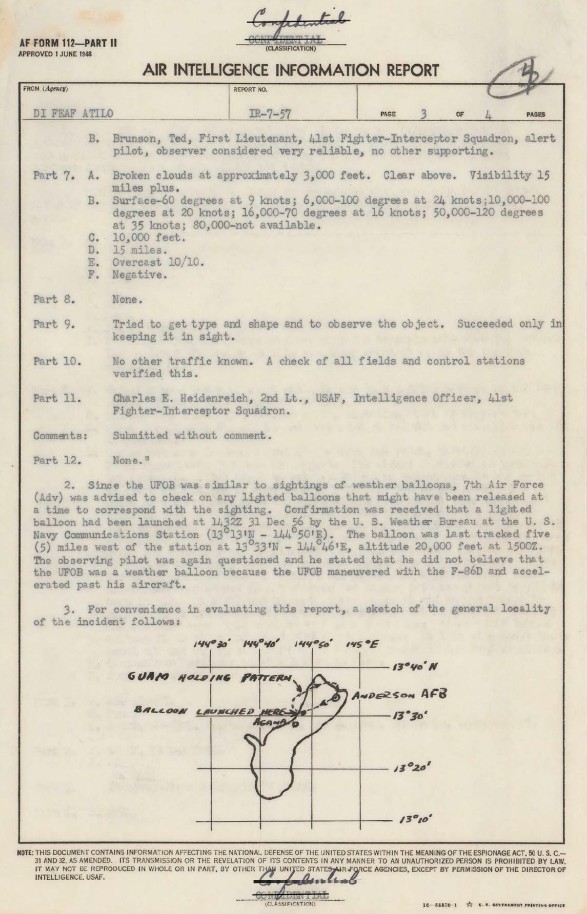
DOW-UAP-D156, Air Intelligence Information Report, Guam, 1956
This document is an Air Intelligence Information Report (AIIR), a standardized U.S. Air Force reporting form used to record raw information of potential intelligence value for later analysis. The form served as a primary vehicle for U.S. Air Force field intelligence collection throughout the early Cold War, until defense-wide reporting standards were established in the early 1960s. This AIIR records a December 31, 1956, incident in the vicinity of Guam in which the pilot of a U.S. Air Force F-86D aircraft reported observing an unidentified aerial blinking light. The report notes that a lighted weather balloon had been launched before the sighting and states that, if the balloon had malfunctioned and remained at a relatively low altitude, it could possibly explain the reported object. It also indicates that the preparing officer did not regard the balloon explanation as sufficient unless that condition applied. All descriptive and estimative language contained in this report reflects the reporter’s subjective interpretation at the time of the event. Such characterizations should not be interpreted as a conclusive indication of the presence or absence of any intrinsic object features or performance characteristics.
 PDF
DoD / AARO · Saudi Arabia
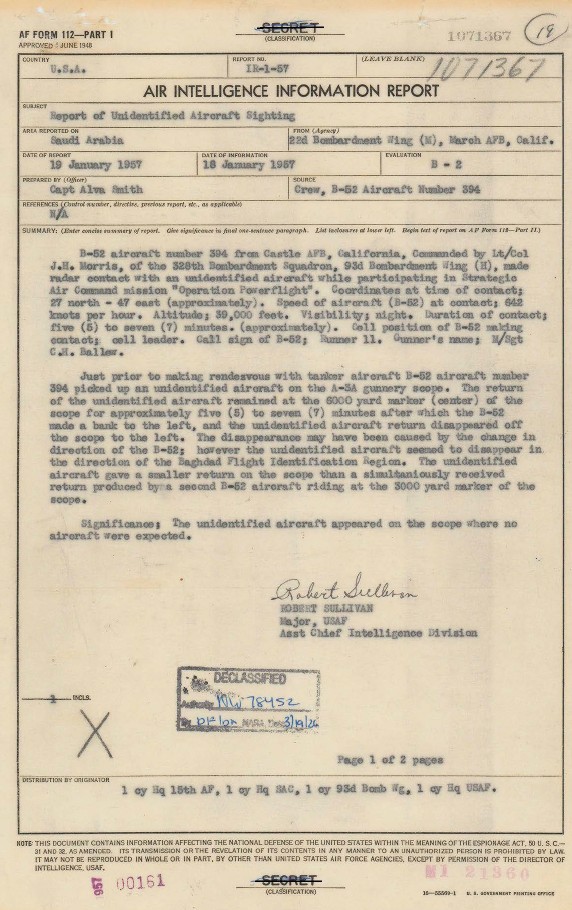
DOW-UAP-D155, Air Intelligence Information Report, Saudi Arabia, 1957
This document is an Air Intelligence Information Report (AIIR), a standardized U.S. Air Force reporting form used to record raw information of potential intelligence value for later analysis. The form served as a primary vehicle for U.S. Air Force field intelligence collection throughout the early Cold War, until defense-wide reporting standards were established in the early 1960s. This AIIR records a January 18, 1957, incident over Saudi Arabia in which the crew of a U.S. Air Force B-52 aircraft reported detecting an unidentified return on the aircraft’s gunnery scope for approximately five to seven minutes. The report characterizes the unidentified return as smaller than one produced by another B-52 operating in the area. All descriptive and estimative language contained in this report reflects the reporter’s subjective interpretation at the time of the event. Such characterizations should not be interpreted as a conclusive indication of the presence or absence of any intrinsic object features or performance characteristics.
Released September 18, 2026 · U.S. Department of War
59 records in this release
 PDF
Local Law Enforcement · Colorado
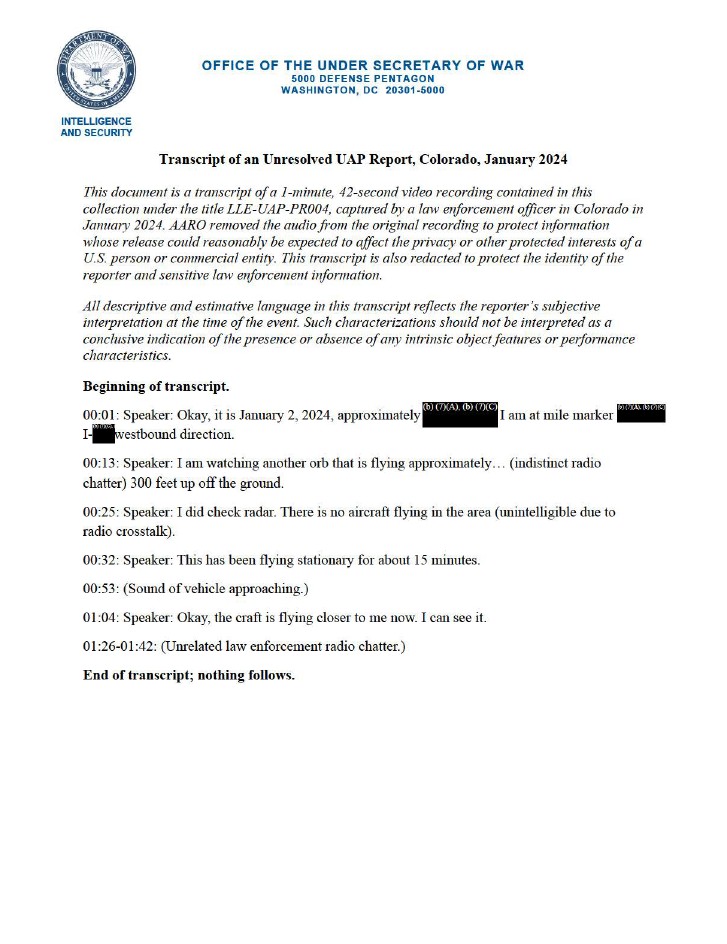
LLE-UAP-D004, Transcript of an Unresolved UAP Report, Colorado, January 2024
This document is a transcript of a 1-minute, 42-second video recording contained in this collection under the title LLE-UAP-PR004, captured by a law enforcement officer in Colorado in January 2024. AARO removed the audio from the original recording to protect information whose release could reasonably be expected to affect the privacy or other protected interests of a U.S. person or commercial entity. This transcript is also redacted to protect the identity of the reporter and sensitive law enforcement information. All descriptive and estimative language in this transcript reflects the reporter’s subjective interpretation at the time of the event. Such characterizations should not be interpreted as a conclusive indication of the presence or absence of any intrinsic object features or performance characteristics.
 PDF
Local Law Enforcement · Colorado
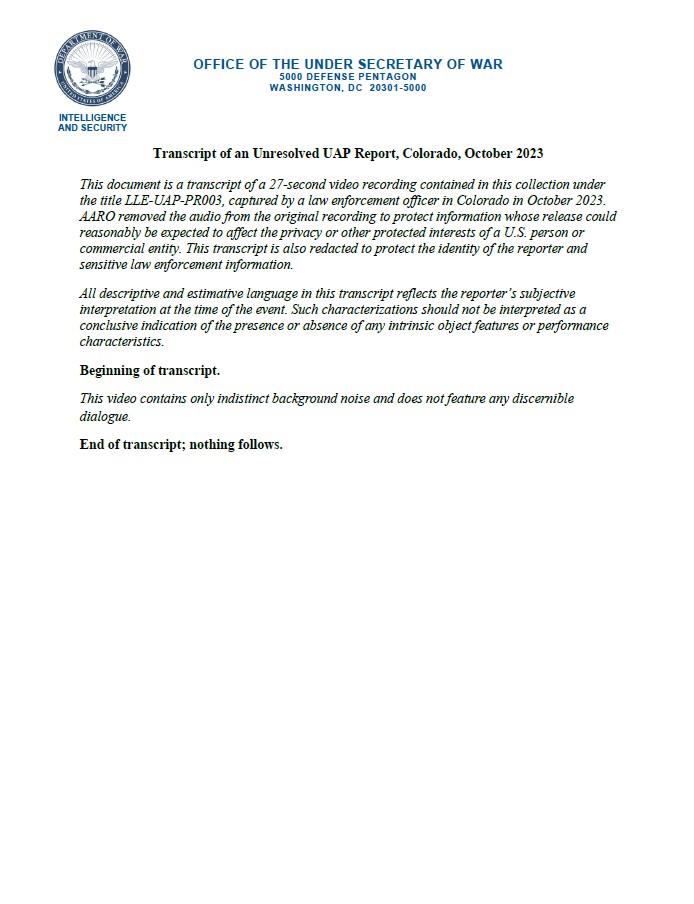
LLE-UAP-D003, Transcript of an Unresolved UAP Report, Colorado, October 2023
This document is a transcript of a 27-second video recording contained in this collection under the title LLE-UAP-PR003, captured by a law enforcement officer in Colorado in October 2023. AARO removed the audio from the original recording to protect information whose release could reasonably be expected to affect the privacy or other protected interests of a U.S. person or commercial entity. This transcript is also redacted to protect the identity of the reporter and sensitive law enforcement information. All descriptive and estimative language in this transcript reflects the reporter’s subjective interpretation at the time of the event. Such characterizations should not be interpreted as a conclusive indication of the presence or absence of any intrinsic object features or performance characteristics.
 PDF
Local Law Enforcement · Colorado
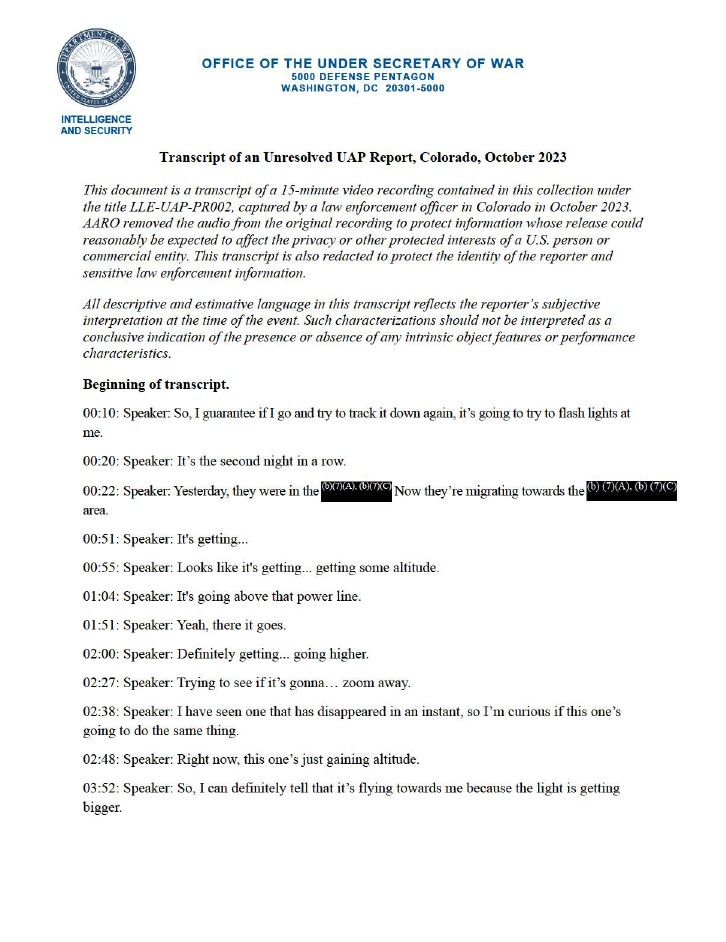
LLE-UAP-D002, Transcript of an Unresolved UAP Report, Colorado, October 2023
This document is a transcript of a 15-minute video recording contained in this collection under the title LLE-UAP-PR002, captured by a law enforcement officer in Colorado in October 2023. AARO removed the audio from the original recording to protect information whose release could reasonably be expected to affect the privacy or other protected interests of a U.S. person or commercial entity. This transcript is also redacted to protect the identity of the reporter and sensitive law enforcement information. All descriptive and estimative language in this transcript reflects the reporter’s subjective interpretation at the time of the event. Such characterizations should not be interpreted as a conclusive indication of the presence or absence of any intrinsic object features or performance characteristics.
 PDF
Local Law Enforcement · Colorado
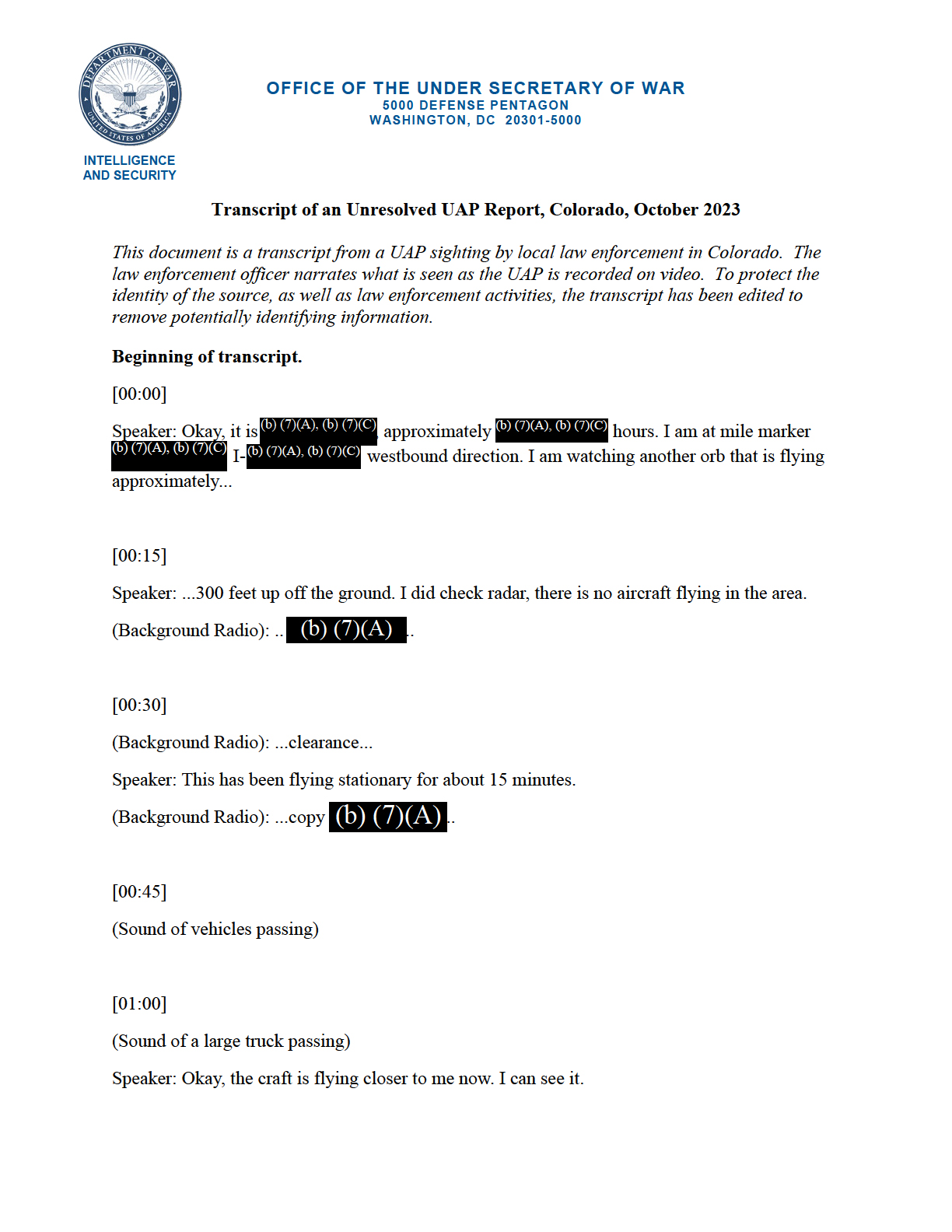
LLE-UAP-D001, Transcript of an Unresolved UAP Report, Colorado, October 2023
This document is a transcript of a 1-minute, 19-second video recording contained in this collection under the title LLE-UAP-PR001, captured by a law enforcement officer in Colorado in October 2023. AARO removed the audio from the original recording to protect information whose release could reasonably be expected to affect the privacy or other protected interests of a U.S. person or commercial entity. This transcript is also redacted to protect the identity of the reporter and sensitive law enforcement information. All descriptive and estimative language in this transcript reflects the reporter’s subjective interpretation at the time of the event. Such characterizations should not be interpreted as a conclusive indication of the presence or absence of any intrinsic object features or performance characteristics.
 PDF
DoD / AARO · Iraq
DOW-UAP-PR131, Unresolved UAP Report, Iraq, 2022
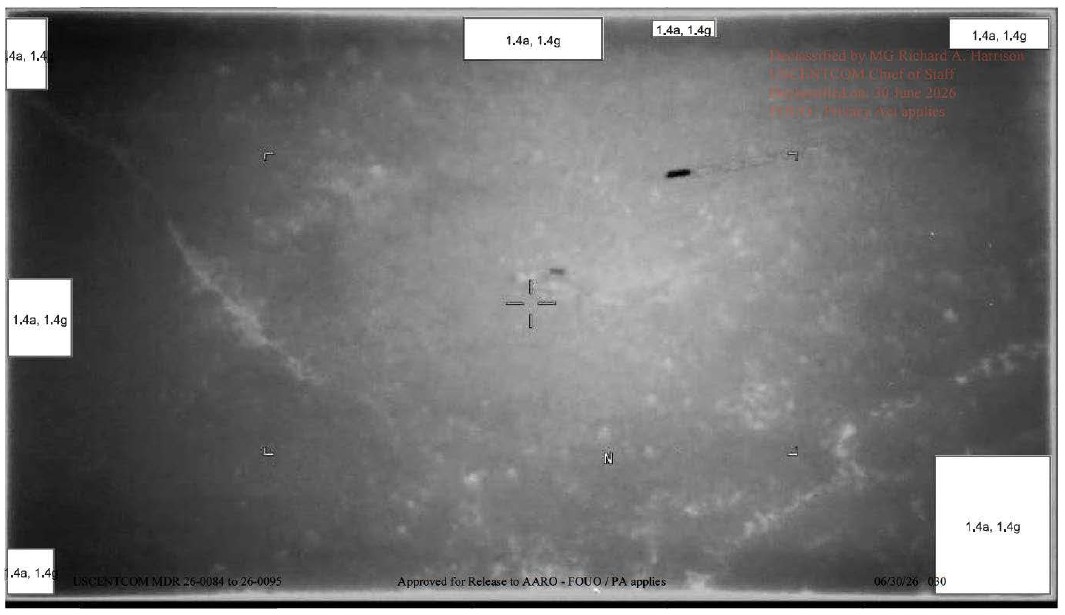
The United States Central Command submitted a report of an unidentified anomalous phenomenon to the All-domain Anomaly Resolution Office (AARO) consisting of a still image derived from an infrared system aboard a U.S. military system in 2022. An accompanying mission report, DOW-UAP-D106, described the UAP as “flying sporadically… at various speeds between 80-180 miles per hour.” Image Description: This image features two areas of contrast. One appears near the center of the sensor display. Another appears in the top third of the frame. The area of contrast in the top third of the frame appears elongated and is followed by a visible trail. These features suggest motion across the focal plane from the top right to the bottom left of the sensor field-of-view. The apparent trail is consistent with known image-compression and processing effects and does not necessarily represent a physical feature. This image description is provided for informational purposes only. Readers should not interpret any part of this description as reflecting an analytical judgment, investigative conclusion, or factual determination regarding the described event’s validity, nature, or significance.
 PDF
DoD / AARO · Iraq
DOW-UAP-PR130, Unresolved UAP Report, Iraq, 2022
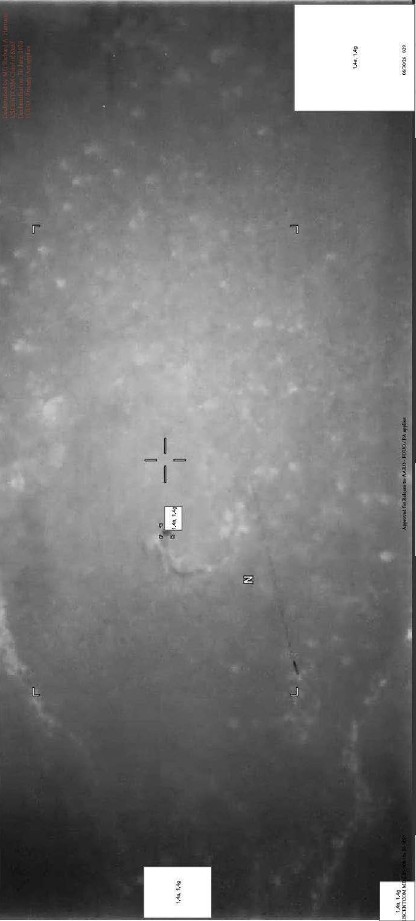
The United States Central Command submitted a report of an unidentified anomalous phenomenon to the All-domain Anomaly Resolution Office (AARO) consisting of a still image derived from an infrared system aboard a U.S. military system in 2022. An accompanying mission report, DOW-UAP-D106, described the UAP as “flying sporadically… at various speeds between 80-180 miles per hour.” Image Description: This image features two areas of contrast. One appears near the center of the sensor display, bounded by a reticle. Another appears in the lower third of the frame. The area of contrast in the lower third of the frame appears elongated and is followed by a visible trail. These features suggest motion across the focal plane from the top right to the bottom left of the sensor field-of-view. The apparent trail is consistent with known image-compression and processing effects and does not necessarily represent a physical feature. This image description is provided for informational purposes only. Readers should not interpret any part of this description as reflecting an analytical judgment, investigative conclusion, or factual determination regarding the described event’s validity, nature, or significance.
 PDF
DoD / AARO · Boston, Massachusetts
DOW-UAP-D154, Transcript of a Presentation by Captain Edward J. Ruppelt, 1952
This document is a transcript of a March 1952 presentation by Captain Edward J. Ruppelt outlining the U.S. Air Force’s reorganized investigation into unidentified flying objects (UFOs). The presentation previews prospective technical methodologies, such as diffraction-grating photography and radar-scope synchronization, that were subsequently incorporated into Project Blue Book, a U.S. Air Force program active from 1952 to 1969 that investigated the nature and origin of UFOs. Ruppelt explains that out of approximately 800 historical cases reviewed by the Air Force, approximately 20% remained unexplained after technical analysis. These unresolved reports were sourced from credible military personnel, commercial pilots, and other qualified technical observers. He highlights geographic report concentrations around sensitive national security and nuclear weapons installations (including Los Alamos, Albuquerque, and Oak Ridge National Laboratories) and notes recurring anomalous characteristics, including silent high-speed flight and radar detections indicating unconfirmed air speeds between 1,000 and 3,500 miles per hour. Emphasizing that the Air Force found no conclusive evidence regarding the nature or origin of the phenomena, Ruppelt underscores the national security need for a systematic physical data collection effort to better evaluate these sightings.
 PDF
DoD / AARO · Las Vegas, Nevada
DOW-UAP-D153, AAWSAP DIRD, Quantum Tomography of Negative Energy States in the Vacuum, January 2011
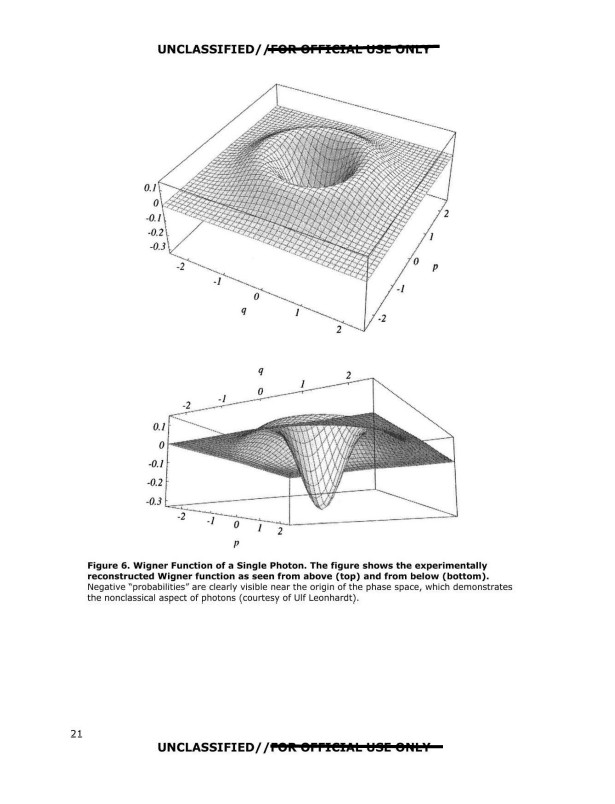
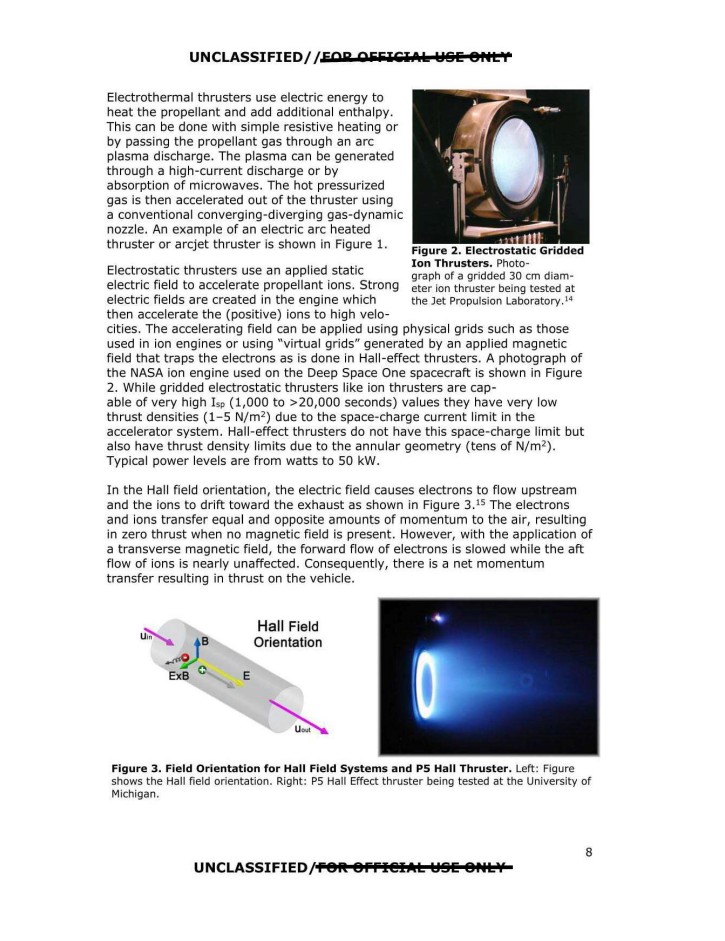
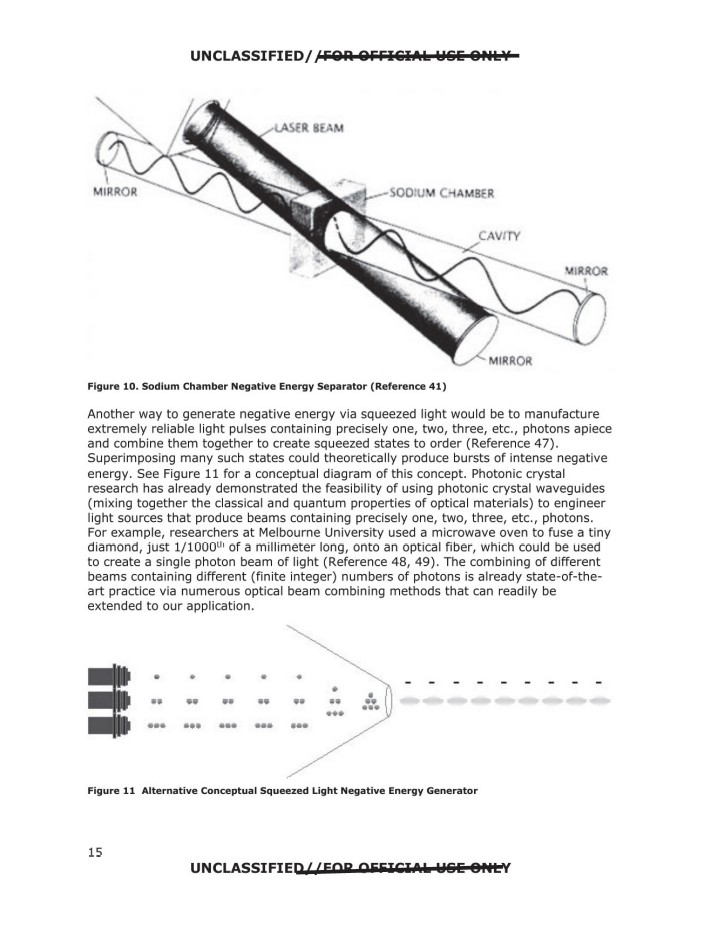
This document is a Defense Intelligence Reference Document (DIRD), a technical reference format used by the Defense Intelligence Agency (DIA) to capture baseline knowledge on a specific topic for later analytic use. DIRDs are best understood as reference and synthesis products rather than as original research. It is one of 38 DIRDs produced under the Advanced Aerospace Weapon System Applications Program (AAWSAP) between 2009 and 2011. Because AAWSAP’s scope permitted a broad range of supporting topics, not every DIRD in the series directly concerns aerospace systems or future threat assessment. The following summary reflects the DIRD’s scope and framing at the time of writing and should not be read as implying current validation of the concepts discussed. This DIRD examines how negative-energy, or “sub-vacuum,” states in quantum fields might be detected and mapped. Its practical scope is limited to the laboratory-scale measurement of minute quantum effects, though it extrapolates from those effects to consider theoretical relevance to concepts such as warp drives, wormholes, or gravitational control. By reviewing previously identified laboratory examples such as the Casimir effect and squeezed light states, the report identifies the core technical challenge as mapping their spatial and temporal structures reliably. To address this, it proposes quantum optical homodyne tomography as a method to reconstruct and quantify the vacuum fluctuations associated with these states. The document acknowledges that only microscopic, transient negative-energy effects have been realized in laboratory settings. It remains unknown whether larger or longer-lived distributions of such effects can be generated or stabilized, particularly given the experimentally unresolved constraints imposed by quantum inequalities. Overall, this DIRD functions as a measurement- and diagnostics-oriented review intended to lay experimental groundwork for a far more ambitious, highly speculative negative-energy research agenda.
 PDF
DoD / AARO · Las Vegas, Nevada
DOW-UAP-D152, AAWSAP DIRD, Negative Mass Propulsion, January 2011
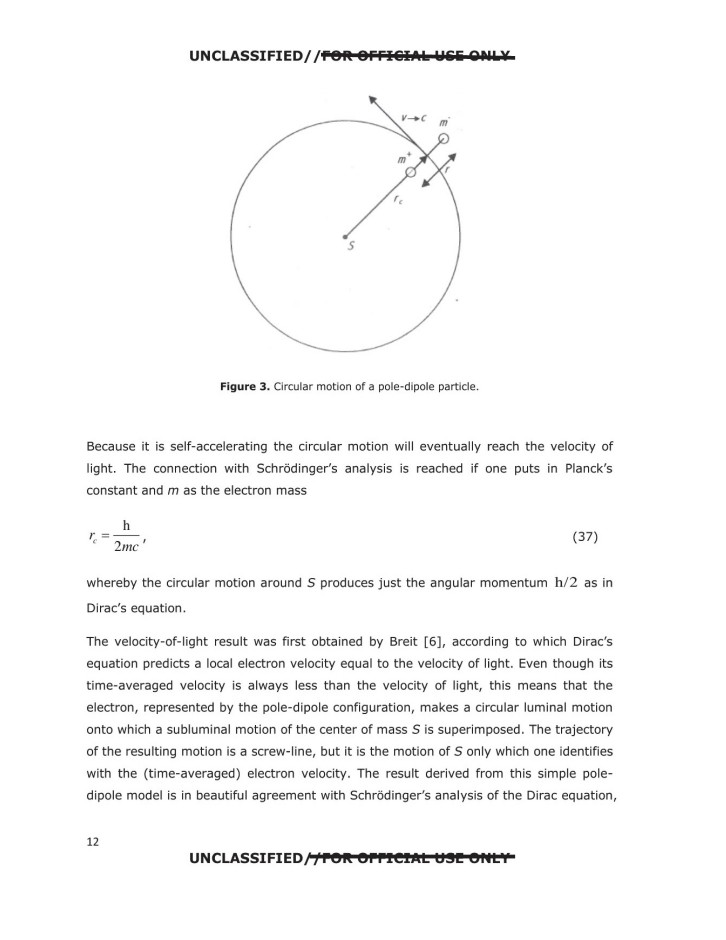
This document is a Defense Intelligence Reference Document (DIRD), a technical reference format used by the Defense Intelligence Agency (DIA) to capture baseline knowledge on a specific topic for later analytic use. DIRDs are best understood as reference and synthesis products rather than as original research. It is one of 38 DIRDs produced under the Advanced Aerospace Weapon System Applications Program (AAWSAP) between 2009 and 2011. Because AAWSAP’s scope permitted a broad range of supporting topics, not every DIRD in the series directly concerns aerospace systems or future threat assessment. The following summary reflects the DIRD’s scope and framing at the time of writing and should not be read as implying current validation of the concepts discussed. This DIRD examines whether negative mass could exist in a physically meaningful way and whether it could someday reduce the energy cost of spaceflight. The report reviews the unusual dynamics that would follow if positive and negative mass could interact, including self-accelerating mass pairs and matter with very low or nearly zero effective inertia, and treats such ideas as at least formally compatible with certain extensions of gravitational theory. It then considers two broad paths toward practical use: creating or separating negative mass through extreme fields or particle energies, and locating naturally separated negative matter in deep gravitational wells such as galactic centers or possibly the Moon. However, the document also concludes that the first path is effectively beyond technical reach and treats the second as highly uncertain, resting on a long chain of unverified assumptions about the existence, separability, and macroscopic behavior of negative mass. Overall, this DIRD is a far-reaching theoretical exploration of an exotic propulsion concept whose practical application depends on premises that remain unestablished in consensus physics.
 PDF
DoD / AARO · Las Vegas, Nevada
DOW-UAP-D151, AAWSAP DIRD, Cognitive Limits on Simultaneous Control of Multiple Unmanned Spacecraft, December 2010
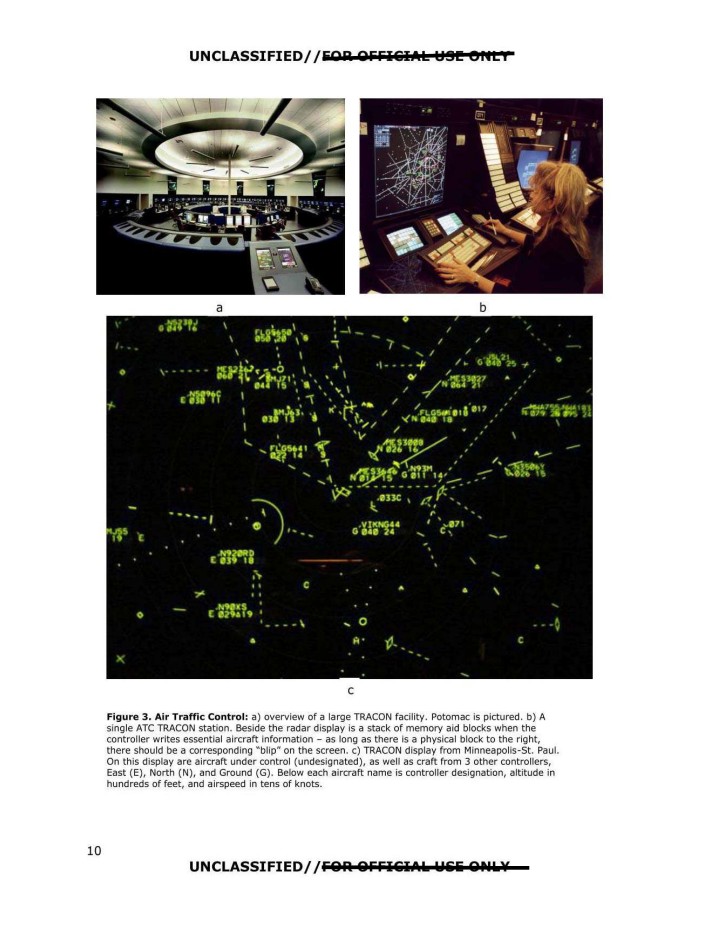
This document is a Defense Intelligence Reference Document (DIRD), a technical reference format used by the Defense Intelligence Agency (DIA) to capture baseline knowledge on a specific topic for later analytic use. DIRDs are best understood as reference and synthesis products rather than as original research. It is one of 38 DIRDs produced under the Advanced Aerospace Weapon System Applications Program (AAWSAP) between 2009 and 2011. Because AAWSAP’s scope permitted a broad range of supporting topics, not every DIRD in the series directly concerns aerospace systems or future threat assessment. The following summary reflects the DIRD’s scope and framing at the time of writing and should not be read as implying current validation of the concepts discussed. This DIRD examines how many unmanned spacecraft a single human operator could realistically supervise or control at once, using research from air traffic control and multi-vehicle remote piloting as rough analogs. The report argues that the practical limit depends heavily on task complexity: about 16 craft for simple monitoring or destination assignment, about 7 for moderately complex piloting or mission tasks, and about 4 for complex heterogeneous operations. It places particular emphasis on the operator’s ability to maintain a coherent mental “big picture” of multiple vehicles at once, and it suggests that automation and external displays can help by offloading working-memory demands, though not eliminating them. The document also highlights physiological workload measures as a possible way to detect or predict operator overload in real time. Overall, it presents multi-spacecraft control as a human-factors and systems-integration problem in which progress depends on managing cognitive limits through interface design, automation, and workload monitoring.
 PDF
DoD / AARO · Las Vegas, Nevada
DOW-UAP-D150, AAWSAP DIRD, Quantum Computing and Utilizing Organic Molecules in Automation Technology, December 2010
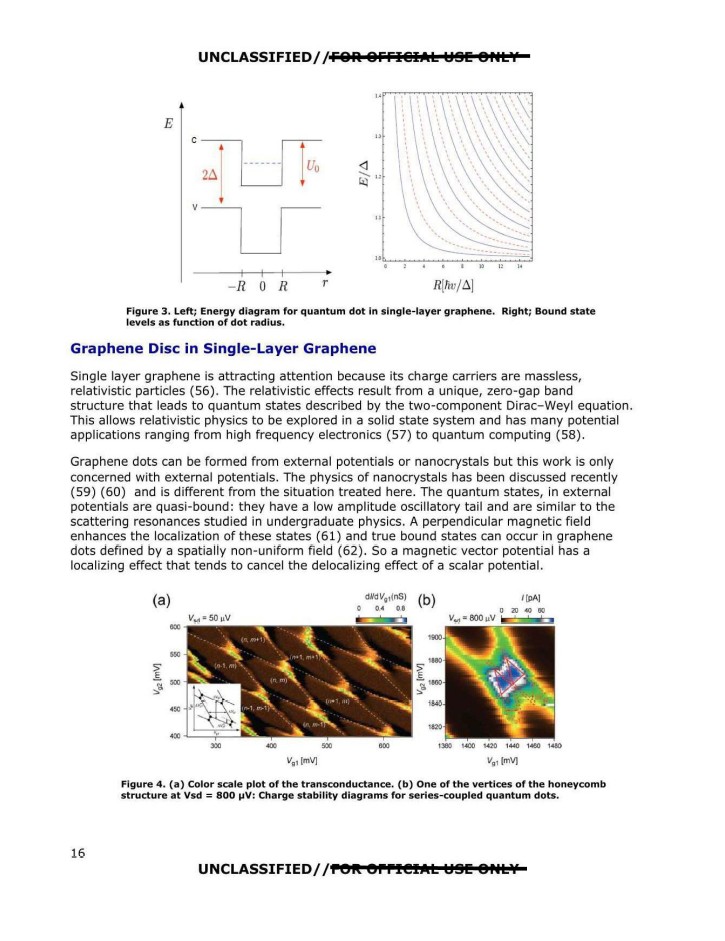
This document is a Defense Intelligence Reference Document (DIRD), a technical reference format used by the Defense Intelligence Agency (DIA) to capture baseline knowledge on a specific topic for later analytic use. DIRDs are best understood as reference and synthesis products rather than as original research. It is one of 38 DIRDs produced under the Advanced Aerospace Weapon System Applications Program (AAWSAP) between 2009 and 2011. Because AAWSAP’s scope permitted a broad range of supporting topics, not every DIRD in the series directly concerns aerospace systems or future threat assessment. The following summary reflects the DIRD’s scope and framing at the time of writing and should not be read as implying current validation of the concepts discussed. This DIRD surveys advanced computing concepts for future space and automation applications, focusing on quantum and molecular (DNA-based) computing as potential alternatives to conventional silicon electronics. The report introduces quantum computing principles alongside DNA-based logic gates, self-assembly, and nanoscale repair mechanisms, arguing that these unconventional architectures might eventually offer advantages in radiation tolerance, physical robustness, and specialized onboard processing for space-based platforms. It notes that near-term practical barriers remain substantial. Quantum systems continue to depend on complex cryogenics, shielding, and unsolved reliability challenges, while DNA-based computing remains a far-future concept rather than a viable alternative to general-purpose processors. Overall, the document presents both frameworks as long-term possibilities to complement, rather than immediately replace proven space-qualified electronics. It concludes that the stronger, nearer-term cases for such architectures are in highly specialized or hybrid roles rather than in fully mature general-purpose onboard computing applications.
 PDF
DoD / AARO · Las Vegas, Nevada
DOW-UAP-D149, AAWSAP DIRD, MHD Air Breathing Propulsion and Power for Aerospace Applications, November 2010
This document is a Defense Intelligence Reference Document (DIRD), a technical reference format used by the Defense Intelligence Agency (DIA) to capture baseline knowledge on a specific topic for later analytic use. DIRDs are best understood as reference and synthesis products rather than as original research. It is one of 38 DIRDs produced under the Advanced Aerospace Weapon System Applications Program (AAWSAP) between 2009 and 2011. Because AAWSAP’s scope permitted a broad range of supporting topics, not every DIRD in the series directly concerns aerospace systems or future threat assessment. The following summary reflects the DIRD’s scope and framing at the time of writing and should not be read as implying current validation of the concepts discussed. This DIRD surveys magnetohydrodynamic (MHD) and plasma-based concepts for air-breathing propulsion, onboard power generation, and aerodynamic control, arguing that such systems could in principle extend aerospace performance beyond the limits of conventional chemical propulsion and control surfaces. The report reviews concepts including MHD acceleration, flow control, inlet control, onboard power generation, drag reduction, and plasma-generated “virtual” aerodynamic surfaces, while giving particular attention to hypersonic applications such as scramjet power extraction, reentry vehicles, global-strike gliders, and aero-assisted orbital maneuvers. However, it emphasizes major practical constraints, especially extreme power requirements, system weight and complexity, and the difficulty of achieving useful ionization in colder air at lower hypersonic speeds; on that basis, it argues that Ajax-style MHD bypass concepts, in which energy is extracted from the airflow upstream and reintroduced downstream through an electromagnetic system, are not meaningful below about Mach 12, while treating the “virtual cowl” and related reentry applications as more plausible. The document presents plasma and MHD aerospace systems as a technically serious but highly demanding field whose nearer-term promise lies in specialized hypersonic control, power generation, and reentry applications rather than a fully realized air-breathing propulsion system.
 PDF
DoD / AARO · Las Vegas, Nevada
DOW-UAP-D148, AAWSAP DIRD, Detection and High-Resolution Tracking of Vehicles at Hypersonic Velocities, November 2010
This document is a Defense Intelligence Reference Document (DIRD), a technical reference format used by the Defense Intelligence Agency (DIA) to capture baseline knowledge on a specific topic for later analytic use. DIRDs are best understood as reference and synthesis products rather than as original research. It is one of 38 DIRDs produced under the Advanced Aerospace Weapon System Applications Program (AAWSAP) between 2009 and 2011. Because AAWSAP’s scope permitted a broad range of supporting topics, not every DIRD in the series directly concerns aerospace systems or future threat assessment. The following summary reflects the DIRD’s scope and framing at the time of writing and should not be read as implying current validation of the concepts discussed. This DIRD surveys how hypersonic vehicles may be detected and tracked by exploiting the physical effects they create in flight, especially shock waves, ionized gas, hot surfaces, and turbulent atmospheric wakes. The report reviews a broad set of detection methods, including radar, infrared sensing, optical imaging, LIDAR, passive radio reflection, infrasound, and seismic techniques, and argues that the most effective systems will likely combine multiple sensor types, because each captures different features of a high-speed vehicle’s passage through the atmosphere. It presents radar and infrared sensing as the strongest existing tools for operational detection, while giving particular attention to wake-based methods such as LIDAR and passive radio techniques for improving tracking, identification, and discrimination of future hypersonic aircraft. The paper identifies hypersonic vehicles as an evolving surveillance problem in which future progress will depend on better multi-sensor integration, improved wake characterization, and novel signature-exploitation techniques.
 PDF
DoD / AARO · Las Vegas, Nevada
DOW-UAP-D147, AAWSAP DIRD, Ultracapacitors as Energy and Power Storage Devices, November 2010
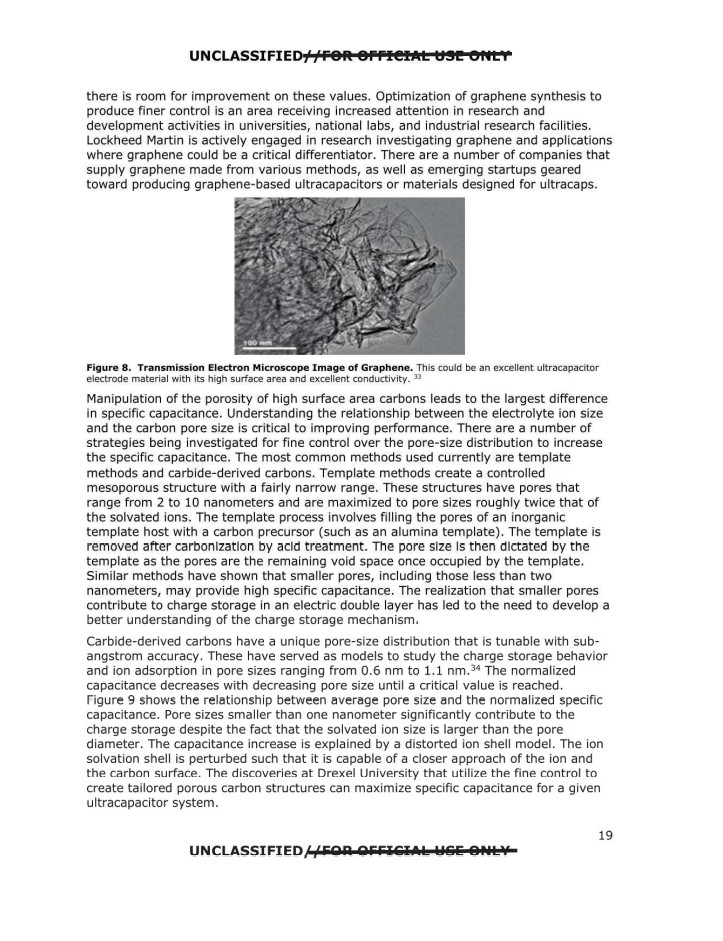
This document is a Defense Intelligence Reference Document (DIRD), a technical reference format used by the Defense Intelligence Agency (DIA) to capture baseline knowledge on a specific topic for later analytic use. DIRDs are best understood as reference and synthesis products rather than as original research. It is one of 38 DIRDs produced under the Advanced Aerospace Weapon System Applications Program (AAWSAP) between 2009 and 2011. Because AAWSAP’s scope permitted a broad range of supporting topics, not every DIRD in the series directly concerns aerospace systems or future threat assessment. The following summary reflects the DIRD’s scope and framing at the time of writing and should not be read as implying current validation of the concepts discussed. This DIRD surveys ultracapacitors as high-power energy-storage devices and argues that their main value lies in extremely rapid charge and discharge, very long cycle life, and usefulness in systems that need short bursts of power rather than sustained energy delivery. The report explains how ultracapacitors differ from batteries, reviews the materials and cell designs that determine their performance, and emphasizes that they are especially useful for power stabilization, backup power, load leveling, regenerative braking, and other applications where fast energy transfer matters more than total stored energy. It also notes their drawbacks, including lower energy density, self-discharge, and voltage-management requirements that limit their usefulness as stand-alone replacements for batteries in many applications. The document presents ultracapacitors as a maturing and increasingly important technology whose most credible aerospace and military uses lie in pulsed-power, missile and munitions systems, electric propulsion support, and other hybrid power architectures rather than in long-duration primary energy storage.
 PDF
DoD / AARO · Las Vegas, Nevada
DOW-UAP-D146, AAWSAP DIRD, Aneutronic Fusion Propulsion II, November 2010
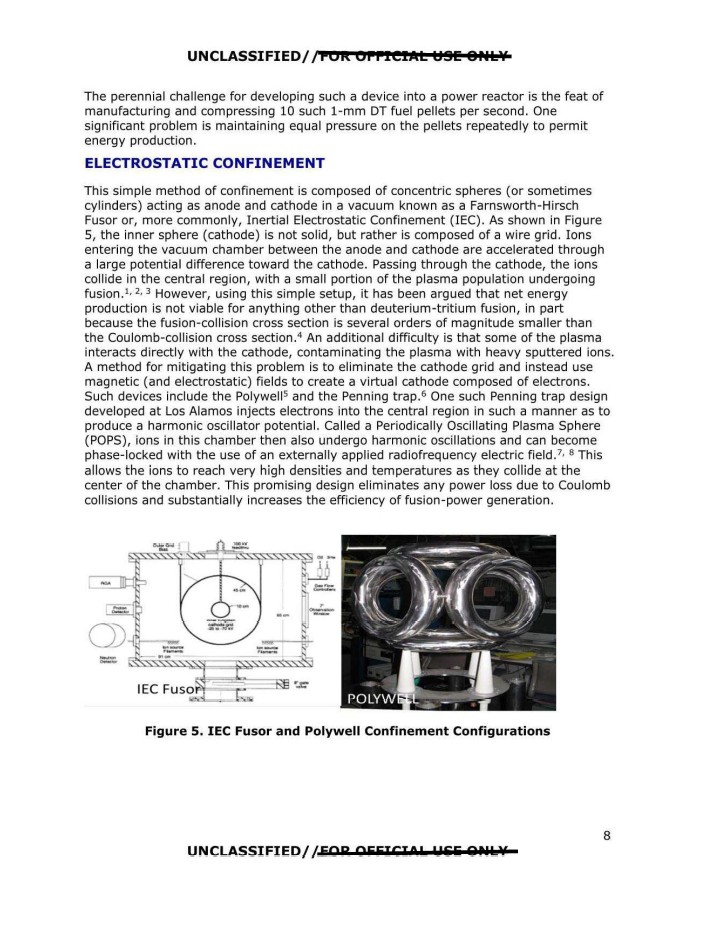
This document is a Defense Intelligence Reference Document (DIRD), a technical reference format used by the Defense Intelligence Agency (DIA) to capture baseline knowledge on a specific topic for later analytic use. DIRDs are best understood as reference and synthesis products rather than as original research. It is one of 38 DIRDs produced under the Advanced Aerospace Weapon System Applications Program (AAWSAP) between 2009 and 2011. Because AAWSAP’s scope permitted a broad range of supporting topics, not every DIRD in the series directly concerns aerospace systems or future threat assessment. The following summary reflects the DIRD’s scope and framing at the time of writing and should not be read as implying current validation of the concepts discussed. This DIRD revisits aneutronic fusion propulsion in a more systems-oriented manner, arguing that fusion concepts using low-neutron fuels such as proton-boron or helium-3 could become attractive for space propulsion because they reduce shielding burdens and may support direct conversion of charged-particle energy into thrust or onboard power. The report reviews the relevant fusion plasma physics and focuses on several candidate confinement approaches, then connects those concepts to possible applications in near-space, orbital, and interplanetary propulsion. It presents the most plausible nearer-term use as very high-power electric or plasma propulsion for satellites and deep-space missions rather than atmospheric flight or interstellar travel, while emphasizing that major obstacles remain in ignition, sustained confinement, system mass, power handling, fuel storage, launch integration, and end-to-end engineering.
 PDF
DoD / AARO · Las Vegas, Nevada
DOW-UAP-D145, AAWSAP DIRD, Aneutronic Fusion Propulsion I, November 2010
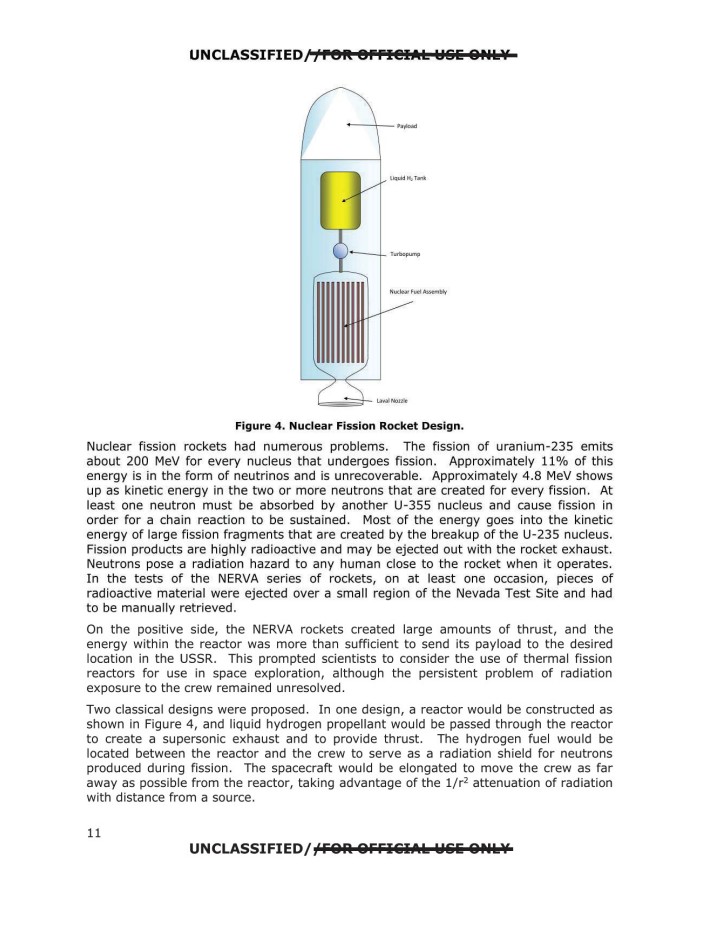
This document is a Defense Intelligence Reference Document (DIRD), a technical reference format used by the Defense Intelligence Agency (DIA) to capture baseline knowledge on a specific topic for later analytic use. DIRDs are best understood as reference and synthesis products rather than as original research. It is one of 38 DIRDs produced under the Advanced Aerospace Weapon System Applications Program (AAWSAP) between 2009 and 2011. Because AAWSAP’s scope permitted a broad range of supporting topics, not every DIRD in the series directly concerns aerospace systems or future threat assessment. The following summary reflects the DIRD’s scope and framing at the time of writing and should not be read as implying current validation of the concepts discussed. This DIRD surveys aneutronic fusion as a possible advanced space-propulsion method, focusing on fusion reactions that release most of their energy in charged particles rather than neutrons and therefore offer potential advantages over more neutron-intensive fusion concepts, especially in radiation shielding, direct energy conversion, and thrust generation. The report reviews the underlying rocket physics, compares candidate fusion fuels and ignition conditions, and gives particular attention to proton-boron and related schemes, while also discussing Bussard’s concepts and other fusion projects as representative development paths. It also makes clear that the central obstacle remains ignition and sustained net-energy fusion under practical conditions, and it notes additional problems such as x-ray energy losses from the hot plasma, extreme temperature requirements, and the gap between theoretical specific impulse and what proposed systems had demonstrated experimentally. Overall, the document presents aneutronic fusion propulsion as an attractive long-range concept for deep-space travel, but one whose practical realization still depended on major unresolved advances in fusion engineering.
 PDF
DoD / AARO · Las Vegas, Nevada
DOW-UAP-D144, AAWSAP DIRD, Cockpits in the Era of Breakthrough Flight, November 2010
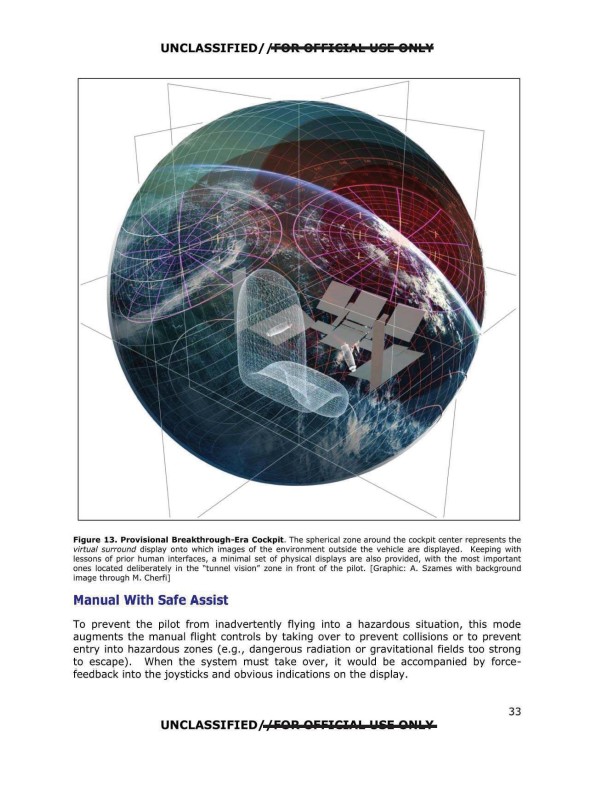
This document is a Defense Intelligence Reference Document (DIRD), a technical reference format used by the Defense Intelligence Agency (DIA) to capture baseline knowledge on a specific topic for later analytic use. DIRDs are best understood as reference and synthesis products rather than as original research. It is one of 38 DIRDs produced under the Advanced Aerospace Weapon System Applications Program (AAWSAP) between 2009 and 2011. Because AAWSAP’s scope permitted a broad range of supporting topics, not every DIRD in the series directly concerns aerospace systems or future threat assessment. The following summary reflects the DIRD’s scope and framing at the time of writing and should not be read as implying current validation of the concepts discussed. This DIRD examines how cockpit design might change if future aerospace vehicles were ever to achieve major propulsion breakthroughs such as control over gravity and inertia, “propellantless” flight, or faster-than-light travel. The report does not describe an existing or emerging vehicle class. Instead, it asks what such hypothetical capabilities would mean for piloting, displays, controls, and human factors, and it argues that the biggest design challenges would come from full six-degree-of-freedom motion, operation across multiple flight regimes from near-surface flight to orbit and deep space, and the possible separation between the craft’s actual motion and the crew’s internal physical sensations. It combines those assumptions with established human-machine-interface principles and with maturing inputs such as gesture, voice, and brain-machine control to outline a provisional cockpit centered on intuitive displays, stress-tolerant physical controls, and a virtual surround display.
 PDF
DoD / AARO · Las Vegas, Nevada
DOW-UAP-D143, AAWSAP DIRD, Laser Lightcraft Nanosatellites, November 2010
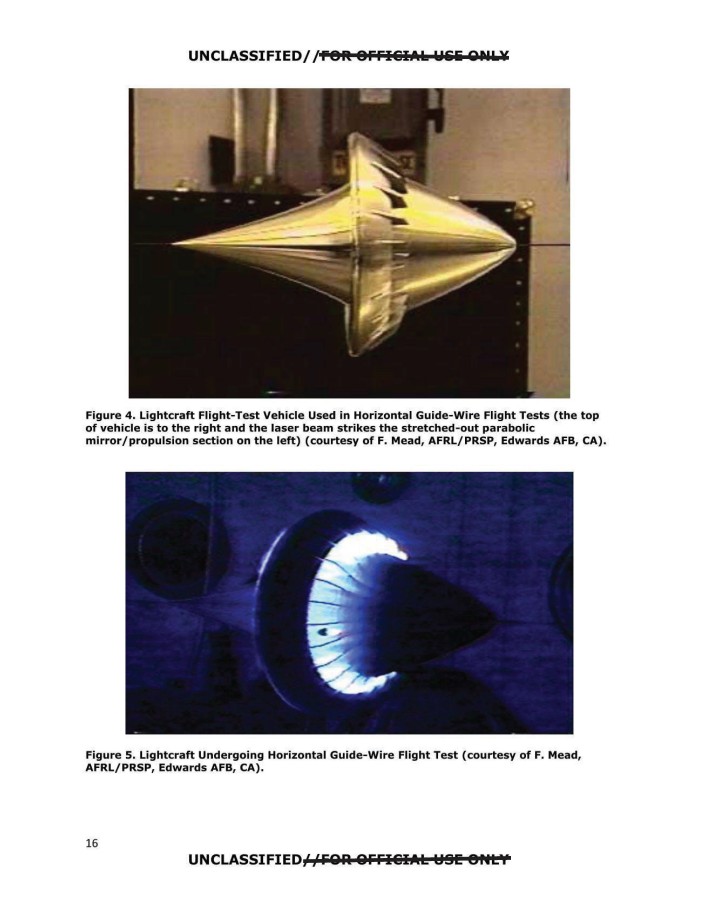
This document is a Defense Intelligence Reference Document (DIRD), a technical reference format used by the Defense Intelligence Agency (DIA) to capture baseline knowledge on a specific topic for later analytic use. DIRDs are best understood as reference and synthesis products rather than as original research. It is one of 38 DIRDs produced under the Advanced Aerospace Weapon System Applications Program (AAWSAP) between 2009 and 2011. Because AAWSAP’s scope permitted a broad range of supporting topics, not every DIRD in the series directly concerns aerospace systems or future threat assessment. The following summary reflects the DIRD’s scope and framing at the time of writing and should not be read as implying current validation of the concepts discussed. This DIRD examines laser-propelled “Lightcraft” as a possible low-cost method to launch very small satellites into low Earth orbit by using a remote high-energy laser to supply most of the propulsion energy rather than relying entirely on onboard energy sources. The report combines a survey of nanosatellite trends with a review of “Lightcraft” propulsion concepts, vehicle design, beam-control requirements, and mission studies, and argues that the most promising application is the launch of nano- or pico-satellites, especially Earth- and space-observing payloads of a few kilograms or less. It presents the concept as potentially much cheaper than conventional multistage rockets for very small payloads, while also noting significant practical constraints including strict beam-riding geometry, atmospheric losses, demanding pointing and adaptive-optics requirements, and heavy dependence on large ground-, sea-, or air-based laser infrastructure. Overall, the document presents laser “Lightcraft” as a technically plausible launch concept whose attractiveness depends on whether the supporting laser and beam-control system can be made reliable and economical at operational scale.
 PDF
DoD / AARO · Las Vegas, Nevada
DOW-UAP-D142, AAWSAP DIRD, Concepts for Extracting Energy from the Quantum Vacuum, April 2010
This document is a Defense Intelligence Reference Document (DIRD), a technical reference format used by the Defense Intelligence Agency (DIA) to capture baseline knowledge on a specific topic for later analytic use. DIRDs are best understood as reference and synthesis products rather than as original research. It is one of 38 DIRDs produced under the Advanced Aerospace Weapon System Applications Program (AAWSAP) between 2009 and 2011. Because AAWSAP’s scope permitted a broad range of supporting topics, not every DIRD in the series directly concerns aerospace systems or future threat assessment. The following summary reflects the DIRD’s scope and framing at the time of writing and should not be read as implying current validation of the concepts discussed. This DIRD examines whether useful energy might be extracted from the quantum vacuum, the ground state with the lowest possible energy of quantum fields. This treatment considers applications for space power or “propellantless” propulsion by reviewing a range of concepts involving zero-point fluctuations, Casimir effects, squeezed vacuum states, Dirac-vacuum decay, and possible vacuum phase changes in quantum chromodynamics. The report argues that established physical models contain real vacuum-related phenomena, and that certain mechanisms can be modeled as energy-releasing phase changes under specific boundary conditions or intense external fields. However, it acknowledges that no practical method for continuous or useful energy extraction has been demonstrated experimentally and that standard quantum electrodynamics does not support continuous vacuum-energy conversion in the manner proposed. Frameworks based on the concepts described in the DIRD remain theoretically underdeveloped and experimentally unconfirmed at the time of writing.
 PDF
DoD / AARO · Las Vegas, Nevada
DOW-UAP-D141, AAWSAP DIRD, Metamaterials for Aerospace Applications, April 2010
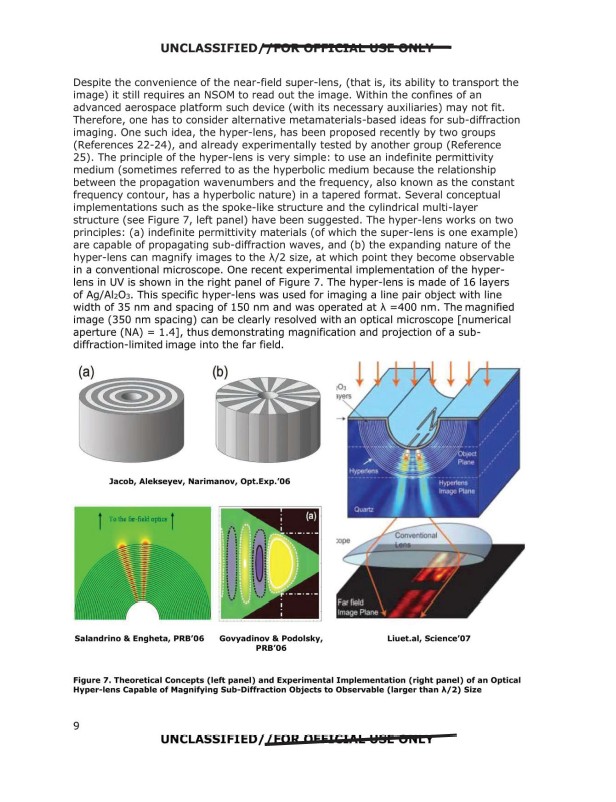
This document is a Defense Intelligence Reference Document (DIRD), a technical reference format used by the Defense Intelligence Agency (DIA) to capture baseline knowledge on a specific topic for later analytic use. DIRDs are best understood as reference and synthesis products rather than as original research. It is one of 38 DIRDs produced under the Advanced Aerospace Weapon System Applications Program (AAWSAP) between 2009 and 2011. Because AAWSAP’s scope permitted a broad range of supporting topics, not every DIRD in the series directly concerns aerospace systems or future threat assessment. The following summary reflects the DIRD’s scope and framing at the time of writing and should not be read as implying current validation of the concepts discussed. This DIRD surveys metamaterials, engineered structures designed to control electromagnetic waves in ways ordinary materials cannot, and argues that their main aerospace value lies in unusual optical and microwave properties together with significant component miniaturization. The report reviews possible applications including sub-wavelength imaging, compact waveguides and lasers, energy harvesting, tunable absorbers, nonreciprocal devices, and switchable materials, with particular emphasis on infrared and microwave uses for sensing, power management, and payload efficiency. It notes that many of the most ambitious applications depend on the practical output of a still-nascent field, especially in optical metamaterials, where only limited demonstrations had been achieved and fabrication remained a major constraint. The document presents metamaterials as a promising advanced materials field with credible niche applications and broader long-term potential.
 PDF
DoD / AARO · Las Vegas, Nevada
DOW-UAP-D140, AAWSAP DIRD, High-Frequency Gravitational Wave Communications, April 2010
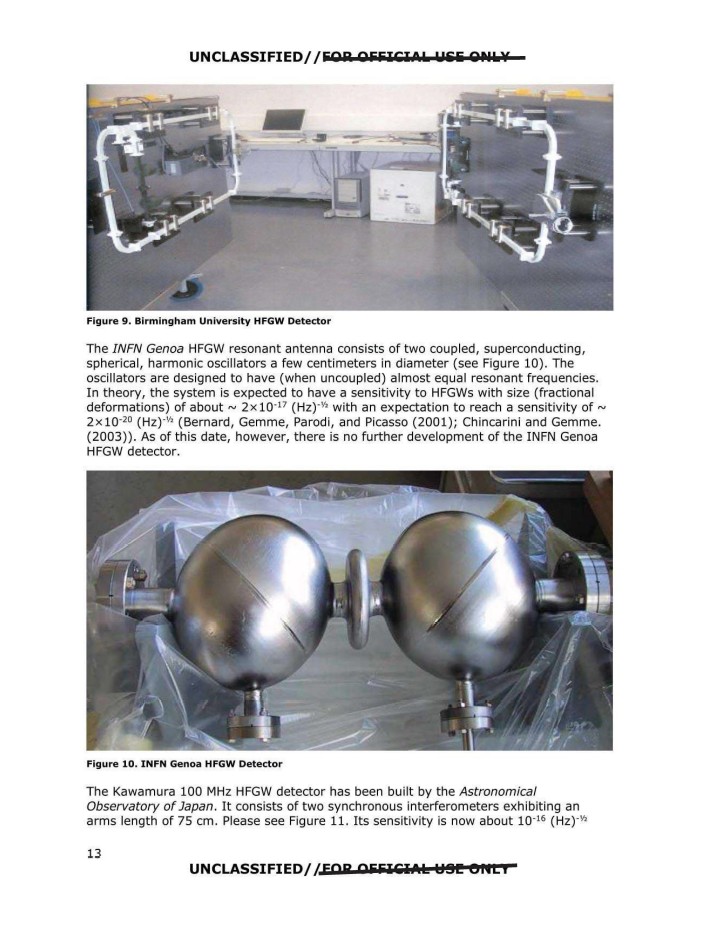
This document is a Defense Intelligence Reference Document (DIRD), a technical reference format used by the Defense Intelligence Agency (DIA) to capture baseline knowledge on a specific topic for later analytic use. DIRDs are best understood as reference and synthesis products rather than as original research. It is one of 38 DIRDs produced under the Advanced Aerospace Weapon System Applications Program (AAWSAP) between 2009 and 2011. Because AAWSAP’s scope permitted a broad range of supporting topics, not every DIRD in the series directly concerns aerospace systems or future threat assessment. The following summary reflects the DIRD’s scope and framing at the time of writing and should not be read as implying current validation of the concepts discussed. This DIRD examines whether high-frequency gravitational waves could serve as a communications medium while avoiding the attenuation that limits radio-frequency systems. The report surveys proposed transmitter and detector concepts, argues that gravitational-wave communications could support secure point-to-point links, timing standards, and interplanetary navigation, and gives particular attention to laboratory generator concepts and the Li-Baker detector as possible building blocks for such a system. The document makes clear, however, that the entire concept depends on capabilities that had not been demonstrated in practice, including laboratory-scale generation and reliable detection of usable high-frequency gravitational-wave signals. It is an exploratory systems-oriented review built around a future communications concept.
 PDF
DoD / AARO · Las Vegas, Nevada
DOW-UAP-D139, AAWSAP DIRD, Traversable Wormholes, Stargates, and Negative Energy, April 2010
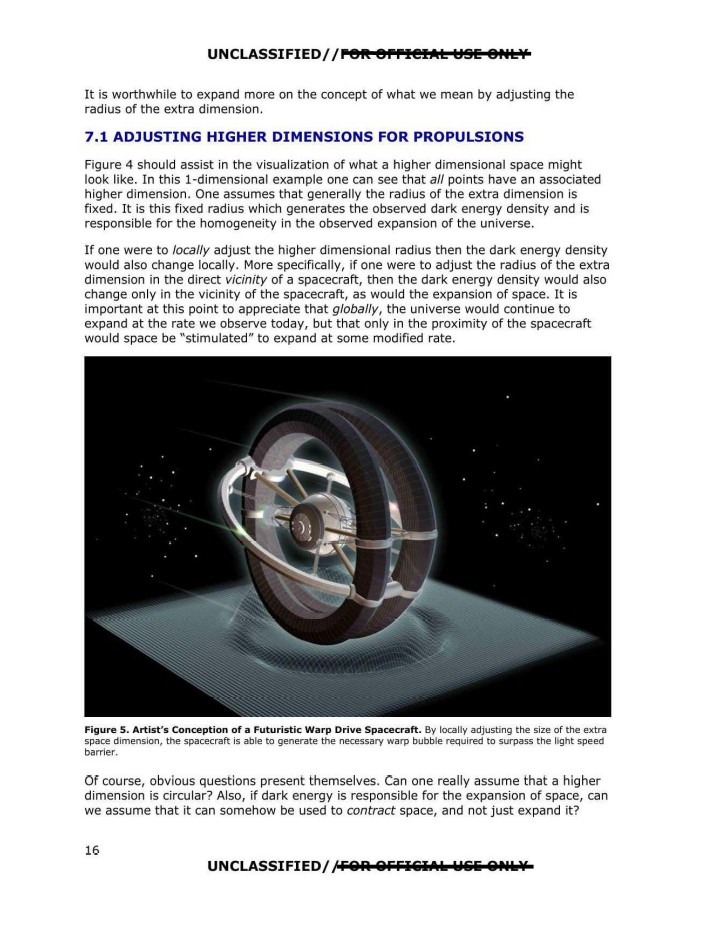
This document is a Defense Intelligence Reference Document (DIRD), a technical reference format used by the Defense Intelligence Agency (DIA) to capture baseline knowledge on a specific topic for later analytic use. DIRDs are best understood as reference and synthesis products rather than as original research. It is one of 38 DIRDs produced under the Advanced Aerospace Weapon System Applications Program (AAWSAP) between 2009 and 2011. Because AAWSAP’s scope permitted a broad range of supporting topics, not every DIRD in the series directly concerns aerospace systems or future threat assessment. The following summary reflects the DIRD’s scope and framing at the time of writing and should not be read as implying current validation of the concepts discussed. This DIRD examines traversable wormholes and “stargates” as hypothetical spacetime structures within general relativity that theoretically offer a means of faster-than-light travel or communication. The report focuses extensively on the requirement for exotic, negative-energy matter to stabilize and keep such geometries open for the passage of macro-scale objects. It reviews standard wormhole models, describes a flat-throated “stargate” variant, and argues that violations of general relativity's standard energy conditions do not physically rule such structures out, citing microscopic, transient negative-energy effects observed in Casimir-type laboratory phenomena. However, the document acknowledges that the transition from microscopic quantum fluctuations to macroscopic engineering is an unresolved barrier. While small-scale negative-energy effects are observable, there is no known mechanism to generate, concentrate, or stabilize the amounts of exotic matter proposed to be required to sustain a traversable macroscopic wormhole. Ultimately, while the paper frames wormhole concepts within accepted relativistic physics, it confirms that the gap between theoretical models and any realizable technology remains enormous.
 PDF
DoD / AARO · Las Vegas, Nevada
DOW-UAP-D138, AAWSAP DIRD, Warp Drive, Dark Energy, and the Manipulation of Extra Dimensions, April 2010
This document is a Defense Intelligence Reference Document (DIRD), a technical reference format used by the Defense Intelligence Agency (DIA) to capture baseline knowledge on a specific topic for later analytic use. DIRDs are best understood as reference and synthesis products rather than as original research. It is one of 38 DIRDs produced under the Advanced Aerospace Weapon System Applications Program (AAWSAP) between 2009 and 2011. Because AAWSAP’s scope permitted a broad range of supporting topics, not every DIRD in the series directly concerns aerospace systems or future threat assessment. The following summary reflects the DIRD’s scope and framing at the time of writing and should not be read as implying current validation of the concepts discussed. This DIRD examines whether a warp-propulsion concept can be grounded in known theoretical physics by linking general-relativistic warp metrics with dark energy, Casimir effects, and higher-dimensional models from string theory and brane cosmology. The paper hypothesizes that if dark energy arises from vacuum effects and originates in extra dimensions, then a future technology capable of manipulating those dimensions might be capable of altering local spacetime expansion to generate a warp bubble. While framed as a method to mitigate the astronomical energy demands of more traditional warp models, the report acknowledges that this concept relies entirely on unverified assumptions; namely, the physical reality, stability, and macroscopic controllability of extra dimensions. Consequently, while the paper draws on mainstream theoretical physics concepts, the speculative chain linking them lacks empirical support and offers no viable engineering pathway toward a functioning propulsion system.
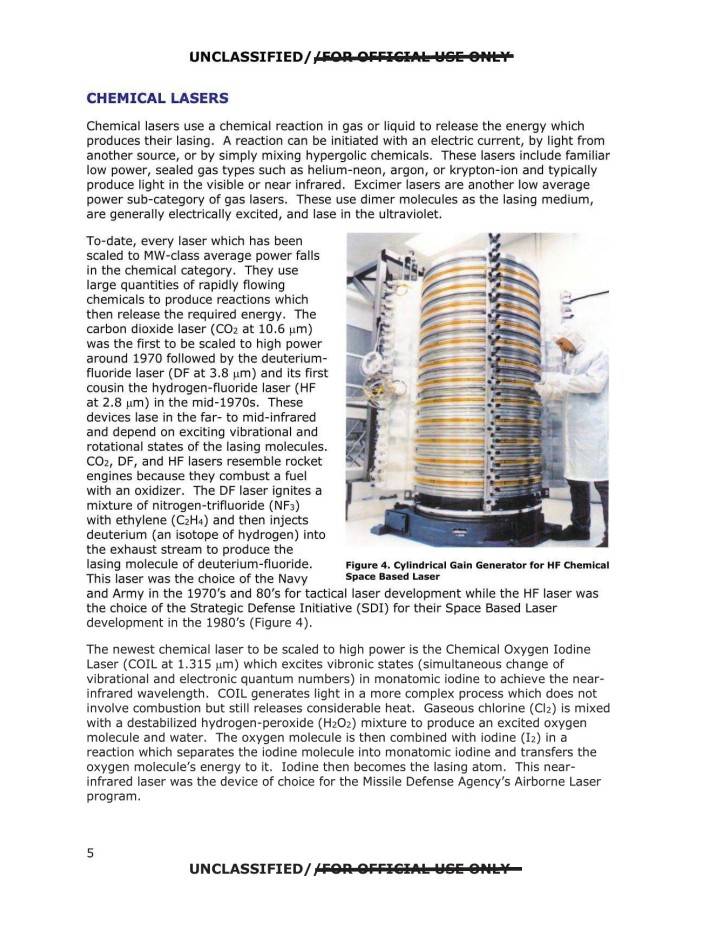 PDF
DoD / AARO · Las Vegas, Nevada
DOW-UAP-D137, AAWSAP DIRD, State of the Art and Evolution of High-Energy Lasers, March 2010
This document is a Defense Intelligence Reference Document (DIRD), a technical reference format used by the Defense Intelligence Agency (DIA) to capture baseline knowledge on a specific topic for later analytic use. DIRDs are best understood as reference and synthesis products rather than as original research. It is one of 38 DIRDs produced under the Advanced Aerospace Weapon System Applications Program (AAWSAP) between 2009 and 2011. Because AAWSAP’s scope permitted a broad range of supporting topics, not every DIRD in the series directly concerns aerospace systems or future threat assessment. The following summary reflects the DIRD’s scope and framing at the time of writing and should not be read as implying current validation of the concepts discussed. This DIRD surveys the development of high-energy laser weapons and notes that, although lasers had already become important military tools for ranging, guidance, and other lower-power uses, true weapon-class systems remained limited by power generation, beam control, atmospheric propagation, and logistics. The report reviews major laser types along with the optical, tracking, and thermal-management systems needed to make them militarily useful. It argues that high-energy lasers can offer important advantages over kinetic weapons in speed, precision, and low collateral damage, especially against softer or fast-moving targets, while also emphasizing that practical deployment has long been hindered by hazardous chemical fuels, thermal blooming in the atmosphere, power-supply constraints for mobile systems, and waste-heat removal.
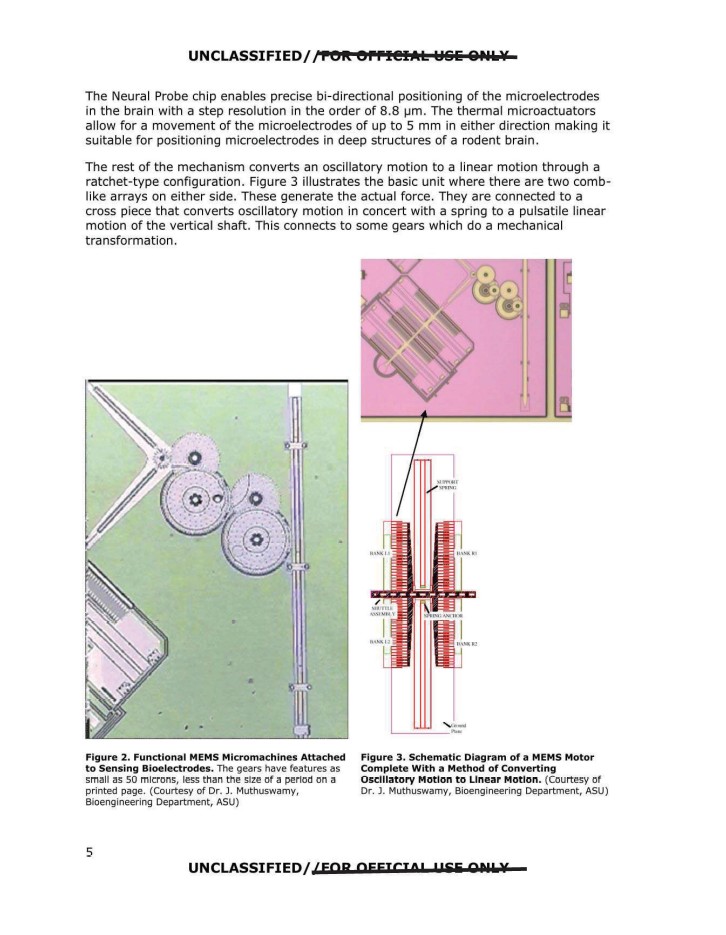 PDF
DoD / AARO · Las Vegas, Nevada
DOW-UAP-D136, AAWSAP DIRD, Biosensors and BioMEMS: A Survey of the Present Field, March 2010
This document is a Defense Intelligence Reference Document (DIRD), a technical reference format used by the Defense Intelligence Agency (DIA) to capture baseline knowledge on a specific topic for later analytic use. DIRDs are best understood as reference and synthesis products rather than as original research. It is one of 38 DIRDs produced under the Advanced Aerospace Weapon System Applications Program (AAWSAP) between 2009 and 2011. Because AAWSAP’s scope permitted a broad range of supporting topics, not every DIRD in the series directly concerns aerospace systems or future threat assessment. The following summary reflects the DIRD’s scope and framing at the time of writing and should not be read as implying current validation of the concepts discussed. This DIRD surveys biosensors and BioMEMS, a broad class of miniature biomedical devices that combine microscale engineering with sensing, fluid handling, stimulation, or drug-delivery functions. The report reviews major application areas including implantable blood-chemistry sensors, neural interfaces, neurostimulation, drug-delivery pumps, microfluidic systems, and emerging nanoscale extensions of the field, while emphasizing that miniaturization can improve sensitivity and enable functions that are difficult or impossible at larger scales. However, it also makes clear that practical development is constrained by biocompatibility, long-term stability, sensor drift, device degradation inside the body, and the high regulatory burden associated with implantable medical systems. The document presents BioMEMS as a rapidly growing and productive field whose future advances are likely to come through continued improvements in fabrication, materials, and reliability.
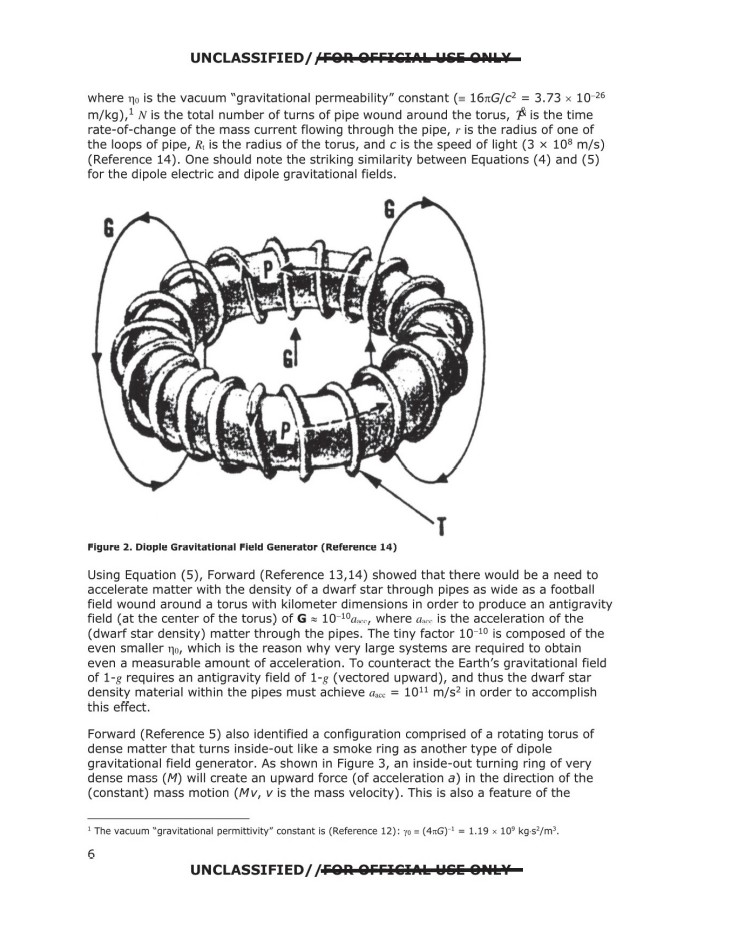 PDF
DoD / AARO · Las Vegas, Nevada
DOW-UAP-D135, AAWSAP DIRD, Antigravity for Aerospace Applications, March 2010
This document is a Defense Intelligence Reference Document (DIRD), a technical reference format used by the Defense Intelligence Agency (DIA) to capture baseline knowledge on a specific topic for later analytic use. DIRDs are best understood as reference and synthesis products rather than as original research. It is one of 38 DIRDs produced under the Advanced Aerospace Weapon System Applications Program (AAWSAP) between 2009 and 2011. Because AAWSAP’s scope permitted a broad range of supporting topics, not every DIRD in the series directly concerns aerospace systems or future threat assessment. The following summary reflects the DIRD’s scope and framing at the time of writing and should not be read as implying current validation of the concepts discussed. This DIRD surveys a range of proposed “antigravity,” or gravitational control, concepts for aerospace applications, drawing mainly from Newtonian gravity, general relativity, cosmology, and quantum field theory to hypothesize that gravity might someday be reduced, counteracted, or redirected as a means of propulsion. The report reviews mechanisms including ultra-dense matter, gravitomagnetic effects, relativistic moving masses, negative energy, dark or vacuum energy, and quantum vacuum or dispersion-force approaches, while presenting some of these ideas as theoretically permissible under extreme, idealized conditions within established physics. However, it notes that any practical implementation faces currently insurmountable engineering barriers, including astronomical energy requirements, currently unproven exotic matter conditions, kilometer-scale or otherwise unbuildable apparatuses, and highly immature experimental foundations. Although the report draws on broadly accepted theoretical concepts, its implication that those concepts might eventually yield viable “antigravity” propulsion systems deviates significantly from mainstream physics consensus.
 PDF
DoD / AARO · Las Vegas, Nevada
DOW-UAP-D134, AAWSAP DIRD, Maverick Inventor Versus Corporate Inventor: Where Will the Next Major Innovations Arise, March 2010
This document is a Defense Intelligence Reference Document (DIRD), a technical reference format used by the Defense Intelligence Agency (DIA) to capture baseline knowledge on a specific topic for later analytic use. DIRDs are best understood as reference and synthesis products rather than as original research. It is one of 38 DIRDs produced under the Advanced Aerospace Weapon System Applications Program (AAWSAP) between 2009 and 2011. Because AAWSAP’s scope permitted a broad range of supporting topics, not every DIRD in the series directly concerns aerospace systems or future threat assessment. The following summary reflects the DIRD’s scope and framing at the time of writing and should not be read as implying current validation of the concepts discussed. This DIRD compares lone “maverick” inventors with researchers working inside larger organizations in order to ask where major future breakthroughs are most likely to come from, especially in unconventional energy and propulsion. It concludes that the strongest candidates are technically trained, relatively independent, and flexible researchers working with some freedom from institutional constraint. Because that preferred profile closely resembles the kind of researcher who appears to have authored or shaped much of the broader AAWSAP DIRD effort, the document reflects a notable methodological circularity, validating the program’s operational model rather than neutrally assessing the innovation ecosystem.
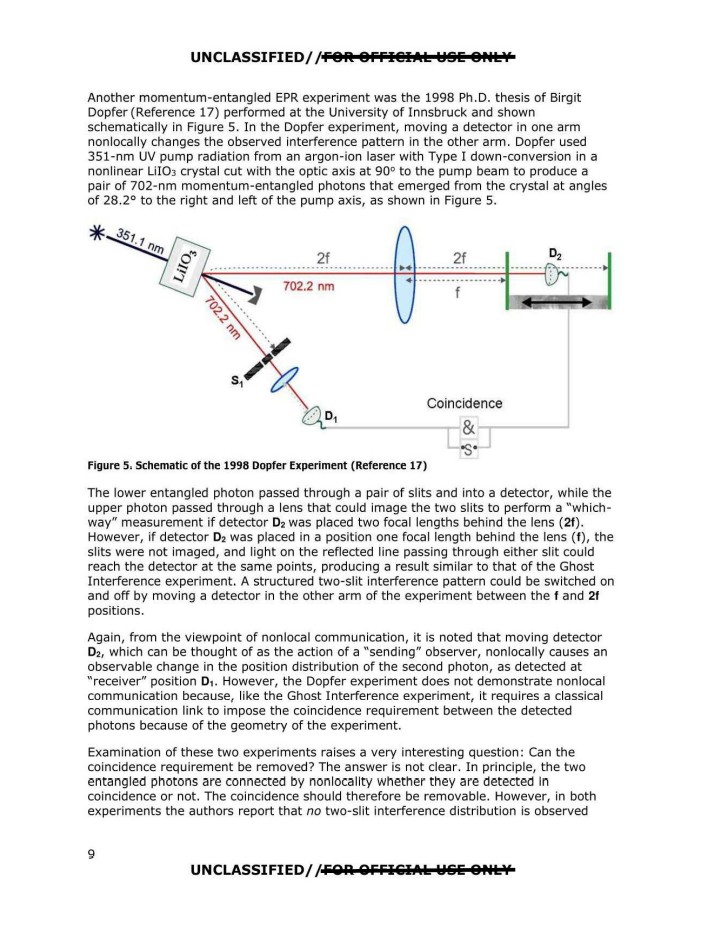 PDF
DoD / AARO · Las Vegas, Nevada
DOW-UAP-D133, AAWSAP DIRD, The Space Communication Implications of Quantum Entanglement and Nonlocality, March 2010
This document is a Defense Intelligence Reference Document (DIRD), a technical reference format used by the Defense Intelligence Agency (DIA) to capture baseline knowledge on a specific topic for later analytic use. DIRDs are best understood as reference and synthesis products rather than as original research. It is one of 38 DIRDs produced under the Advanced Aerospace Weapon System Applications Program (AAWSAP) between 2009 and 2011. Because AAWSAP’s scope permitted a broad range of supporting topics, not every DIRD in the series directly concerns aerospace systems or future threat assessment. The following summary reflects the DIRD’s scope and framing at the time of writing and should not be read as implying current validation of the concepts discussed. This DIRD reviews quantum entanglement and nonlocality with a focus on whether those phenomena might be usable as a means of faster-than-light communication between observers, especially for real-time space operations over interplanetary distances. The report surveys the relevant quantum experiments and no-signal theorems, then examines proposed communication schemes based mainly on momentum-entangled photons, including scenarios involving superluminal and retro-causal signaling. However, it repeatedly acknowledges that the central question remains unresolved experimentally, and it gives substantial attention to the coherence-versus-entanglement tradeoff and other features of standard quantum mechanics that may prevent usable signaling even if non-local correlations are experimentally validated. Overall, the document is an exploratory analysis of whether quantum nonlocality could conceivably support a practical communications application rather than a demonstration of prospective utility.
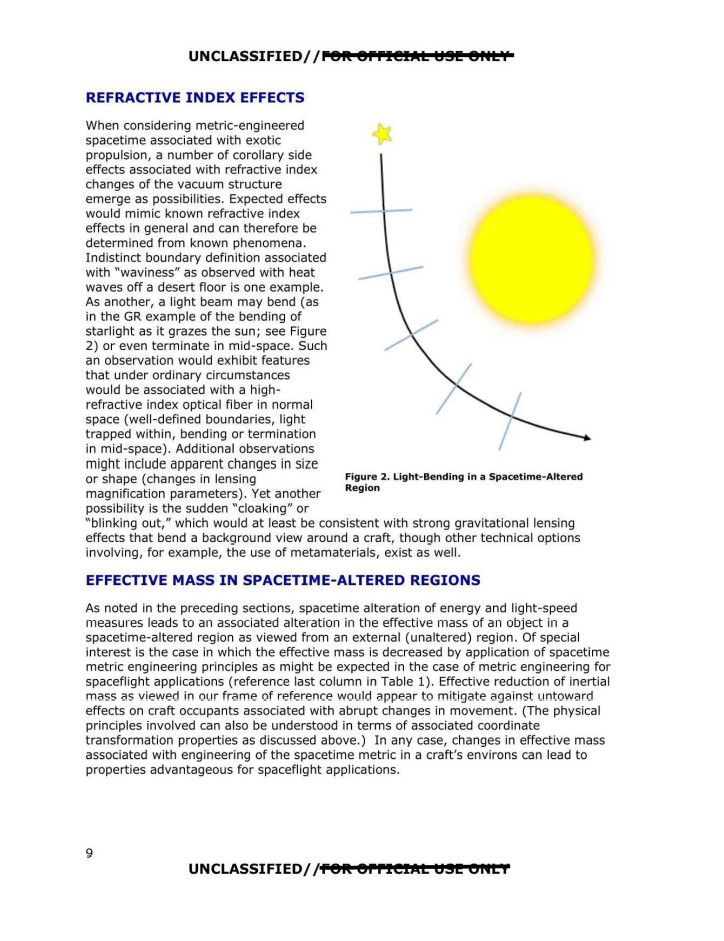 PDF
DoD / AARO · Las Vegas, Nevada
DOW-UAP-D132, AAWSAP DIRD, Advanced Space Propulsion Based on Vacuum (Spacetime Metric) Engineering, March 2010
This document is a Defense Intelligence Reference Document (DIRD), a technical reference format used by the Defense Intelligence Agency (DIA) to capture baseline knowledge on a specific topic for later analytic use. DIRDs are best understood as reference and synthesis products rather than as original research. It is one of 38 DIRDs produced under the Advanced Aerospace Weapon System Applications Program (AAWSAP) between 2009 and 2011. Because AAWSAP’s scope permitted a broad range of supporting topics, not every DIRD in the series directly concerns aerospace systems or future threat assessment. The following summary reflects the DIRD’s scope and framing at the time of writing and should not be read as implying current validation of the concepts discussed. This DIRD examines the idea of vacuum or spacetime-metric engineering: the possibility that an unspecified future technology might alter the structure of spacetime in ways useful for propulsion, power generation, or extremely rapid long-distance travel. Using general relativity as a model-independent framework, it explores the physical effects that would theoretically follow if such metric changes could be artificially induced, including altered time rates, changes in effective mass, modified light propagation, gravity-like effects, and warp-drive propulsion. The document does not propose any mechanism for generating these effects and treats these physical consequences as an assumed result of spacetime manipulation rather than as the outcome of a practical engineering pathway. It also emphasizes that the energy requirements predicted by current theory to create such effects are far beyond existing technological capability.
 PDF
DoD / AARO · Las Vegas, Nevada
DOW-UAP-D131, AAWSAP DIRD, The Role of Superconductors in Gravity Research, March 2010
This document is a Defense Intelligence Reference Document (DIRD), a technical reference format used by the Defense Intelligence Agency (DIA) to capture baseline knowledge on a specific topic for later analytic use. DIRDs are best understood as reference and synthesis products rather than as original research. It is one of 38 DIRDs produced under the Advanced Aerospace Weapon System Applications Program (AAWSAP) between 2009 and 2011. Because AAWSAP’s scope permitted a broad range of supporting topics, not every DIRD in the series directly concerns aerospace systems or future threat assessment. The following summary reflects the DIRD’s scope and framing at the time of writing and should not be read as implying current validation of the concepts discussed. This DIRD is a historical survey of efforts to determine whether superconductors might play a role in producing, detecting, or modifying gravity-related effects in a laboratory setting. It reviews the main theoretical and experimental lines of work in that area and attempts to connect superconducting materials with gravitational-wave or propulsion-related concepts. Because the topic is highly contested within the scientific literature, the report spends substantial attention on experiments of disputed value and on controversial theories, especially claims that rotating or energized superconductors might generate anomalous gravitational effects. Overall, the document treats the subject as an exploratory research area with potentially major implications if any real effect were verified, while also making clear that the evidentiary base remained weak, that prominent claims had not been convincingly replicated, and that both the underlying theory and the experimental record remained deeply disputed.
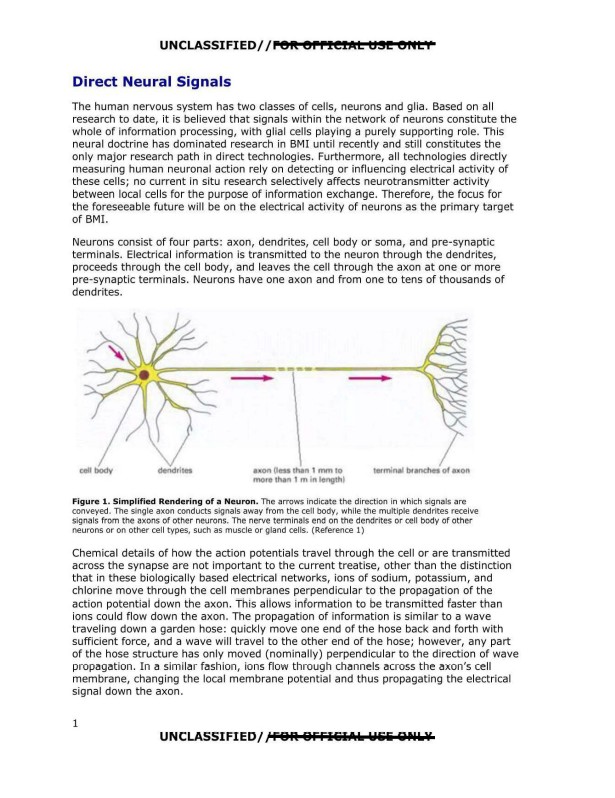 PDF
DoD / AARO · Las Vegas, Nevada
DOW-UAP-D130, AAWSAP DIRD, Technological Approaches to Controlling External Devices, March 2010
This document is a Defense Intelligence Reference Document (DIRD), a technical reference format used by the Defense Intelligence Agency (DIA) to capture baseline knowledge on a specific topic for later analytic use. DIRDs are best understood as reference and synthesis products rather than as original research. It is one of 38 DIRDs produced under the Advanced Aerospace Weapon System Applications Program (AAWSAP) between 2009 and 2011. Because AAWSAP’s scope permitted a broad range of supporting topics, not every DIRD in the series directly concerns aerospace systems or future threat assessment. The following summary reflects the DIRD’s scope and framing at the time of writing and should not be read as implying current validation of the concepts discussed. This DIRD surveys brain-machine interface technologies intended to allow users to control external devices without conventional manual controls, and it evaluates both noninvasive and invasive approaches for turning neural or related physiological signals into usable commands. The report reviews the underlying neural signals, distinguishes between open- and closed-loop control systems, and examines technologies including scalp-based electrical recording, magnetic and imaging-based methods, and implanted cortical interfaces, with particular attention to bandwidth, response time, signal quality, and practical usability. It concludes that, in the near term, the most practical systems are likely to be noninvasive electrical approaches that draw heavily on muscle and neural signals, while longer-term high-bandwidth control would likely require more advanced invasive interfaces capable of robust two-way communication with individual neurons. The document presents thought-based control of external devices as a research field with plausible assistive and specialized applications, while emphasizing that naturalistic, high-performance control remained constrained by major technical and physiological limits.
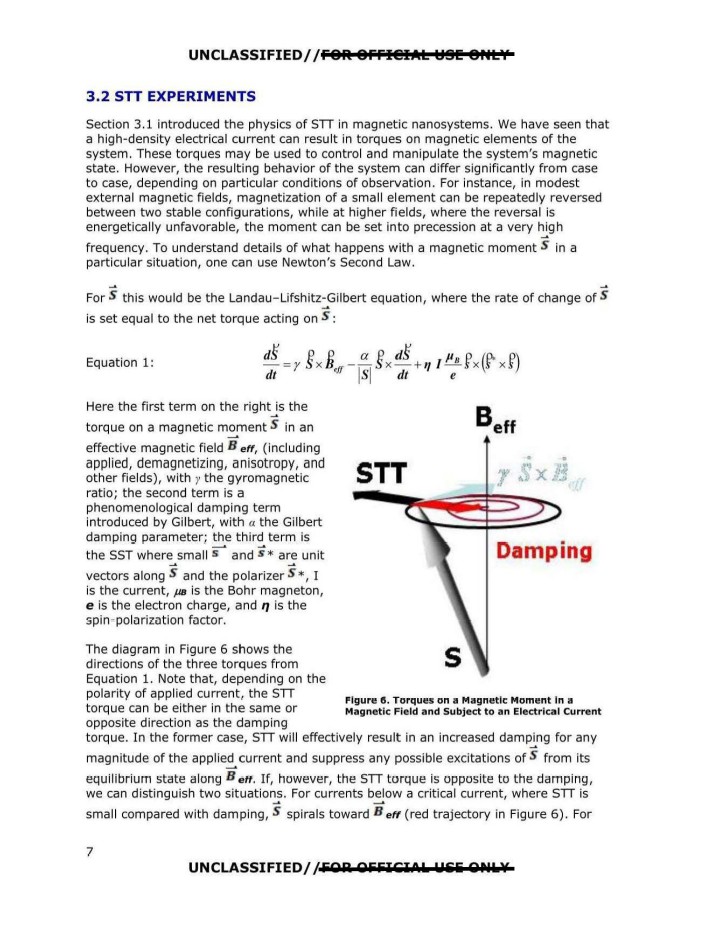 PDF
DoD / AARO · Las Vegas, Nevada
DOW-UAP-D129, AAWSAP DIRD, Metallic Spintronics, March 2010
This document is a Defense Intelligence Reference Document (DIRD), a technical reference format used by the Defense Intelligence Agency (DIA) to capture baseline knowledge on a specific topic for later analytic use. DIRDs are best understood as reference and synthesis products rather than as original research. It is one of 38 DIRDs produced under the Advanced Aerospace Weapon System Applications Program (AAWSAP) between 2009 and 2011. Because AAWSAP’s scope permitted a broad range of supporting topics, not every DIRD in the series directly concerns aerospace systems or future threat assessment. The following summary reflects the DIRD’s scope and framing at the time of writing and should not be read as implying current validation of the concepts discussed. This DIRD surveys metallic spintronics, a branch of electronics that seeks to use both the electric charge and the magnetic spin of electrons to store, detect, and manipulate information, and argues that the field could lead to faster, lower-power, and more radiation-resistant devices than conventional semiconductor electronics. The report focuses on two main effects: giant magnetoresistance (GMR), which allows magnetic states to be read through changes in electrical resistance, and spin-transfer torque (STT), which allows electrical currents to change those magnetic states. The DIRD reviews their underlying physics, the experimental work then available, and possible applications in memory, sensors, oscillators, and logic devices. The document treats metallic spintronics as a promising field while emphasizing that many of its more advanced proposed applications still require substantial further development.
 PDF
DoD / AARO · Las Vegas, Nevada
DOW-UAP-D128, AAWSAP DIRD, Anomalous Acute and Subacute Field Effects on Human Biological Tissues, March 2010
This document is a Defense Intelligence Reference Document (DIRD), a technical reference format used by the Defense Intelligence Agency (DIA) to capture baseline knowledge on a specific topic for later analytic use. DIRDs are best understood as reference and synthesis products rather than as original research. It is one of 38 DIRDs produced under the Advanced Aerospace Weapon System Applications Program (AAWSAP) between 2009 and 2011. Because AAWSAP’s scope permitted a broad range of supporting topics, not every DIRD in the series directly concerns aerospace systems or future threat assessment. The following summary reflects the DIRD’s scope and framing at the time of writing and should not be read as implying current validation of the concepts discussed. This DIRD surveys reported acute and subacute injuries allegedly associated with close exposure to anomalous field effects, attempting to draw tentative parallels between these claimed symptoms and the known physiological effects of intense radiofrequency .and microwave exposure on human tissue. By reviewing medical and biophysical literature on heating, burns, neurological effects, and sensory disturbances, the report speculates on theoretical mechanisms by which intense electromagnetic fields might account for some of the reported injury patterns, though it does not establish a direct causal link between the reported injuries and any specific source. It hypothesizes that clinical symptoms and reported exposure circumstances might allow for highly constrained, limited inferences regarding the characteristics of an unknown emitter or propulsion system. Notably, the document’s findings rely heavily on case comparisons lacking physical examinations, untestable exposure conditions, and a mix of established science and more controversial literature. These comparisons are then extended to anomalous-craft scenarios, attempting to map known electromagnetic injury mechanisms onto anomalous encounter claims that lack independent scientific validation in the report.
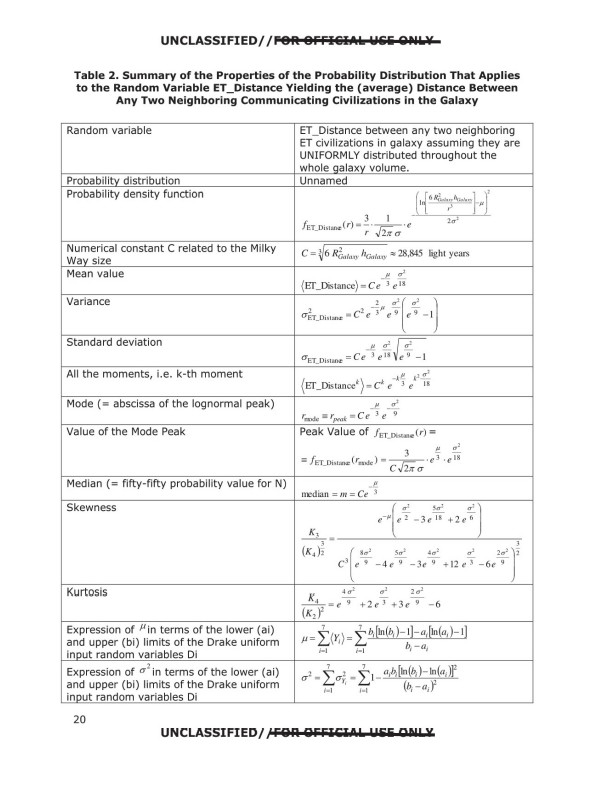 PDF
DoD / AARO · Las Vegas, Nevada
DOW-UAP-D127, AAWSAP DIRD, An Introduction to the Statistical Drake Equation, March 2010
This document is a Defense Intelligence Reference Document (DIRD), a technical reference format used by the Defense Intelligence Agency (DIA) to capture baseline knowledge on a specific topic for later analytic use. DIRDs are best understood as reference and synthesis products rather than as original research. It is one of 38 DIRDs produced under the Advanced Aerospace Weapon System Applications Program (AAWSAP) between 2009 and 2011. Because AAWSAP’s scope permitted a broad range of supporting topics, not every DIRD in the series directly concerns aerospace systems or future threat assessment. The following summary reflects the DIRD’s scope and framing at the time of writing and should not be read as implying current validation of the concepts discussed. This DIRD introduces the Drake Equation, a well-known thought framework for estimating how many communicative extraterrestrial civilizations might exist in the galaxy. It reformulates the equation in statistical terms, arguing that the usual approach of assigning fixed values to its variables is too simplistic because major inputs are uncertain and are better modeled as probability distributions. Using that approach, it concludes that, if one accepts the underlying logic of the Drake Equation, the estimated number of communicating civilizations should be treated as a range of possible values, and that the likely distance between neighboring civilizations can likewise be expressed statistically rather than as a single figure. The document is primarily a mathematical and methodological exercise, and its worked examples rely on assumed values to illustrate the framework rather than to establish a firm astrophysical estimate. Overall, it is an attempt to formalize uncertainty within the Drake framework rather than an attempt to bound the actual likelihood, prevalence, or proximity of extraterrestrial civilizations.
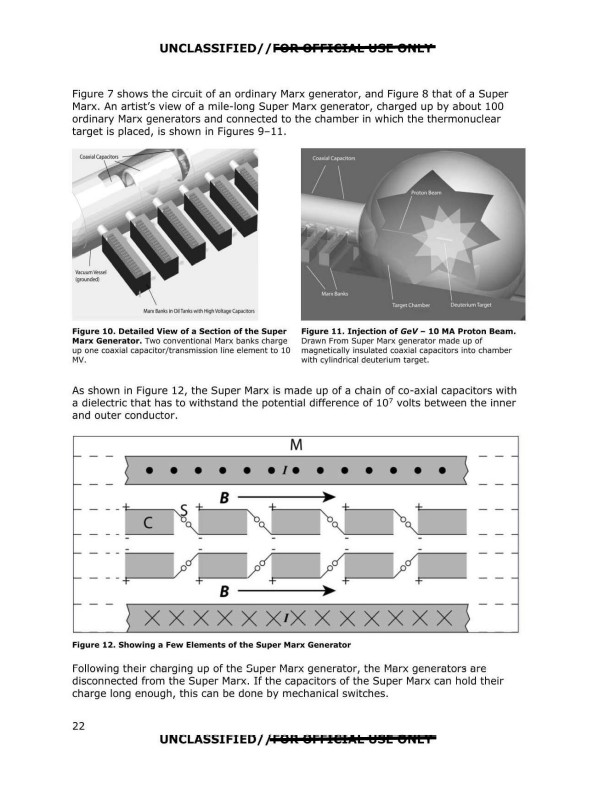 PDF
DoD / AARO · Las Vegas, Nevada
DOW-UAP-D126, AAWSAP DIRD, Advanced Nuclear Propulsion for Manned Deep Space Missions, March 2010
This document is a Defense Intelligence Reference Document (DIRD), a technical reference format used by the Defense Intelligence Agency (DIA) to capture baseline knowledge on a specific topic for later analytic use. DIRDs are best understood as reference and synthesis products rather than as original research. It is one of 38 DIRDs produced under the Advanced Aerospace Weapon System Applications Program (AAWSAP) between 2009 and 2011. Because AAWSAP’s scope permitted a broad range of supporting topics, not every DIRD in the series directly concerns aerospace systems or future threat assessment. The following summary reflects the DIRD’s scope and framing at the time of writing and should not be read as implying current validation of the concepts discussed. This DIRD examines advanced nuclear propulsion for crewed deep-space travel and argues that human missions beyond the Moon would require propulsion systems with both very high thrust and very high specific impulse, which the author contends are difficult to achieve with conventional chemical, nuclear-thermal, and nuclear-electric systems. The report focuses on concepts derived from Project Orion, the discontinued General Atomics nuclear pulse propulsion study sponsored first by ARPA and later by the U.S. Air Force between 1958 and 1965, in which a spacecraft would be driven by repeated nuclear explosions. In this case, the DIRD emphasizes small non-fission-triggered fusion explosions using deuterium, magnetic mirrors, and other unconventional ignition concepts intended to avoid the inefficiencies associated with small fission devices. It presents these ideas as a possible pathway to crewed missions across the solar system, while also linking them to broader visions of long-range human expansion into space. The document is exploratory in character and depends on several unproven ignition methods, enabling technologies, and engineering assumptions. Overall, it is a theoretical examination of fusion-based pulse propulsion concepts rather than as a documentary account of a technology nearing practical realization.
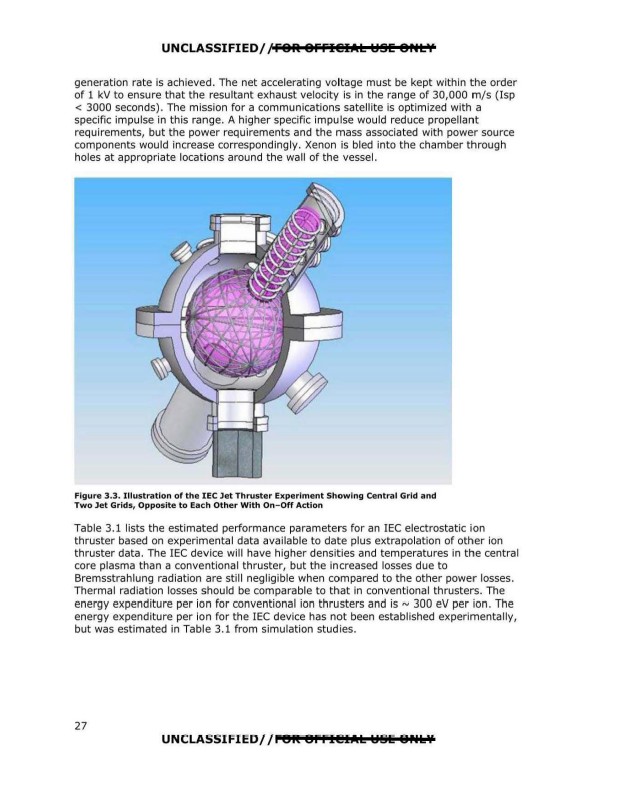 PDF
DoD / AARO · Las Vegas, Nevada
DOW-UAP-D125, AAWSAP DIRD, Inertial Electrostatic Confinement Fusion, March 2010
This document is a Defense Intelligence Reference Document (DIRD), a technical reference format used by the Defense Intelligence Agency (DIA) to capture baseline knowledge on a specific topic for later analytic use. DIRDs are best understood as reference and synthesis products rather than as original research. It is one of 38 DIRDs produced under the Advanced Aerospace Weapon System Applications Program (AAWSAP) between 2009 and 2011. Because AAWSAP’s scope permitted a broad range of supporting topics, not every DIRD in the series directly concerns aerospace systems or future threat assessment. The following summary reflects the DIRD’s scope and framing at the time of writing and should not be read as implying current validation of the concepts discussed. This DIRD surveys inertial electrostatic confinement (IEC) fusion, a relatively unconventional fusion concept that uses electric fields rather than the more established magnetic or laser-based approaches to confine ions, and it reviews both the underlying physics and the experimental work associated with the concept. The report emphasizes that IEC may have nearer-term value as a compact neutron, proton, or x-ray source and as a platform for studying experimental fusion approaches, while also presenting more ambitious possibilities such as aneutronic power generation and propulsion applications. At the same time, it makes clear that the concept remained far from practical fusion power, with experimental devices operating several orders of magnitude below breakeven and with major unresolved issues involving confinement, losses, grid damage, and scale-up. Overall, the document treats IEC as a technically interesting but still highly speculative path toward fusion energy, while suggesting that its more limited spin-off applications were more plausible in the near term than its long-range power generation or propulsion applications.
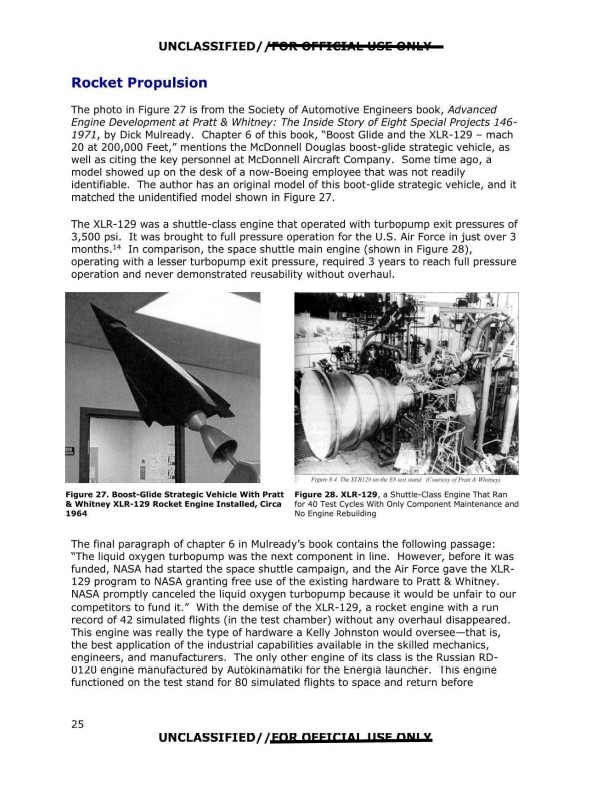 PDF
DoD / AARO · Las Vegas, Nevada
DOW-UAP-D124, AAWSAP DIRD, Space Access: Where We’ve Been and Where We Could Go, March 2010
This document is a Defense Intelligence Reference Document (DIRD), a technical reference format used by the Defense Intelligence Agency (DIA) to capture baseline knowledge on a specific topic for later analytic use. DIRDs are best understood as reference and synthesis products rather than as original research. It is one of 38 DIRDs produced under the Advanced Aerospace Weapon System Applications Program (AAWSAP) between 2009 and 2011. Because AAWSAP’s scope permitted a broad range of supporting topics, not every DIRD in the series directly concerns aerospace systems or future threat assessment. The following summary reflects the DIRD’s scope and framing at the time of writing and should not be read as implying current validation of the concepts discussed. This DIRD is a historical and conceptual survey of space access systems, contending that the main barrier to routine access to space is a failure to build durable, reliable, operational hardware and the supporting infrastructure needed for regular service to and from low Earth orbit. The report reviews earlier launch and aerospace concepts, especially reusable and aircraft-like approaches, and suggests that U.S. space access development became too strongly centered on expendable rockets derived from ballistic missiles rather than bespoke systems designed for repeated space access and payload delivery. Its central claim is that meaningful future progress will depend on creating a purpose-built space transportation infrastructure, including frequent round-trip capability and orbital support networks, rather than continuing to rely on one-off launch vehicles. Overall, the document presents a forceful case for infrastructure-first space development, though its characterization of past technological choices is more assertive than a fully neutral account of past U.S. space programming.
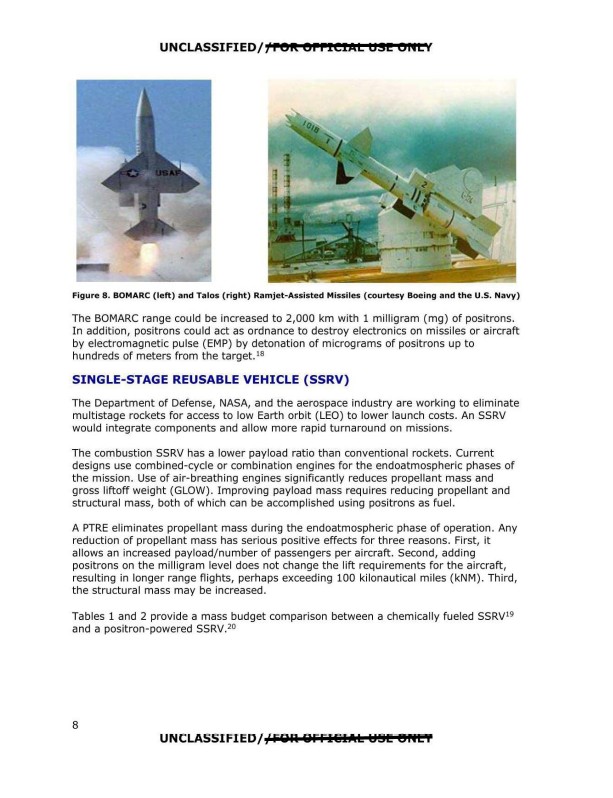 PDF
DoD / AARO · Las Vegas, Nevada
DOW-UAP-D123, AAWSAP DIRD, Positron Aerospace Propulsion, March 2010
This document is a Defense Intelligence Reference Document (DIRD), a technical reference format used by the Defense Intelligence Agency (DIA) to capture baseline knowledge on a specific topic for later analytic use. DIRDs are best understood as reference and synthesis products rather than as original research. It is one of 38 DIRDs produced under the Advanced Aerospace Weapon System Applications Program (AAWSAP) between 2009 and 2011. Because AAWSAP’s scope permitted a broad range of supporting topics, not every DIRD in the series directly concerns aerospace systems or future threat assessment. The following summary reflects the DIRD’s scope and framing at the time of writing and should not be read as implying current validation of the concepts discussed. This DIRD examines positrons as a possible fuel for advanced aerospace propulsion, arguing that antimatter offers extraordinary energy density and could, in principle, support applications ranging from long-endurance aircraft and missiles to single-stage launch vehicles, onboard power systems, and crewed Mars missions. At the same time, it makes clear that the concept depends on resolving major unsolved problems in producing positrons in sufficient quantities and storing them safely for long periods, and much of the document’s discussion of flight systems and Mars missions remains conceptual rather than closely tied to demonstrated engineering practice. Its overall conclusion is that positron propulsion is theoretically attractive, but remains highly speculative as a practical technology because its core production and storage requirements remain unsolved.
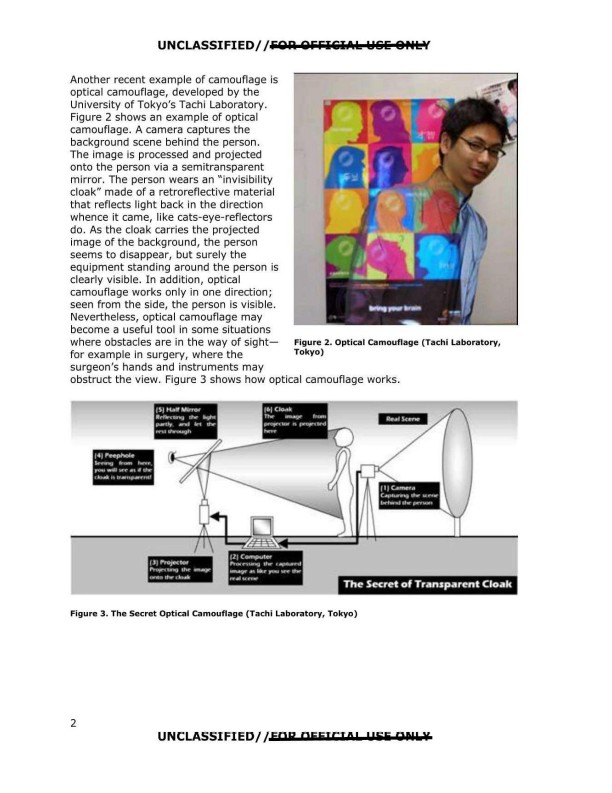 PDF
DoD / AARO · Las Vegas, Nevada
DOW-UAP-D122, AAWSAP DIRD, Invisibility Cloaking Theory and Experiments, March 2010
This document is a Defense Intelligence Reference Document (DIRD), a technical reference format used by the Defense Intelligence Agency (DIA) to capture baseline knowledge on a specific topic for later analytic use. DIRDs are best understood as reference and synthesis products rather than as original research. It is one of 38 DIRDs produced under the Advanced Aerospace Weapon System Applications Program (AAWSAP) between 2009 and 2011. Because AAWSAP’s scope permitted a broad range of supporting topics, not every DIRD in the series directly concerns aerospace systems or future threat assessment. The following summary reflects the DIRD’s scope and framing at the time of writing and should not be read as implying current validation of the concepts discussed. This DIRD surveys the theory and early experiments behind invisibility cloaking, describing several ways an object might be hidden from visual or sensor detection, including camouflage, transparency effects, and optical cloaking that bends light around an object. It focuses mainly on metamaterials, negative refraction, and transformation optics, and reviews experiments that had already demonstrated limited cloaking at microwave frequencies. The report argues that “imperfect” cloaking is physically achievable in some parts of the electromagnetic spectrum, especially for microwaves, but that “perfect” cloaking is not practical because it would require material properties that conflict with the underlying physics. Its overall conclusion is that cloaking is a scientific field with plausible narrow applications, but that useful visible-light cloaking depends more on future theoretical breakthroughs than on conventional advances in materials science.
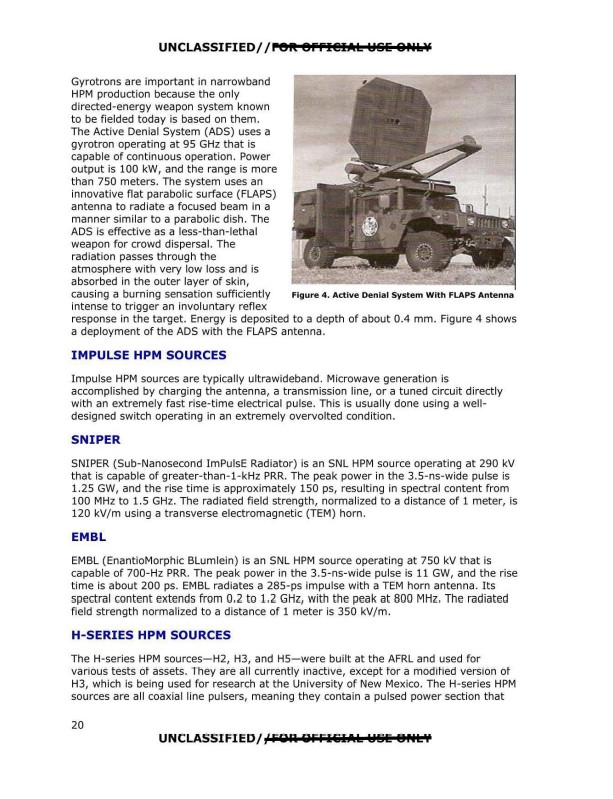 PDF
DoD / AARO · Las Vegas, Nevada
DOW-UAP-D121, AAWSAP DIRD, Pulsed High-Power Microwave Source Technology, January 2010
This document is a Defense Intelligence Reference Document (DIRD), a technical reference format used by the Defense Intelligence Agency (DIA) to capture baseline knowledge on a specific topic for later analytic use. DIRDs are best understood as reference and synthesis products rather than as original research. It is one of 38 DIRDs produced under the Advanced Aerospace Weapon System Applications Program (AAWSAP) between 2009 and 2011. Because AAWSAP’s scope permitted a broad range of supporting topics, not every DIRD in the series directly concerns aerospace systems or future threat assessment. The following summary reflects the DIRD’s scope and framing at the time of writing and should not be read as implying current validation of the concepts discussed. This DIRD surveys pulsed high-power microwave (HPM) source technology and argues that such systems remain of military interest because they can disrupt or damage electronic systems with short, intense electromagnetic pulses. The report reviews the main source types and the supporting technologies they depend on, including high-voltage insulation, switching, cathode materials, antennas, and pulse-power generation. It emphasizes the difficulty of building systems that are compact, efficient, and practical to field, since short pulse durations, antenna size, heating, detectability, and beam or signal quality all impose hard engineering limits. Its overall conclusion is that the technology has significant potential military value, but that further progress depends on advances in cathodes, predictive modeling, high-speed high-voltage switching, and low-loss insulation, while compact ultrawideband systems will remain difficult because of basic physical constraints on antenna design.
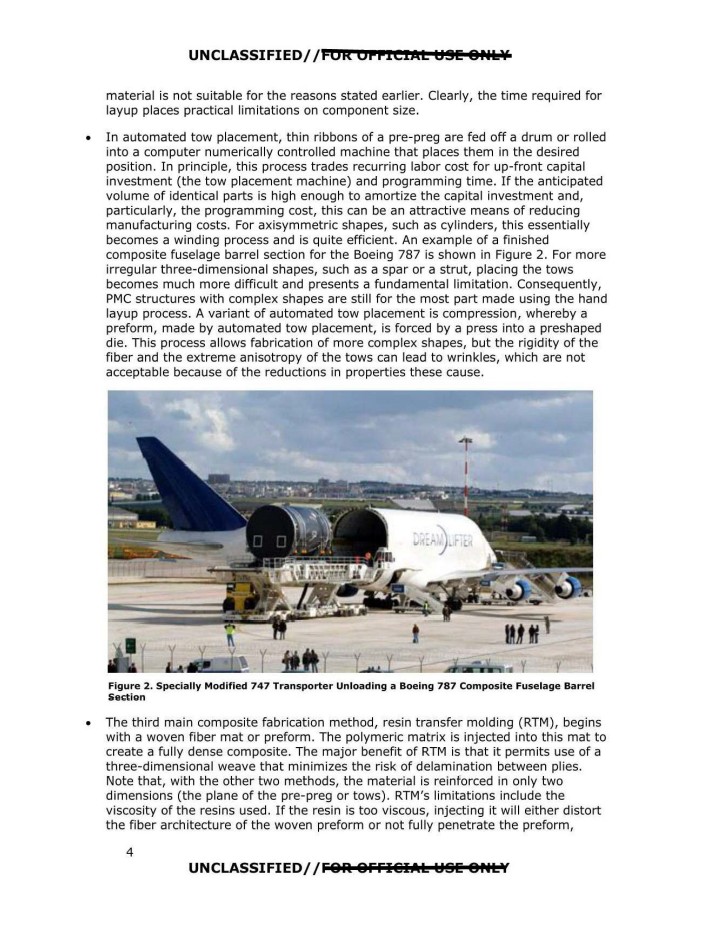 PDF
DoD / AARO · Las Vegas, Nevada
DOW-UAP-D120, AAWSAP DIRD, Materials for Advanced Aerospace Platforms, January 2010
This document is a Defense Intelligence Reference Document (DIRD), a technical reference format used by the Defense Intelligence Agency (DIA) to capture baseline knowledge on a specific topic for later analytic use. DIRDs are best understood as reference and synthesis products rather than as original research. It is one of 38 DIRDs produced under the Advanced Aerospace Weapon System Applications Program (AAWSAP) between 2009 and 2011. Because AAWSAP’s scope permitted a broad range of supporting topics, not every DIRD in the series directly concerns aerospace systems or future threat assessment. The following summary reflects the DIRD’s scope and framing at the time of writing and should not be read as implying current validation of the concepts discussed. This DIRD surveys the structural materials needed for advanced aerospace platforms and argues that material choice cannot be separated from overall vehicle design, because launch vehicles, space vehicles, reusable systems, and propulsion hardware each face different temperature, durability, weight, and manufacturing constraints. The report reviews a range of candidate material classes, including advanced aluminum alloys; polymer-, aluminum-, and titanium-matrix composites; titanium alloys; nickel-base alloys; refractory metals; ceramic-matrix composites; carbon-carbon composites; and titanium aluminides. It emphasizes that balancing performance against practical limits such as fabrication methods, cost, inspection, contamination control, and service environment remains a major challenge. Its overall conclusion is that many promising materials exist, but their usefulness depends on application-specific tradeoffs and on closer integration of material selection with design and manufacturing, with some systems judged to be more valuable targets for development than others.
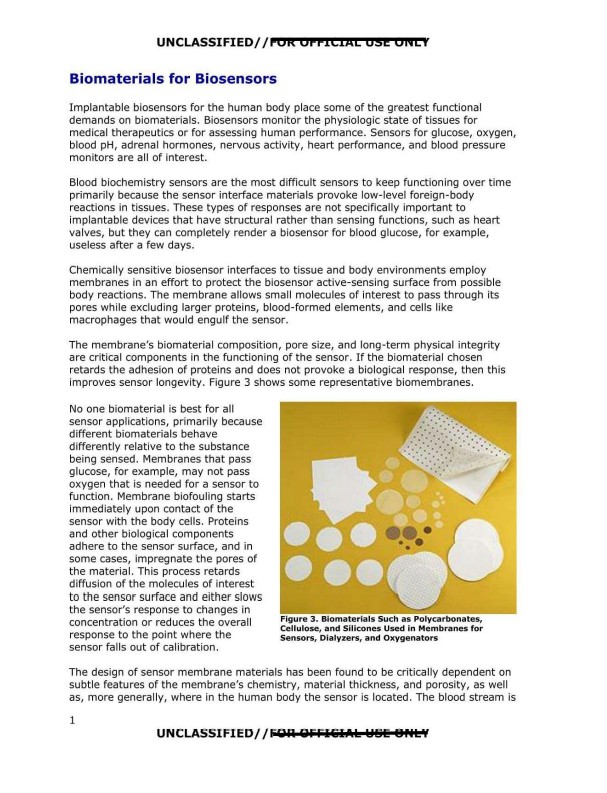 PDF
DoD / AARO · Las Vegas, Nevada
DOW-UAP-D119, AAWSAP DIRD, Biomaterials, January 2010
This document is a Defense Intelligence Reference Document (DIRD), a technical reference format used by the Defense Intelligence Agency (DIA) to capture baseline knowledge on a specific topic for later analytic use. DIRDs are best understood as reference and synthesis products rather than as original research. It is one of 38 DIRDs produced under the Advanced Aerospace Weapon System Applications Program (AAWSAP) between 2009 and 2011. Because AAWSAP’s scope permitted a broad range of supporting topics, not every DIRD in the series directly concerns aerospace systems or future threat assessment. The following summary reflects the DIRD’s scope and framing at the time of writing and should not be read as implying current validation of the concepts discussed. This DIRD is a broad survey of biomaterials, including metals, polymers, ceramics, glasses, and composites designed to interact with living tissue, and argues that their value depends mainly on biocompatibility, reliability, and careful matching of material properties to specific medical uses. The report reviews major application areas including biosensors, implants, cardiovascular devices, contact lenses, drug delivery systems, tissue constructs, titanium devices, and dialysis membranes, emphasizing that no single biomaterial works best in every setting. Its overall conclusion is that biomaterials are already foundational to a large medical-device industry and save or improve millions of lives, but that progress tends to be slow because safety testing is stringent; as a result, most advances come from improved ways of applying established materials such as silicone, Teflon, biodegradable polymers, ceramics, and titanium in new devices and clinical settings rather than from radically new substances.
 PDF
DoD / AARO · Las Vegas, Nevada
DOW-UAP-D118, AAWSAP DIRD, Aerospace Applications of Programmable Matter, December 2009
This document is a Defense Intelligence Reference Document (DIRD), a technical reference format used by the Defense Intelligence Agency (DIA) to capture baseline knowledge on a specific topic for later analytic use. DIRDs are best understood as reference and synthesis products rather than as original research. It is one of 38 DIRDs produced under the Advanced Aerospace Weapon System Applications Program (AAWSAP) between 2009 and 2011. Because AAWSAP’s scope permitted a broad range of supporting topics, not every DIRD in the series directly concerns aerospace systems or future threat assessment. The following summary reflects the DIRD’s scope and framing at the time of writing and should not be read as implying current validation of the concepts discussed. This DIRD describes “programmable matter” as smart materials whose properties can be changed on command, potentially allowing spacecraft components to change function through software updates rather than physical repair or replacement. The report suggests that such materials could someday enable adjustable sensors, smart windows, heat control, energy collection, active camouflage, and systems that switch between different functions, making spacecraft more flexible and adaptable. At the same time, it presents the idea as highly speculative and emphasizes major technical obstacles, including manufacturing at extremely small scales, shielding against radiation and electromagnetic interference, managing temperature effects, reducing component failures, and preventing hacking or malicious control. Overall, the document presents programmable matter as a promising long-term concept over the next 50 years, while judging that simpler near-term uses such as smart windows and energy-saving surface materials are far more realistic than the more ambitious aerospace applications.
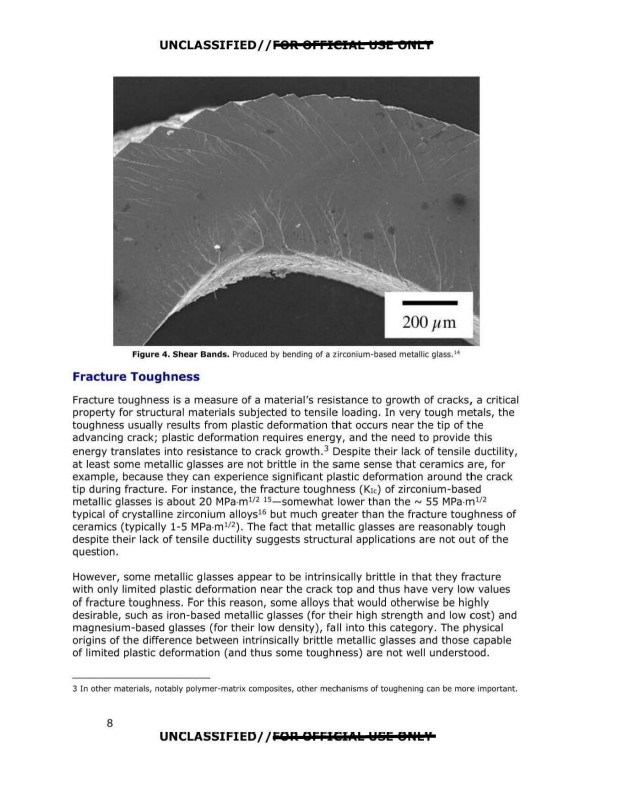 PDF
DoD / AARO · Las Vegas, Nevada
DOW-UAP-D117, AAWSAP DIRD, Metallic Glasses for Aerospace Applications, December 2009
This document is a Defense Intelligence Reference Document (DIRD), a technical reference format used by the Defense Intelligence Agency (DIA) to capture baseline knowledge on a specific topic for later analytic use. DIRDs are best understood as reference and synthesis products rather than as original research. It is one of 38 DIRDs produced under the Advanced Aerospace Weapon System Applications Program (AAWSAP) between 2009 and 2011. Because AAWSAP’s scope permitted a broad range of supporting topics, not every DIRD in the series directly concerns aerospace systems or future threat assessment. The following summary reflects the DIRD’s scope and framing at the time of writing and should not be read as implying current validation of the concepts discussed. This DIRD surveys metallic glasses as a potentially important class of aerospace materials and describes their amorphous structure as offering very high strength and unusual manufacturing advantages, but also significant drawbacks, especially poor ductility and fatigue resistance. The document concludes that the most promising aerospace applications are likely to come from metallic-glass-matrix composites rather than single-phase glasses, because these composites can retain high strength while greatly improving fracture toughness and fatigue performance, potentially enough to substitute for high-strength steels in some space-limited structural uses. At the same time, the report judges that broader aerospace use will depend on substantial progress over the next 20–50 years in alloy design, processing, and especially the development of lightweight systems, including aluminum-based options.
 PDF
DoD / AARO · Washington, D.C.
DOW-UAP-D116, AAWSAP Contract Modification P00005, September 2010
This document is an administrative or programmatic record related to the Advanced Aerospace Weapon System Applications Program (AAWSAP), a Defense Intelligence Agency (DIA)-administered program active from 2008 to 2012. AAWSAP’s official scope of work identified 12 technical research areas relating to potential aerospace threats over a time horizon of more than 40 years. As an administrative record, the file documents how AAWSAP was scoped, organized, tasked, funded, or described at a particular point in time. This September 2010 contract modification extends the period of performance for the AAWSAP contract (HHM402-08-C-0072) from September 22, 2010, to December 21, 2010. The modification states that no additional funding was required for the extension and that no other changes were made to the contract. This bridge action extended AAWSAP contractor support beyond the previously established performance end date without changing the underlying scope of work.
 PDF
DoD / AARO · Washington, D.C.
DOW-UAP-D115, AAWSAP Contract Modification P00004, May 2010
This document is an administrative or programmatic record related to the Advanced Aerospace Weapon System Applications Program (AAWSAP), a Defense Intelligence Agency (DIA)-administered program active from 2008 to 2012. AAWSAP’s official scope of work identified 12 technical research areas relating to potential aerospace threats over a time horizon of more than 40 years. As an administrative record, the file documents how AAWSAP was scoped, organized, tasked, funded, or described at a particular point in time. This May 2010 contract modification records a minor administrative action associated with the AAWSAP contract (HHM402-08-C-0072) to align internal recordkeeping with a change to the Contracting Officer’s Representative documented in a separate contract modification (P00003).
 PDF
DoD / AARO · Washington, D.C.
DOW-UAP-D114, AAWSAP Contract Modification P00003, May 2010
This document is an administrative or programmatic record related to the Advanced Aerospace Weapon System Applications Program (AAWSAP), a Defense Intelligence Agency (DIA)-administered program active from 2008 to 2012. AAWSAP’s official scope of work identified 12 technical research areas relating to potential aerospace threats over a time horizon of more than 40 years. As an administrative record, the file documents how AAWSAP was scoped, organized, tasked, funded, or described at a particular point in time. This May 2010 contract modification is an administrative change to contract HHM402-08-C-0072. The modification states that its purpose is to change the Contracting Officer’s Representative (COR) designation for the AAWSAP contract and identifies the newly designated COR while specifying that guidance from the COR must comply with the contract’s governing terms. In effect, the file is best understood as an internal contract-administration update reflecting oversight realignment rather than a substantive change to AAWSAP’s research deliverables or program direction.
 PDF
DoD / AARO · Washington, D.C.
DOW-UAP-D113, AAWSAP Contract Modification P00002, February 2010
This document is an administrative or programmatic record related to the Advanced Aerospace Weapon System Applications Program (AAWSAP), a Defense Intelligence Agency (DIA)-administered program active from 2008 to 2012. AAWSAP’s official scope of work identified 12 technical research areas relating to potential aerospace threats over a time horizon of more than 40 years. As an administrative record, the file documents how AAWSAP was scoped, organized, tasked, funded, or described at a particular point in time. This February 2010 contract modification provides funding for the exercise of Option Year 1 under contract HHM402-08-C-0072 and removes the availability-of-funds contingency that had been imposed in modification P00001. It also states that the modification identifies impacts to deliverables resulting from reduced Option Year 1 funding and incorporates revised documentation showing how Fiscal Year 2010 funds would be used. The modification converts the previously contingent option-year continuation into a funded contract action while acknowledging that reduced funding would affect the planned scope or timing of deliverables.
 PDF
DoD / AARO · Washington, D.C.
DOW-UAP-D112, AAWSAP Contract Modification P00001, September 2009
This document is an administrative or programmatic record related to the Advanced Aerospace Weapon System Applications Program (AAWSAP), a Defense Intelligence Agency (DIA)-administered program active from 2008 to 2012. AAWSAP’s official scope of work identified 12 technical research areas relating to potential aerospace threats over a time horizon of more than 40 years. As an administrative record, the file documents how AAWSAP was scoped, organized, tasked, funded, or described at a particular point in time. This September 2009 contract modification formally extends the Bigelow Aerospace Advanced Space Studies (BAASS) contract through 30 September 2009, revises the option-year dates to run from 1 October 2009 through 30 September 2010, and exercises the first option year subject to the availability of appropriated funds. The document carries forward the same major deliverable categories as the original contract.
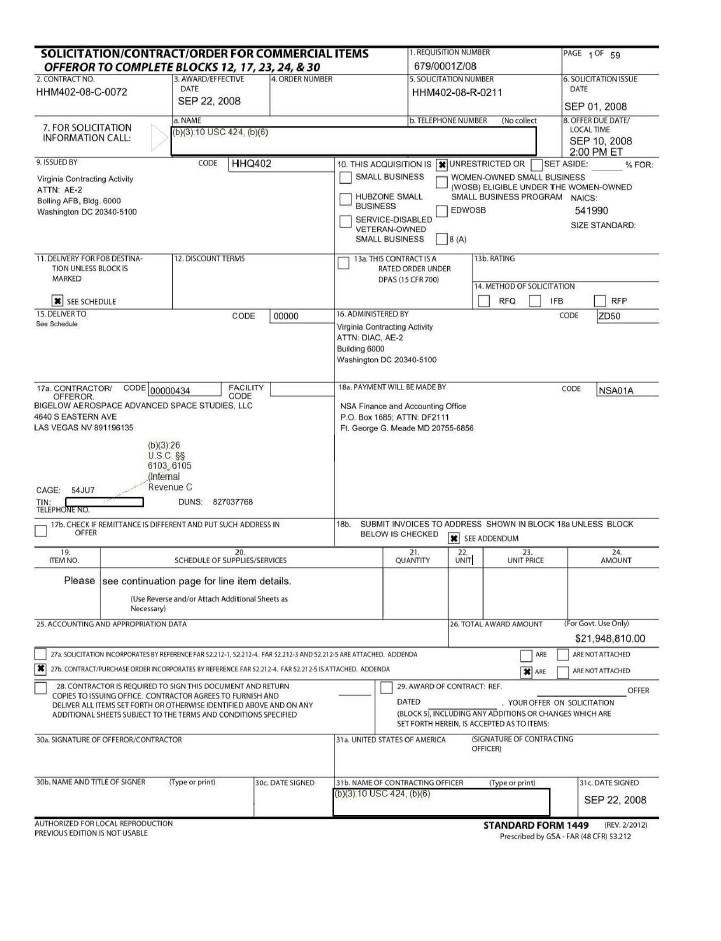 PDF
DoD / AARO · Washington, D.C.
DOW-UAP-D111, AAWSAP Solicitation and Original Order, September 2008
This document is an administrative or programmatic record related to the Advanced Aerospace Weapon System Applications Program (AAWSAP), a Defense Intelligence Agency (DIA)-administered program active from 2008 to 2012. AAWSAP’s official scope of work identified 12 technical research areas relating to potential aerospace threats over a time horizon of more than 40 years. As an administrative record, the file documents how AAWSAP was scoped, organized, tasked, funded, or described at a particular point in time. This September 2008 solicitation/contract/order document serves as the original contract award instrument for AAWSAP work performed by Bigelow Aerospace Advanced Space Studies, Inc. (BAASS), incorporating the contractor’s proposal by reference and translating the earlier Statement of Objectives (DOW-UAP-D110) into priced contract line items. The file breaks the base year into specific deliverable categories, including monthly status reports, program management plans for the 12 technical areas, research reports, a comprehensive integrated threat assessment, travel, and other direct costs, and corresponding option-year line items for follow-on performance.
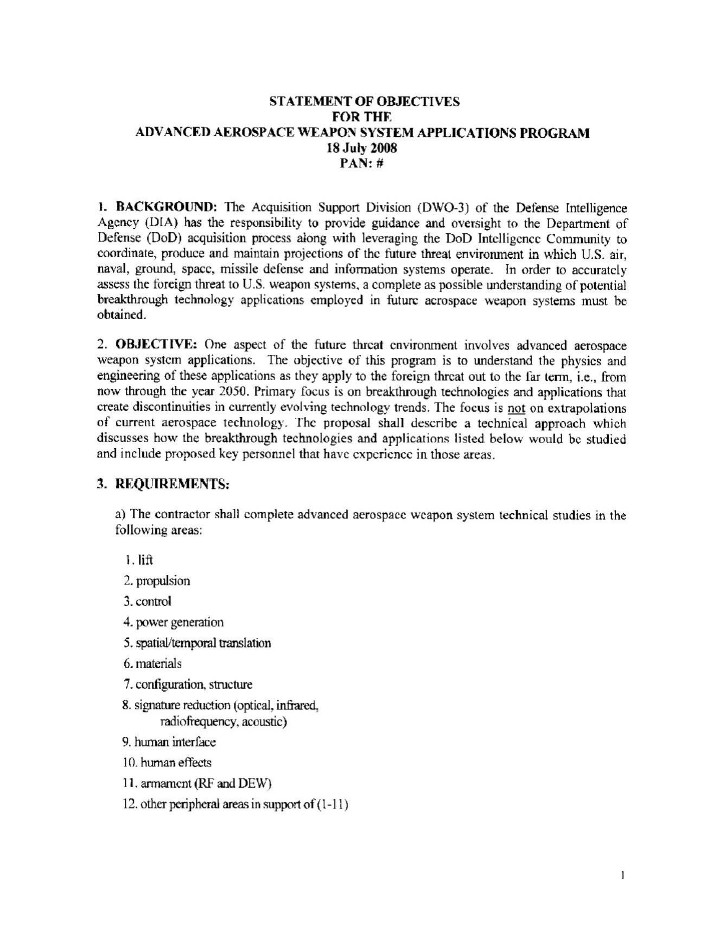 PDF
DoD / AARO · Washington, D.C.
DOW-UAP-D110, AAWSAP Statement of Objectives, July 2008
This document is an administrative or programmatic record related to the Advanced Aerospace Weapon System Applications Program (AAWSAP), a Defense Intelligence Agency (DIA)-administered program active from 2008 to 2012. AAWSAP’s official scope of work identified 12 technical research areas relating to potential aerospace threats over a time horizon of more than 40 years. As an administrative record, the file documents how AAWSAP was scoped, organized, tasked, funded, or described at a particular point in time. This July 2008 Statement of Objectives defines AAWSAP as a contractor-supported research effort intended to assess far-term foreign aerospace threats by understanding the physics and engineering of possible breakthrough technologies out to the year 2050 rather than extrapolating from then-current aerospace trends. It identifies 12 technical study areas, including lift, propulsion, control, power generation, spatial or temporal translation, materials, configuration and structure, signature reduction, human interface, human effects, armament, and related supporting topics. The document also sets out the program’s expected work structure, requiring monthly status reports, technical-area program management plans within 60 days, comprehensive research reports and briefings by the tenth month, and a final integrated threat assessment.
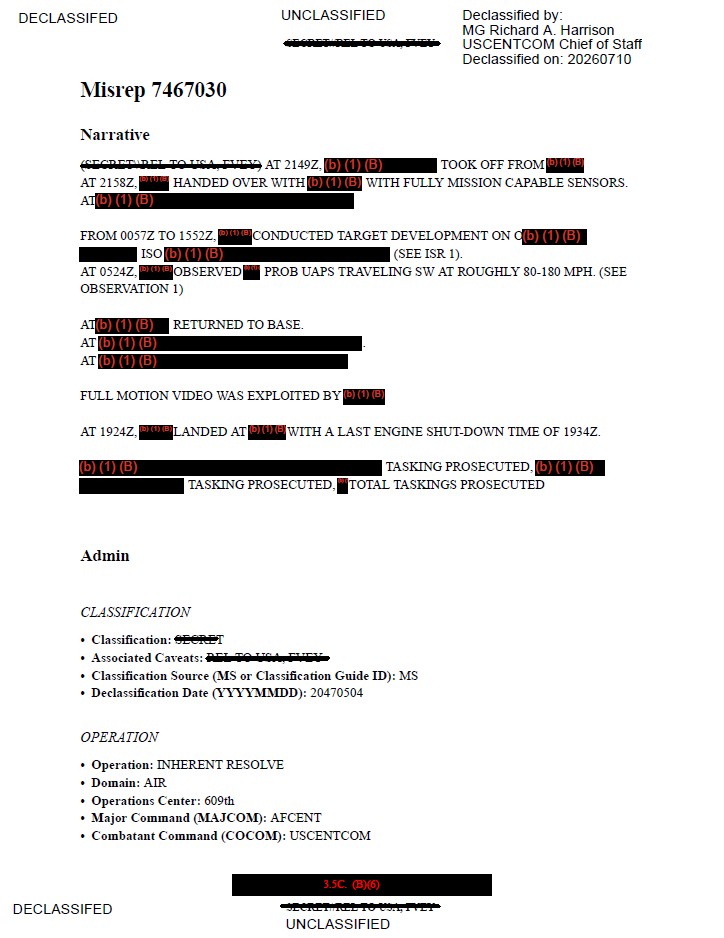 PDF
DoD / AARO · Iraq
DOW-UAP-D109, Mission Report, Middle East, 2022
This document is a Mission Report (MISREP), a standardized reporting form the U.S. military uses to record the circumstances surrounding its operations. U.S. military services often use MISREPs to report unidentified anomalous phenomena (UAP) to the All-domain Anomaly Resolution Office (AARO). The GENTEXT, or “general text” section of these reports often contains important qualitative, contextual information, distinguishing it from the more quantitative, or numerical, data found elsewhere in the report. This mission report accompanies video footage derived from an infrared system aboard a U.S. military platform in 2022 (DOW-UAP-PR140 and DOW-UAP-PR141). A U.S. military operator reported observing UAP, describing it as consisting of “six small spherical objects grouped together. They characterized the behavior of the UAP as “seem[ingle] agile,” and “frequently changing direction.” The reporter estimated the speed of the UAP to have been 480 miles per hour. All descriptive and estimative language contained in this report reflects the reporter’s subjective interpretation at the time of the event. Such characterizations should not be interpreted as a conclusive indication of the presence or absence of any intrinsic object features or performance characteristics.
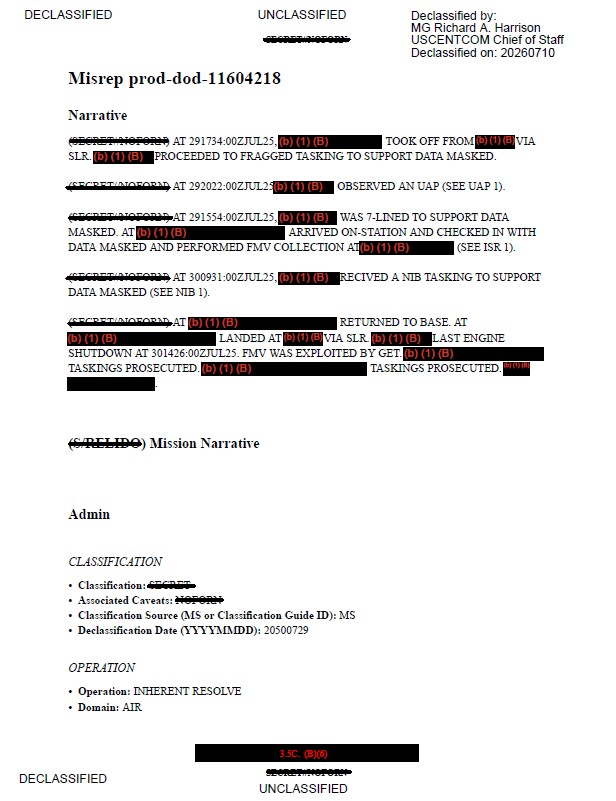 PDF
DoD / AARO · Middle East
DOW-UAP-D108, Mission Report, Middle East, 2025
This document is a Mission Report (MISREP), a standardized reporting form the U.S. military uses to record the circumstances surrounding its operations. U.S. military services often use MISREPs to report unidentified anomalous phenomena (UAP) to the All-domain Anomaly Resolution Office (AARO). The GENTEXT, or “general text” section of these reports often contains important qualitative, contextual information, distinguishing it from the more quantitative, or numerical, data found elsewhere in the report. This mission report accompanies video footage derived from an infrared system aboard a U.S. military platform in 2025 (DOW-UAP-PR135). A U.S. military operator reported observing UAP, describing it as consisting of “six small spherical objects grouped together, and characterized their behavior as “seem[ingle] agile,” and “frequently changing direction.” The reporter estimated the speed of the UAP to have been 480 miles per hour. All descriptive and estimative language contained in this report reflects the reporter’s subjective interpretation at the time of the event. Such characterizations should not be interpreted as a conclusive indication of the presence or absence of any intrinsic object features or performance characteristics.
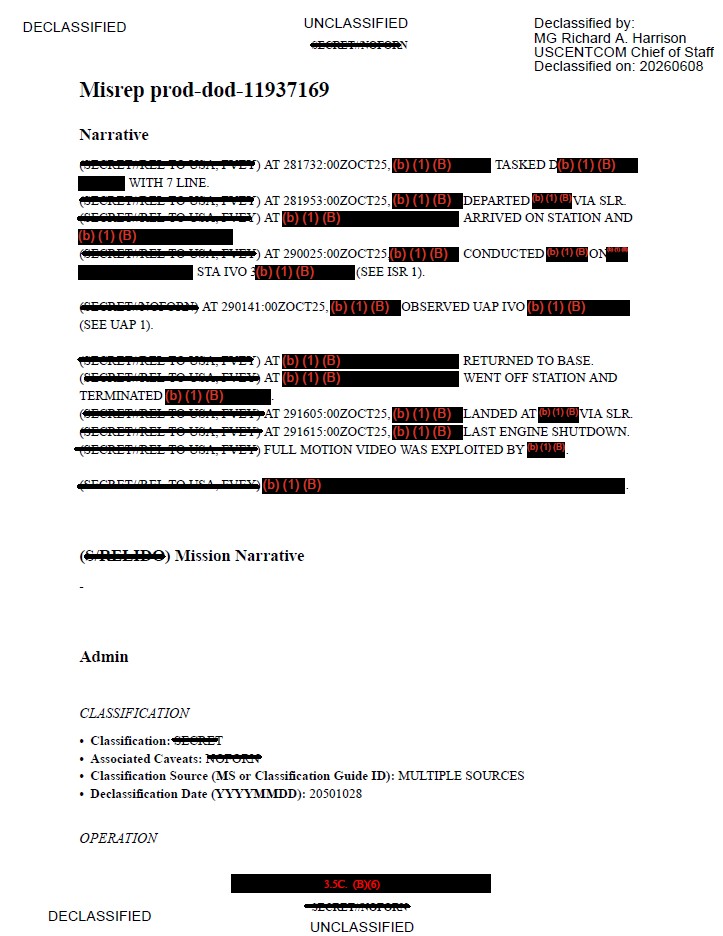 PDF
DoD / AARO · Middle East
DOW-UAP-D107, Mission Report, Middle East, 2025
This document is a Mission Report (MISREP), a standardized reporting form the U.S. military uses to record the circumstances surrounding its operations. U.S. military services often use MISREPs to report unidentified anomalous phenomena (UAP) to the All-domain Anomaly Resolution Office (AARO). The GENTEXT, or “general text” section of these reports often contains important qualitative, contextual information, distinguishing it from the more quantitative, or numerical, data found elsewhere in the report. This mission report accompanies video footage derived from an infrared system aboard a U.S. military platform in 2025 (DOW-UAP-PR133). A U.S. military operator reported observing UAP, describing it as “look[ing] like a white round orbit… moving as fast as 500 miles per hour.” All descriptive and estimative language contained in this report reflects the reporter’s subjective interpretation at the time of the event. Such characterizations should not be interpreted as a conclusive indication of the presence or absence of any intrinsic object features or performance characteristics.
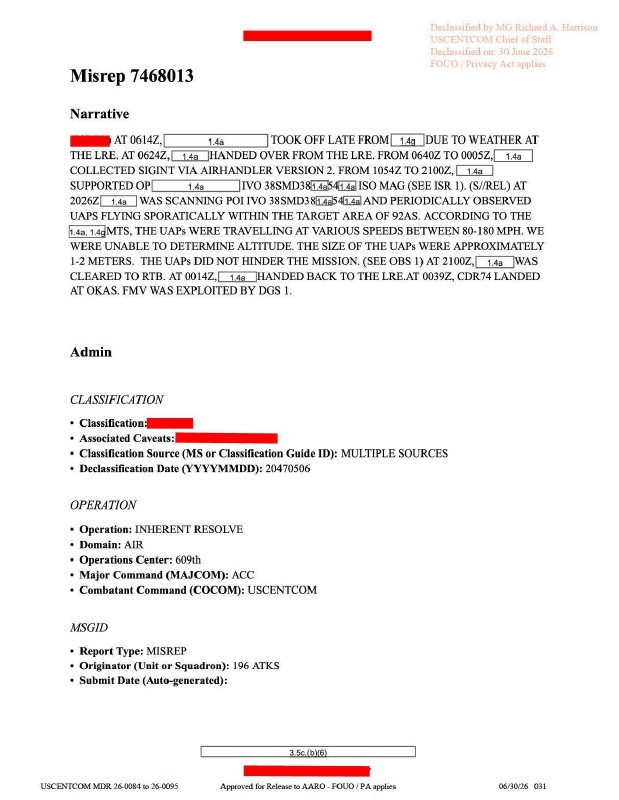 PDF
DoD / AARO · Iraq
DOW-UAP-D106, Mission Report, Iraq, 2022
This document is a Mission Report (MISREP), a standardized reporting form the U.S. military uses to record the circumstances surrounding its operations. U.S. military services often use MISREPs to report unidentified anomalous phenomena (UAP) to the All-domain Anomaly Resolution Office (AARO). The GENTEXT, or “general text” section of these reports often contains important qualitative, contextual information, distinguishing it from the more quantitative, or numerical, data found elsewhere in the report. This mission report accompanies still imagery derived from an infrared system aboard a U.S. military platform in 2022 (DOW-UAP-PR130 and DOW-UAP-PR 131). A U.S. military operator reported observing UAP “flying sporadically within the target area… at various speeds between 80 and 180 miles per hour.” The reporter estimates the size of the UAP as between 1 and 2 meters (approximately 3-6 feet), and states that they were unable to determine the altitude of the phenomena. All descriptive and estimative language contained in this report reflects the reporter’s subjective interpretation at the time of the event. Such characterizations should not be interpreted as a conclusive indication of the presence or absence of any intrinsic object features or performance characteristics.
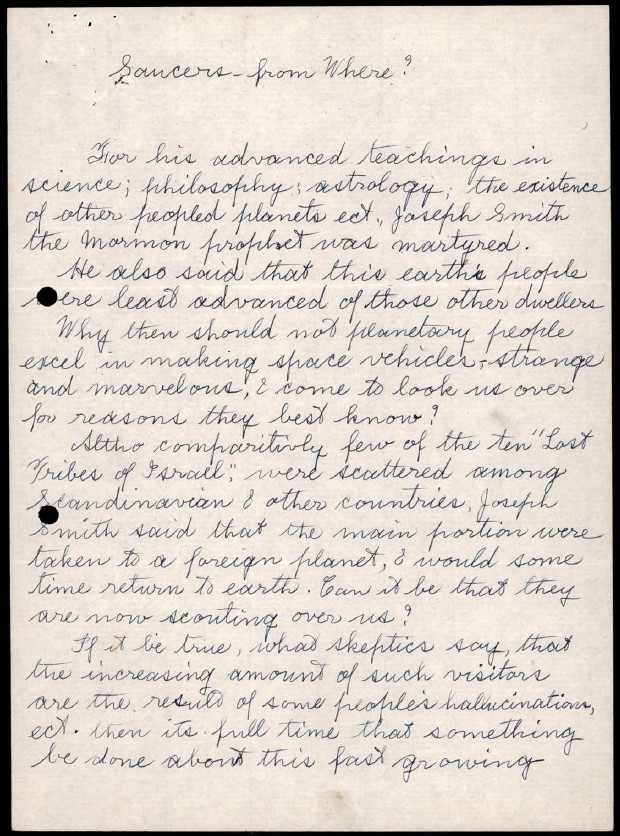 PDF
DoD / AARO · Various
DOW-UAP-D105, U.S. Air Force Flying Discs File, 1952
This file is an archival collection of U.S. Air Force Director of Intelligence records relating to reported “flying disc” incidents during the period from September through December 1952. Drawn from multiple governmental and non-governmental sources, it compiles a wide range of material associated with reported sightings and official handling of those observations, rather than presenting a single analytical conclusion on the nature or origin of “flying discs.” The contents include correspondence, memoranda, reporting forms, case summaries, distribution and routing material, and other administrative or intelligence-related documentation tied to flying-disc reporting and review during that period. Pages 26-36 of the file refer to an incident reported near Tremonton, Utah, in July 1952, in which a U.S. Navy Warrant Officer recorded film of unidentified objects that the Air Force later assessed were likely seabirds. Overall, the file is a broad documentary collection reflecting how such reports were recorded, circulated, and evaluated in late 1952.
 PDF
DoD / AARO
DOW-UAP-D104, Final Personnel Record for Newhouse, Delbert C., U.S. Navy, 1957
This file contains the final personnel record of U.S. Navy Chief Warrant Officer Delbert C. Newhouse, who left naval service as a Chief Warrant Officer 4, then the highest Warrant Officer grade. In July 1952, Newhouse recorded 16mm motion-picture film near Tremonton, Utah; the film later became the subject of a Project Blue Book investigation. Project Blue Book was the U.S. Air Force program active from 1952 to 1969 that investigated the nature and origin of unidentified flying objects (UFOs). In addition to documenting routine assignments and training, the file records Newhouse’s career progression as a Photographer’s Mate, a Navy enlisted specialty responsible for photography and related imaging work. Project Blue Book investigators characterized Newhouse as an expert photographer based on his naval experience.
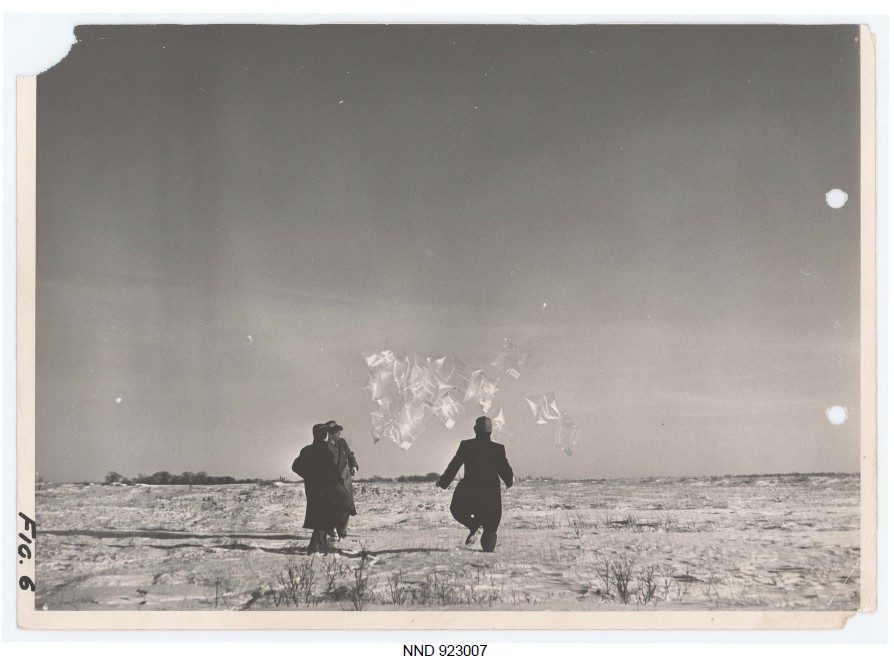 PDF
DoD / AARO · Tremonton, Utah
DOW-UAP-D103, Project Blue Book Photo File Relating to Tremonton Film, Utah, 1952
During its investigation of a July 1952 film of an incident reported near Tremonton, Utah, Project Blue Book examined whether the objects recorded on film might have been “pillow balloons.” Project Blue Book was a U.S. Air Force program active from 1952 to 1969 that investigated the nature and origin of unidentified flying objects (UFOs). In December 1952, investigators contacted General Mills, Inc., the only known manufacturer of pillow balloons at the time, to determine whether a balloon release could account for the incident. The file includes example imagery of pillow balloons supplied by General Mills Research Laboratories. In late December 1952, Project Blue Book personnel, balloon specialists, and representatives from General Mills reviewed the Tremonton footage. The group’s consensus was that the objects closely resembled pillow balloons in flight and behaved consistently with that explanation. One General Mills representative was less convinced, noting that the objects appeared somewhat too bright and seemed to maneuver too rapidly. The reviewers also questioned previous angular-velocity calculations suggesting that the objects moved at a high rate of speed because those calculations depended on the unverified assumption that the camera operator had held the camera still during filming. Subsequent efforts to identify a pillow-balloon release in the Tremonton area were unsuccessful. The file also considered seabirds as a possible explanation, citing similar films showing seabirds as bright points of light under comparable conditions. Later Air Force assessments favored the seabird attribution.
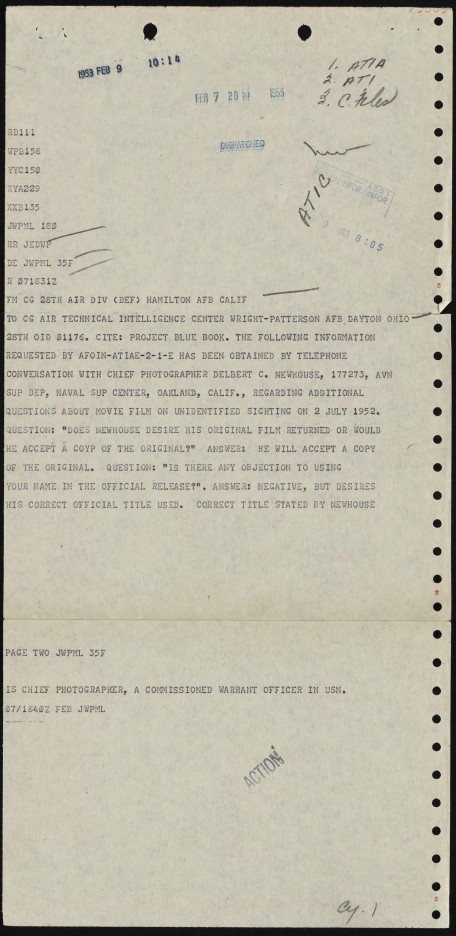 PDF
DoD / AARO · Tremonton, Utah
DOW-UAP-D102, Project Blue Book File on Tremonton Film, Utah, 1952
This document records the Project Blue Book investigation and subsequent assessments of an incident near Tremonton, Utah, on July 2, 1952. Project Blue Book was a 1952-1969 U.S. Air Force program to investigate the nature and origin of unidentified flying objects (UFOs). The file describes the Air Force’s assessment of the principal witness, Delbert C. Newhouse, a U.S. Navy Warrant Officer specializing in photography, as honest and reliable, and as an expert with more than 1,000 hours of aerial-photography experience. Newhouse reported observing 12 to 14 reflective objects and recorded the event on color motion-picture film using a handheld Bell & Howell Auto Master camera. The file reflects an evolving Air Force assessment of the imagery over several years. Early documentation considered several possible explanations, including sunlight reflecting from birds or balloons, and a mirage effect, and did not identify the objects conclusively. Later assessments became more confident that the objects were seabirds reflecting sunlight, citing identifiable seabirds and similar films showing seabirds as bright points of light under comparable conditions. However, the film’s limited detail and lack of fixed reference points prevented reliable determination of the objects’ distance, size, altitude, or linear speed from the film alone. AARO Comment: The file contains conflicting references to the film format. Several documents describe a 35mm film, while contemporaneous submission documentation identifies the original as a 50-foot roll of processed 16mm Kodachrome color motion-picture film recorded with a handheld Bell & Howell Auto Master camera. Newhouse reported exposing approximately 30 feet of the roll during the incident and using the remaining film later that day to record unrelated mountain scenery in Idaho. Other records show that 35mm positive and negative duplicate blowups were produced from the original 16mm material. The file also indicates that the original film was duplicated for preservation, citing its deteriorating condition. The footage retained by the National Archives and Records Administration and presented in this collection as DOW-UAP-PR159 is a digitization of a 16mm print.
Released August 7, 2026 · U.S. Department of War
22 records in this release
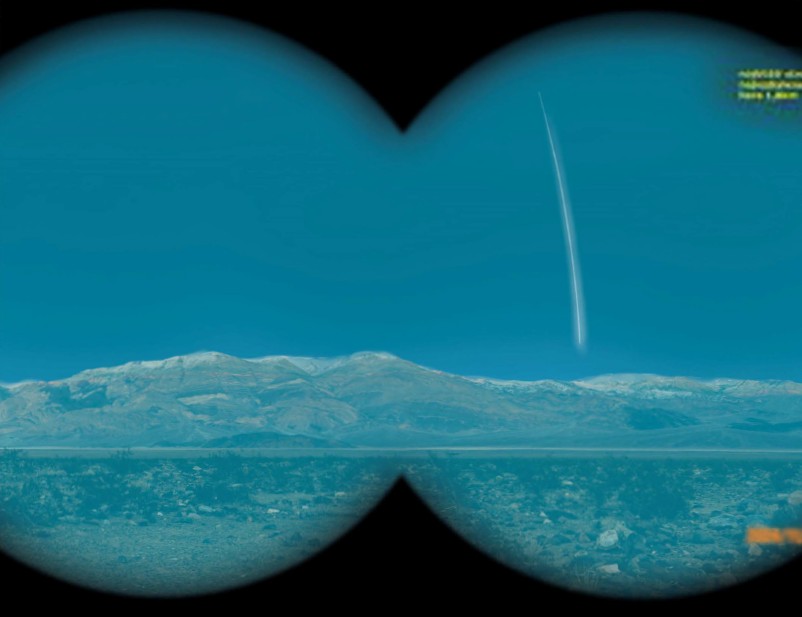 PDF
FBI · Western United States
FBI-UAP-D042, Digital Rendering 2, “Multiple Red Lights,” 2026
This image is an artistic interpretation of a reported incident potentially involving unidentified anomalous phenomena (UAP) in the western United States in 2026. This image is based upon a first-hand description provided by two U.S. persons, as described in FBI-UAP-D040. The Federal Bureau of Investigation prepared this digital rendering in 2026 as a visual aid in support of the PURSUE initiative.
 PDF
FBI · Western United States
FBI-UAP-D041, Digital Rendering 1, “Multiple Red Lights,” 2026
This image is an artistic interpretation of a reported incident potentially involving unidentified anomalous phenomena (UAP) in the western United States in 2026. This image is based upon a first-hand description provided by two U.S. persons, as described in FBI-UAP-D040. The Federal Bureau of Investigation (FBI) prepared this digital rendering in 2026 as a visual aid in support of the PURSUE initiative.
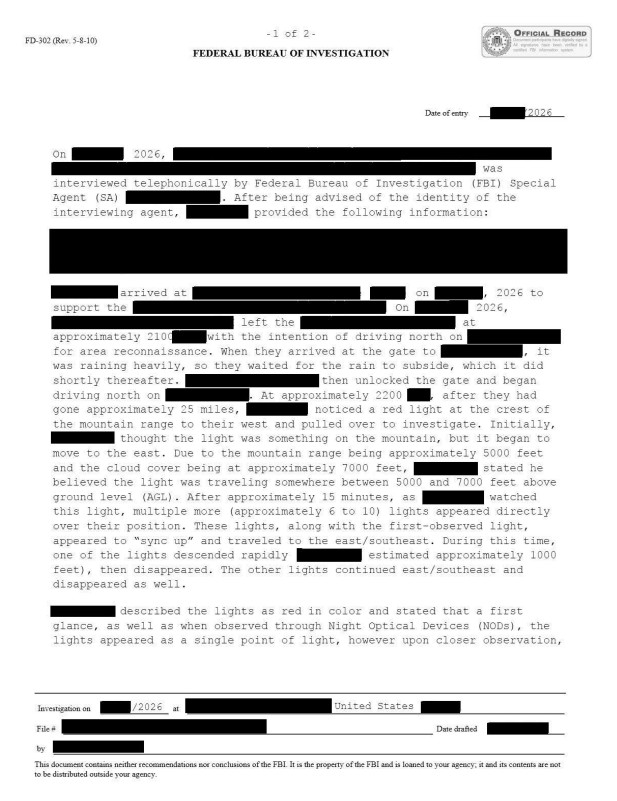 PDF
FBI · Western United States
FBI-UAP-D040, FD-302, “Multiple Red Lights,” 2026
This document is an FBI FD-302, a form the Federal Bureau of Investigation (FBI) uses to record interviews. This FD-302 records a 2026 telephonic interview with a U.S. person, in which the interviewee describes two incidents potentially involving unidentified anomalous phenomena (UAP) in the western United States in 2026. A second individual who was present during the incidents at the time also provided an interview, recorded in this collection as “FBI-UAP-D037.” Two FBI digital renderings based upon the observers’ descriptions accompany this document, under the titles FBI-UAP-D041 and FBI-UAP-D042.
 PDF
FBI · Western United States
FBI-UAP-D039, Digital Rendering 2, “Multiple Red Lights,” 2026
This image is an artistic interpretation of a reported incident potentially involving unidentified anomalous phenomena (UAP) in the western United States in 2026. This image is based upon a first-hand description provided by two U.S. persons, as described in FBI-UAP-D037. The Federal Bureau of Investigation prepared this digital rendering in 2026 as a visual aid in support of the PURSUE initiative.
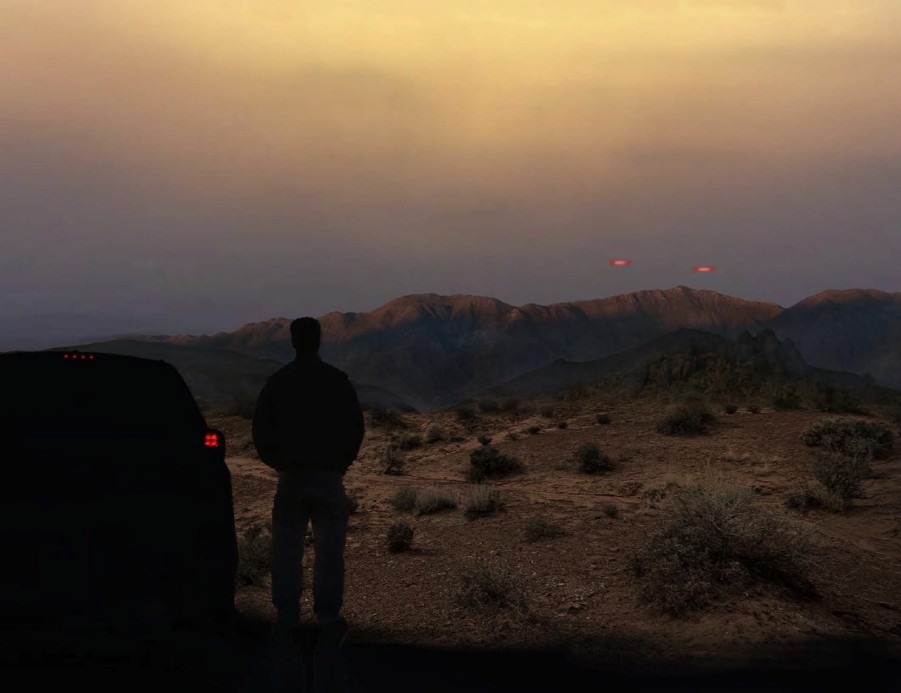 PDF
FBI · Western United States
FBI-UAP-D038, Digital Rendering 1, “Multiple Red Lights,” 2026
This image is an artistic interpretation of a reported incident potentially involving unidentified anomalous phenomena (UAP) in the western United States in 2026. This image is based upon a first-hand description provided by two U.S. persons, as described in FBI-UAP-D037. The Federal Bureau of Investigation prepared this digital rendering in 2026 as a visual aid in support of the PURSUE initiative.
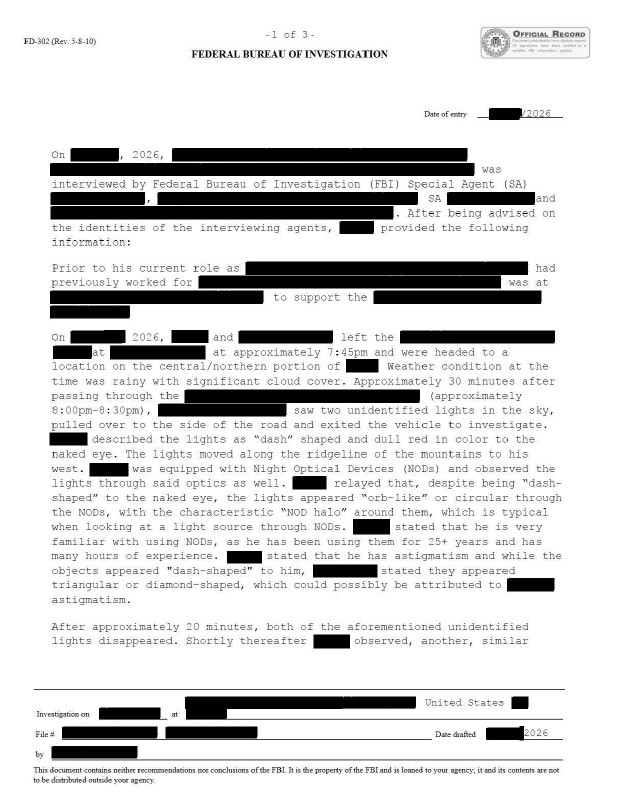 PDF
FBI · Western United States
FBI-UAP-D037, FD-302, “Multiple Red Lights,” 2026
This document is an FBI FD-302, a form the Federal Bureau of Investigation (FBI) uses to record interviews. This FD-302 records a 2026 interview with a U.S. person, in which the interviewee describes three incidents potentially involving unidentified anomalous phenomena (UAP) in the western United States occurring within a 5-hour period in 2026. A second individual who was present at the time also provided an interview, recorded in this collection as “FBI-UAP-D040.” Two FBI digital renderings based upon the observer’s descriptions accompany this document, under the titles FBI-UAP-D038 and FBI-UAP-D039.
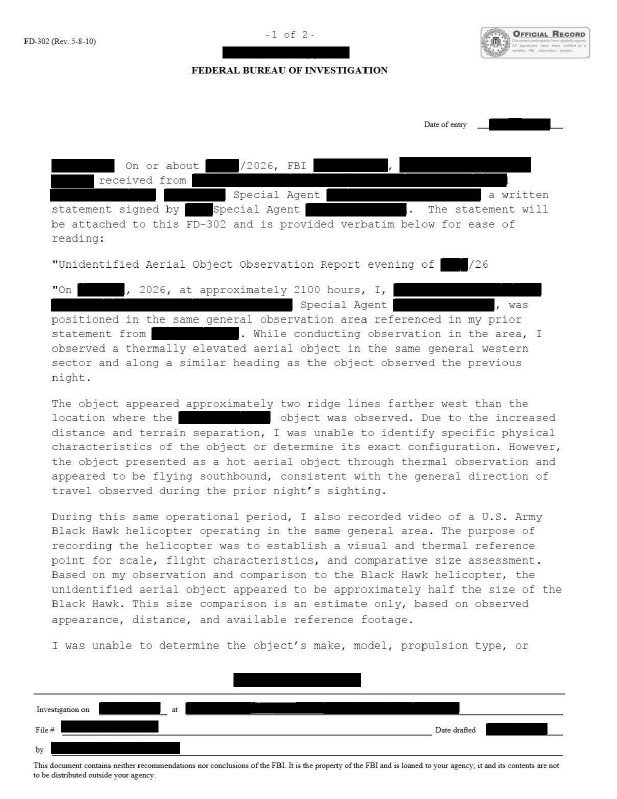 PDF
FBI · Western United States
FBI-UAP-D033, FD-302, “Thermally Elevated Aerial Object,” 2026
This document is an FBI FD-302, a form the Federal Bureau of Investigation (FBI) uses to record interviews. This FD-302 records a 2026 interview with a U.S. Government Special Agent, in which the interviewee describes an incident potentially involving unidentified anomalous phenomena (UAP) in the western United States, at approximately 9:00 PM local time, in 2026.
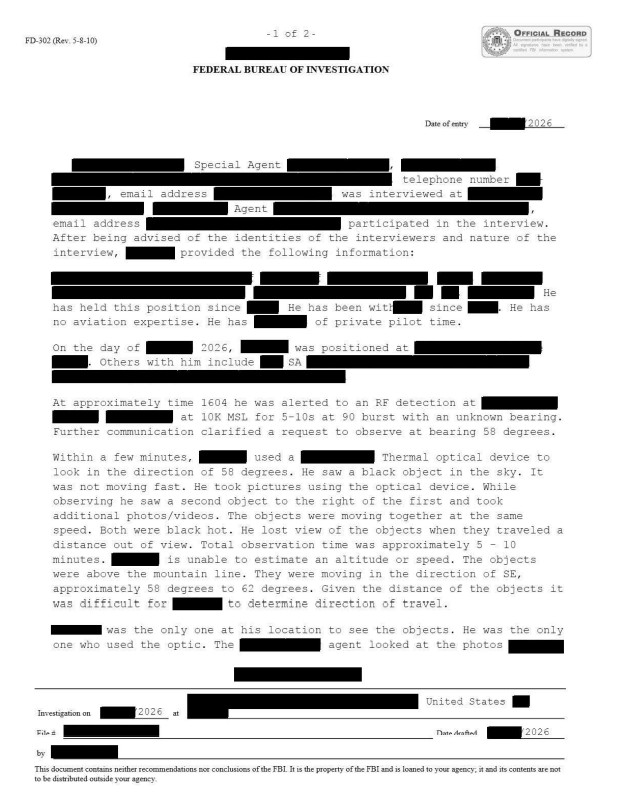 PDF
FBI · Western United States
FBI-UAP-D032, FD-302, “Slow-moving Objects,” 2026
This document is an FBI FD-302, a form the Federal Bureau of Investigation (FBI) uses to record interviews. This FD-302 records a 2026 interview with a U.S. Government Special Agent, in which the interviewee describes an incident potentially involving unidentified anomalous phenomena (UAP) in the western United States, at approximately 4:00 PM local time, in 2026. This FD-302 is accompanied by video footage captured during the incident, under the title FBI-UAP-PR007.
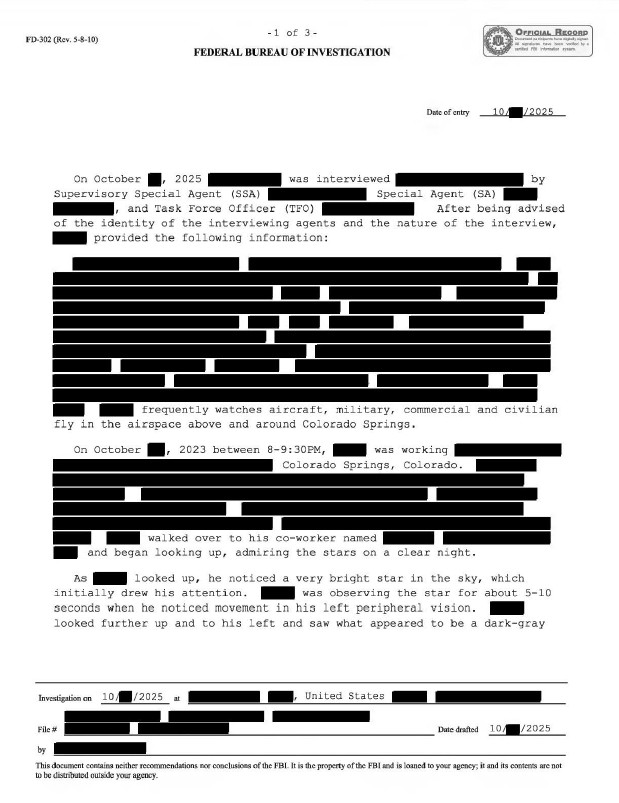 PDF
FBI · Colorado Springs, Colorado
FBI-UAP-D030, FD-302, “Large Triangle with Red Lights,” 2023
This document is an FBI FD-302, a form the Federal Bureau of Investigation (FBI) uses to record interviews. This FD-302 records an October 2025 interview with a U.S. Person, in which the interviewee describes an incident potentially involving unidentified anomalous phenomena (UAP) in Colorado Springs, Colorado, in October 2023. An FBI digital rendering based upon the observer’s description accompanies this document, under the title FBI-UAP-D031.
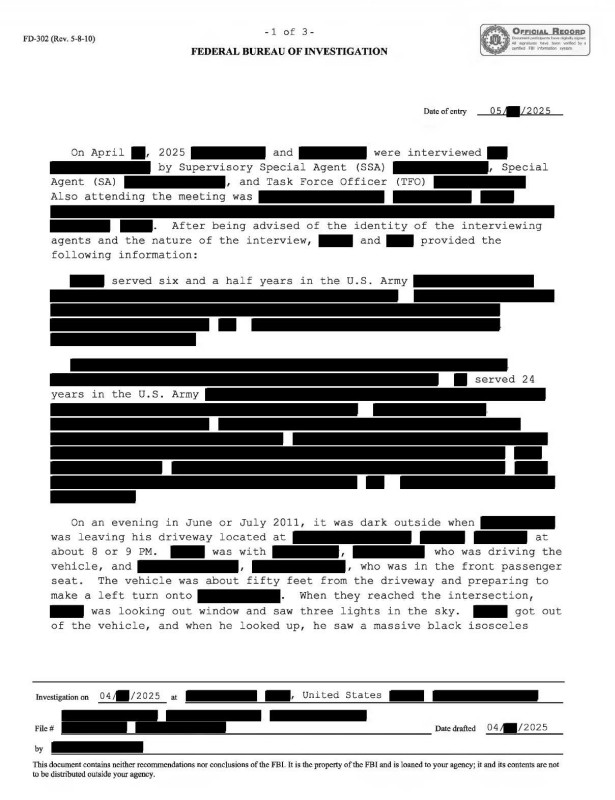 PDF
FBI
FBI-UAP-D028, FD-302, “Dark Triangle with Lights,” 2011
This document is an FBI FD-302, a form the Federal Bureau of Investigation (FBI) uses to record interviews. This FD-302 records an April 2025 interview with two former U.S. military service members, in which the interviewees describe an incident potentially involving unidentified anomalous phenomena (UAP) in June or July of 2011. An FBI digital rendering based upon the observers’ descriptions accompanies this document, under the title FBI-UAP-D029.
 PDF
FBI · Colorado Springs, Colorado
FBI-UAP-D027, Digital Rendering, “Dark Translucent Triangle,” 2023
This image is an artistic interpretation of a reported incident near Colorado Springs, Colorado, potentially involving unidentified anomalous phenomena (UAP) in October 2023. This image is based upon a first-hand description provided by a former Department of War employee, as described in FBI-UAP-D026. The Federal Bureau of Investigation prepared this digital rendering in 2026 as a visual aid in support of the PURSUE initiative.
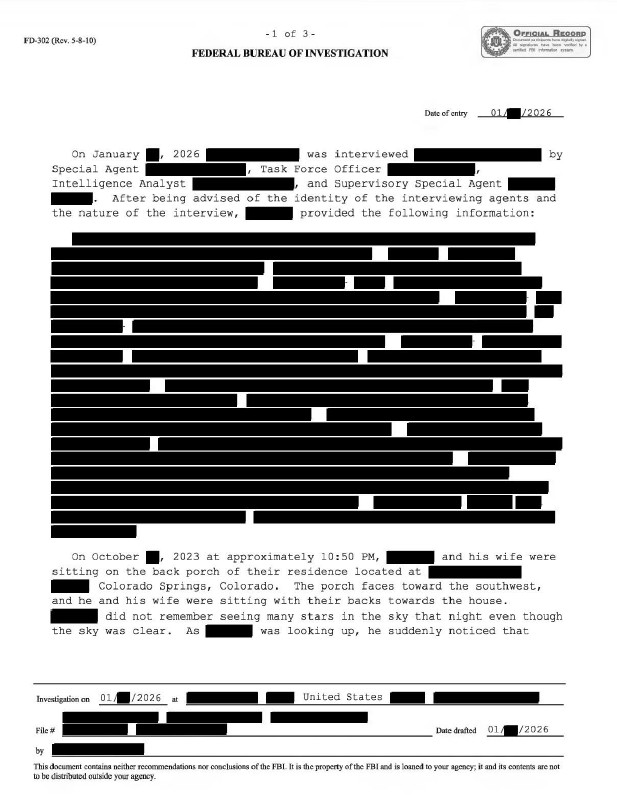 PDF
FBI · Colorado Springs, Colorado
FBI-UAP-D026, FD-302, “Dark Translucent Triangle,” 2023
This document is an FBI FD-302, a form the Federal Bureau of Investigation (FBI) uses to record interviews. This FD-302 records a January 2026 interview with a former employee of the Department of War, in which the interviewee describes an incident potentially involving unidentified anomalous phenomena (UAP) in Colorado Springs, Colorado, in October 2023. An FBI digital rendering based upon the observer’s description accompanies this document, under the title FBI-UAP-D027.
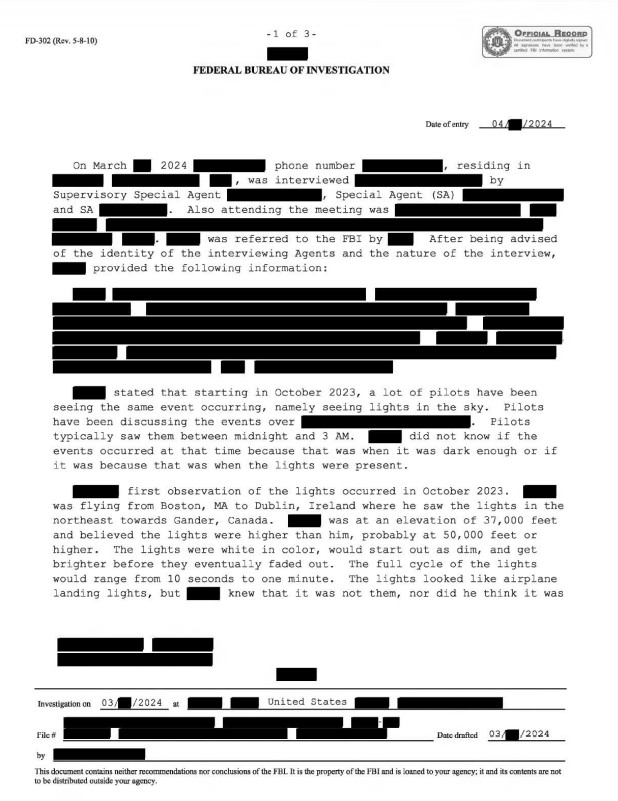 PDF
FBI · Northeastern U.S.; Afghanistan
FBI-UAP-D024, FD-302, “Airborne Lights and Triangle,” 2002, 2023-2024
This document is an FBI FD-302, a form the Federal Bureau of Investigation (FBI) uses to record interviews. This FD-302 records a March 2024 interview with a former U.S. military pilot, in which the interviewee describes several incidents potentially involving unidentified anomalous phenomena (UAP) in 2023 and 2024. The interviewee also recalls a 2002 incident potentially involving UAP, while deployed as a military reservist in Afghanistan. An FBI digital rendering based upon the observer’s description accompanies this document, under the title FBI-UAP-D025.
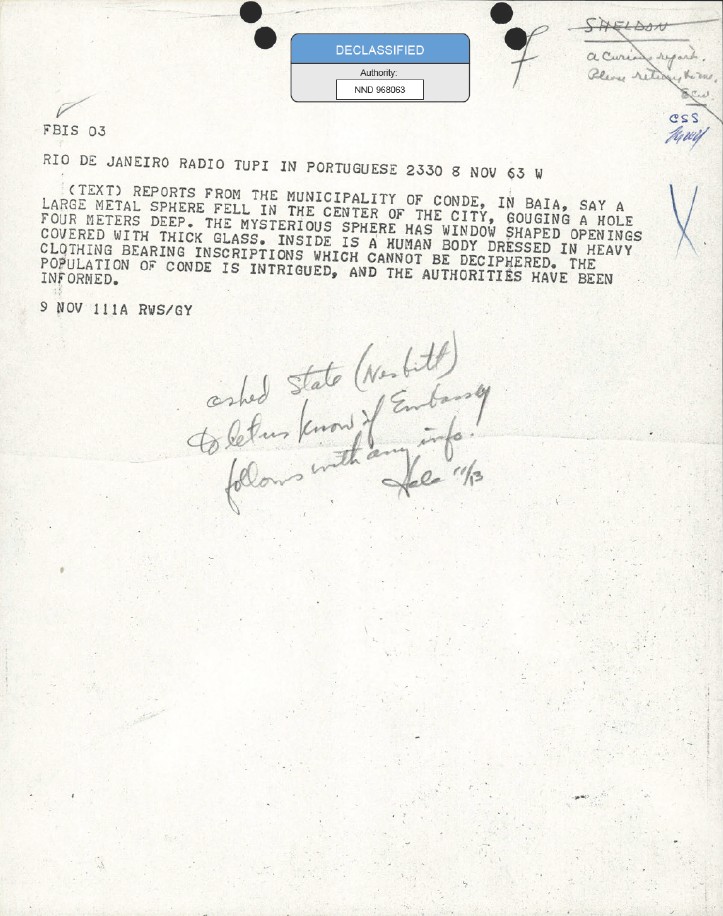 PDF
White House / EOP · Bahia, Brazil
EOP-UAP-D001, NASC Inquiry into Bahia, Brazil Incident, November 13, 1963
This document is a Central Intelligence Agency (CIA) Foreign Broadcast Information Service (FBIS) wire report dated November 9, 1963, tracking a local Portuguese-language radio broadcast from Rio de Janeiro, Brazil, regarding an alleged crash of a “large metal sphere” containing a deceased occupant in Conde, Bahia, Brazil. This FBIS report is excerpted from the files of Edward C. Welsh, Executive Secretary of the National Aeronautics and Space Council (NASC). NASC was a cabinet-level advisory body within the Executive Office of the President responsible for coordinating U.S. space policy from 1958 to 1973. Handwritten annotations dated November 13, 1963, document a communication between officials at NASC and the U.S. Department of State. The note records a NASC request to a State Department official to query the U.S. Embassy in Rio de Janeiro for local verification of the reporting. This inter-agency request precedes a subsequent diplomatic cable sent by the Embassy the following day, cataloged in this collection under the title “DOS-UAP-D001.”
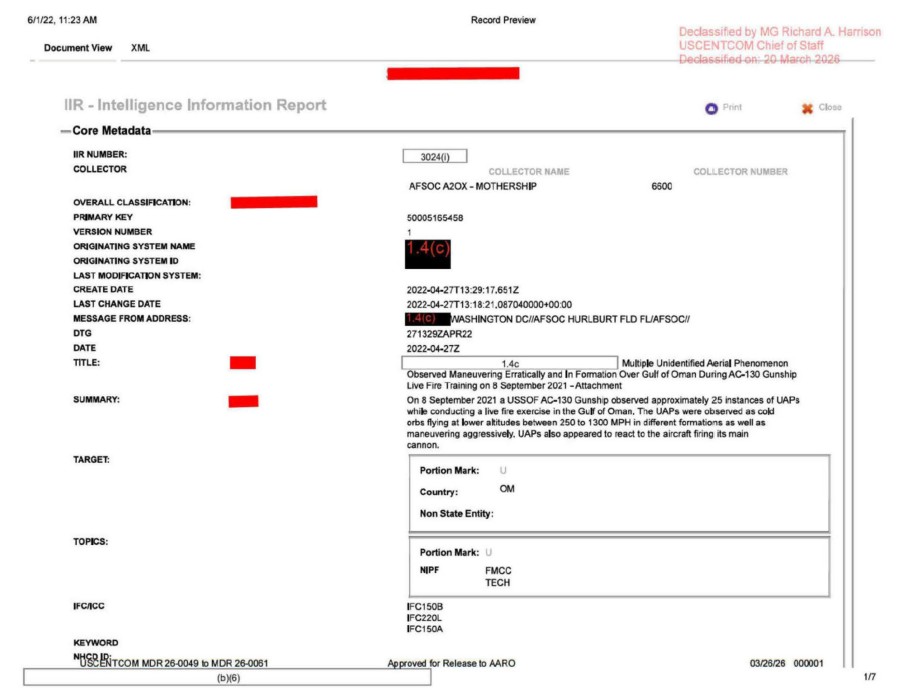 PDF
DoD / AARO
DOW-UAP-D101, Intelligence Information Report, Unresolved UAP Report, Gulf of Oman, 2021
This document is an Intelligence Information Report (IIR), the primary standardized format utilized by the Department of War, military services, and the broader Intelligence Community to disseminate unevaluated intelligence information derived from human sources (HUMINT), open sources, and field collection activities. IIRs are not finished intelligence products; they serve as inputs for subsequent all-source intelligence assessments. This report accompanies the footage contained within DOW-UAP-PR117 through DOW-UAP-PR122. This report documents an observation by the aircrew of a U.S. Special Operations Forces (USSOF) AC-130 Gunship on September 8, 2021, during a nighttime live-fire training exercise over the Gulf of Oman. The aircrew reported first observing two unidentified anomalous phenomena (UAP) after dropping a water-activated flare. The report describes the UAP as stationary, approximately four feet in diameter, 0-20 feet above the water’s surface. Throughout the training sortie, the aircrew reported observing approximately 25 instances involving similar phenomena via infrared sensor, describing them as “cold orbs.” Aircrew visual estimates of the UAP’s apparent speed range from 250 to 1,300 miles per hour. The report characterizes the UAP’s behavior as “maneuvering aggressively,” “flying in various formations,” and appearing to react to deployments of the aircraft’s onboard weapons systems. The aircrew stated that they were unable to capture video footage of the phenomena because the aircraft’s digital video recorder was not functioning during the incident. All descriptive and estimative language contained in this report reflects the reporter’s subjective interpretation at the time of the event. Such characterizations should not be interpreted as a conclusive indication of the presence or absence of any intrinsic object features or performance characteristics.
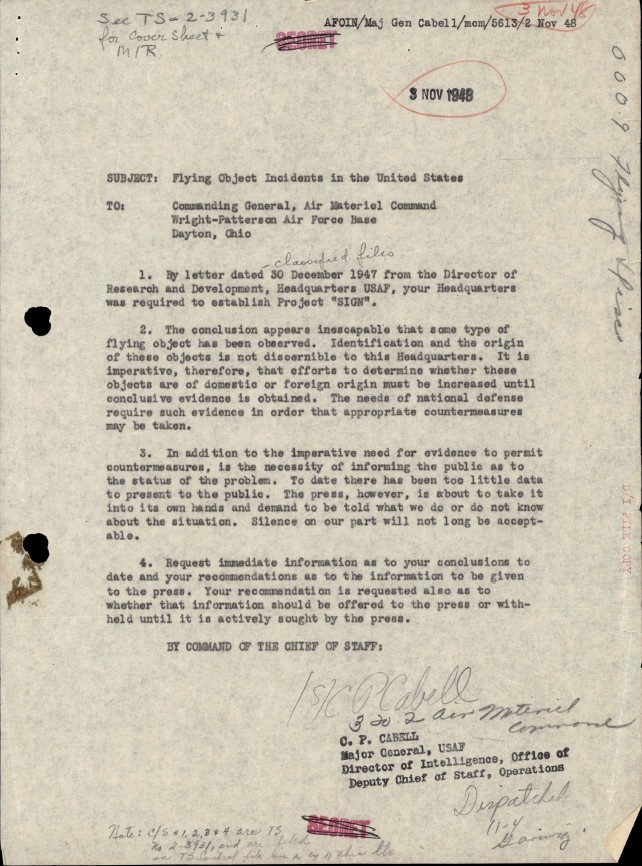 PDF
DoD / AARO
DOW-UAP-D100, Air Materiel Command Report on Unidentified Flying Objects, 1947-1948
This file is a collection of U.S. Government memoranda and correspondence relating to “Project Sign,” a 1948 U.S. Air Force program to investigate reports of high-performance airborne objects. The documents characterize some of these reports as being consistent with “real” objects rather than fabrications or resulting from perceptual errors. The U.S. Air Force cites the reported characteristics of the phenomena, e.g., high speed and maneuverability, as exceeding known performance envelopes of U.S. military aircraft and thereby presenting a potential national security threat, if validated. This potential threat prompted the Air Force to call on the Air Materiel Command (AMC), the Service’s Major Command for logistics and procurement from 1946 to 1961, to gather further evidence to assess the validity of the reports. The Air Force emphasized that there was an “imperative need” for such evidence to enable appropriate countermeasures. The stated urgency of this request reflects the strategic environment of the early Cold War, a period characterized by heightened national defense concerns amid rapid global advancements in aerospace design and development. In framing the call for an investigation, the Air Force noted that sustained public interest and persistent inquiries from the press may eventually require an official statement in response. AMC’s investigation found that observers were generally not mistaken when reporting that they had seen an airborne object, but that their characterizations of those objects as unusual was likely a reflection of the “limits of their personal experience.” It identified “a great many” of the objects reported with a rounded appearance as “weather or upper air scientific balloons of some type.” It also identified several cases in which the reported objects were most likely celestial phenomena, such as Venus. AMC found that a small number of reports lacked a “reasonable everyday explanation,” but that “so far, no physical evidence of the existence of the unidentified sightings has been obtained.” AMC expressly considered whether the phenomena may have been “vehicles from another planet,” but found no evidence supporting such an origin. Ultimately, AMC found that “there is as yet no conclusive proof that unidentified flying objects, other than those which are known to be balloons, are real aircraft.” In light of these findings, AMC recommended that the Department of War should avoid publicly commenting on the subject of “flying discs.” Responding to the Air Force’s anticipated concerns regarding public interest in the subject, AMC recommended that the Department should reply in terms that minimize the investigation’s inconclusive findings, focusing on positive determinations in cases assessed to be weather balloons and celestial phenomena.
 PDF
DoD / AARO · Sweden
DOW-UAP-D099, Intelligence Review of “Ghost Rocket” Incidents, 1947
This document is a U.S. Department of War General Staff intelligence review assessing incidents involving unidentified “Ghost Rockets” reported over Sweden and other Scandinavian countries beginning in May 1946. The review includes an analysis of observational reports, statements from the Swedish government, and reporting from the U.S. military attaché in Stockholm. The review highlights the inconclusive nature of the contemporary evidence available to substantiate reports from civilian and military observers. The review also documents a change in the public stance of the Swedish Defense Staff, which privately attributed the objects to Soviet V-1 missile tests launched from Peenemünde. Peenemünde is a then-occupied municipality in northeastern Germany that had been associated with the development of the V-1 and V-2 rocket program during World War II. The Swedish assessment publicly shifted from an unknown technological origin to one of a “celestial origin.” The review suggests that this shift was a deliberate effort to avoid diplomatic conflict with the Soviet Union. The report’s final assessment concludes that while most reported incidents were likely misidentified natural phenomena, the “best evidence” suggested a small number of “real incidents” involving low-flying V-1 type missiles, likely attributable to Soviet tests of captured German technology.
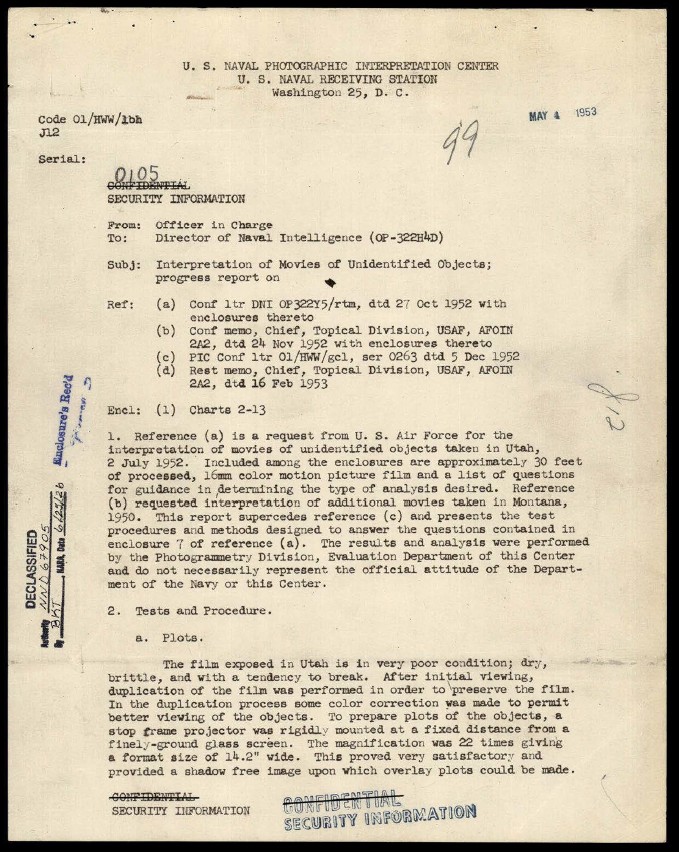 PDF
DoD / AARO · Montana, Utah
DOW-UAP-D098, Film Analysis of Unidentified Objects, 1953
This file contains a memorandum relating to the U.S. Naval Photographic Interpretation Center’s assessment of two films allegedly depicting unidentified airborne objects, captured in Montana and Utah in 1950 and 1952, respectively. The file documents the Center’s analytic process, assumptions that constrained its confidence level, tentative conclusions, and recommendations for future research. The Center assessed, generally, that the objects depicted in the film demonstrated characteristics that were inconsistent with those of natural phenomena or commonly known aerospace technologies. The memorandum documents the Center’s recommendation for a more well-resourced investigation to corroborate its presumptive findings, citing a lack of funding and personnel. The accompanying charts compare the film’s luminosity with the apparent angular size of the phenomena, using contemporary mathematical modeling and photogrammetric analysis techniques.
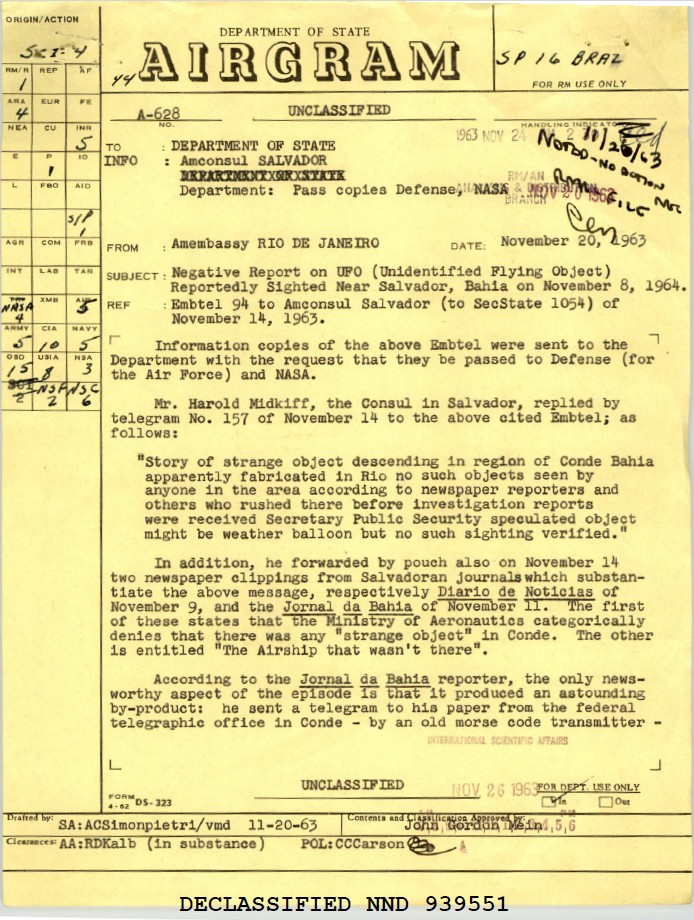 PDF
Department of State · Bahia, Brazil
DOS-UAP-D002, Diplomatic Cable, Brazil, November 20, 1963
This document is a U.S. Department of State diplomatic cable from the U.S. Embassy in Rio de Janeiro, Brazil to the Office of the Secretary of State in Washington, D.C., on November 20, 1963. This cable relays the findings of the scientific attaché at the American Consulate in Salvador, Bahia, Brazil, that a widely reported incident allegedly involving a crashed unidentified object was unsubstantiated, characterizing the reports as a fabrication originating in Rio de Janeiro. The Consulate cites a lack of contemporary local reporting regarding the alleged incident, as well as contradictory reporting from local newspapers after the fact, as evidence that the published claims are unsubstantiated. The Consulate also cites a statement from the Brazilian Ministry of Aeronautics categorically denying that there was “any “strange object” in Conde [Bahia].” This correspondence follows a previous exchange between the Embassy and the Department of State, included in this collection under the title “DOS-UAP-D001.”
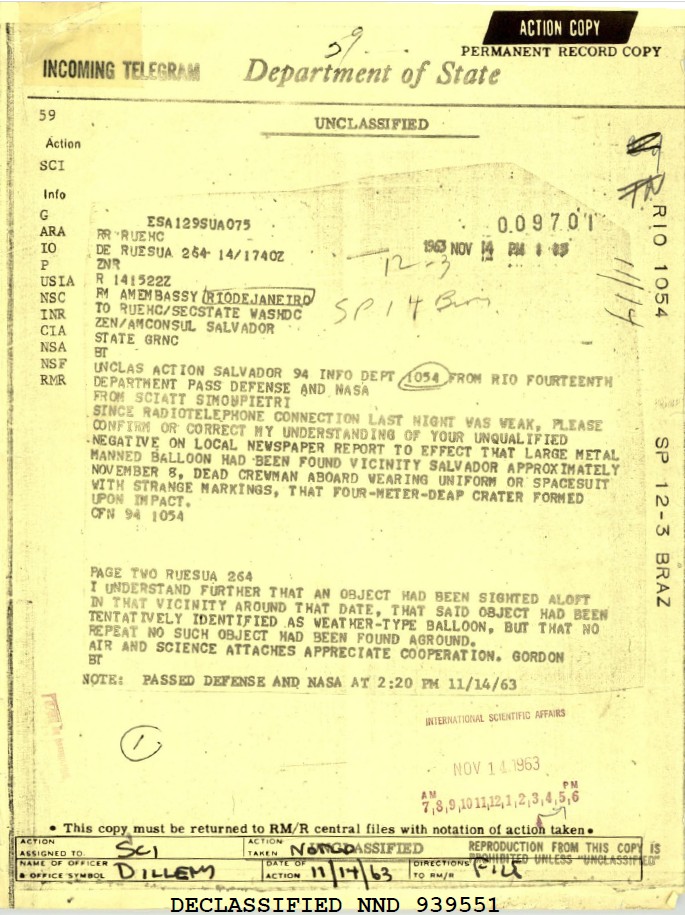 PDF
Department of State · Bahia, Brazil
DOS-UAP-D001, Diplomatic Cable, Brazil, November 14, 1963
This document is a U.S. Department of State diplomatic cable from the U.S. Embassy in Rio de Janeiro, Brazil to the Office of the Secretary of State in Washington, D.C., on November 14, 1963. This cable documents an effort by the Embassy to verify that the Department had assessed certain content published in a local newspaper as inauthentic, following a discussion on a poor-quality telephone connection the previous night. To ensure both offices were referencing the same reporting, the cable cites descriptive language paraphrased from the press, namely a “large metal manned balloon” and a “dead crewman aboard wearing [a] uniform or spacesuit with strange markings.” The cable concludes with the embassy’s understanding that an object assessed to be a weather balloon had been reported in the vicinity, but that no such object had been found to have crashed. A follow-on correspondence regarding the alleged incident is included in this collection under the title “DOS-UAP-D002.”
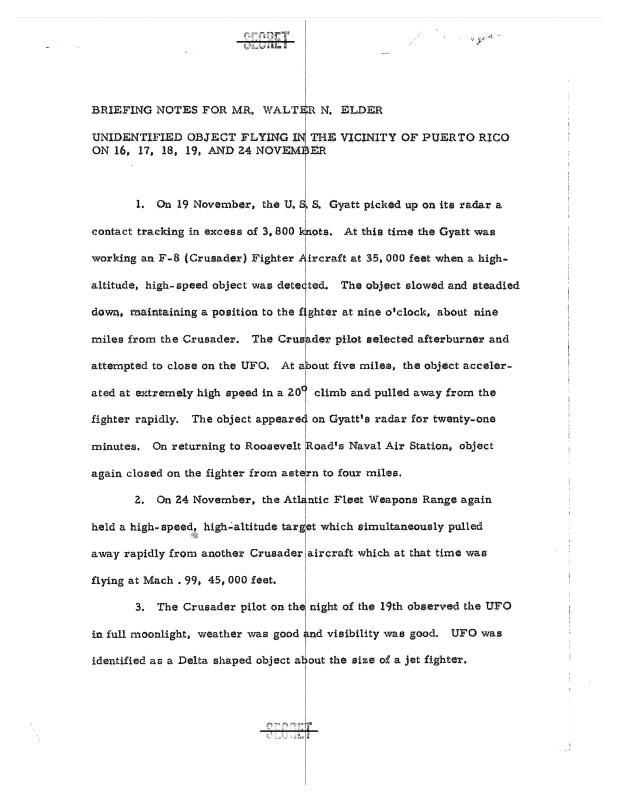 PDF
CIA · Caribbean Sea
CIA-UAP-D023, Briefing Notes for Mr. Walter Elder
This document contains briefing material prepared for Mr. Walter N. Elder, Executive Assistant to the Director of the Central Intelligence Agency (CIA), regarding a November 19, 1964, incident allegedly involving unidentified aircraft in the vicinity of Puerto Rico. The previous entry in this collection, CIA-UAP-D022, contains CIA memoranda on the same subject matter. The briefing includes additional details regarding that incident, including a characterization of the meteorological conditions and sensing capabilities of nearby U.S. military collection systems. The briefing states that a radar system aboard USS Gyatt, a guided missile destroyer operating in the vicinity, detected a contact tracking more than 3,800 knots (approximately 4,373 mph) over a period of 21 minutes. The briefing contains visual estimates regarding the phenomenon’s apparent capabilities from the pilot of an F-8 Crusader who was present during the incident.
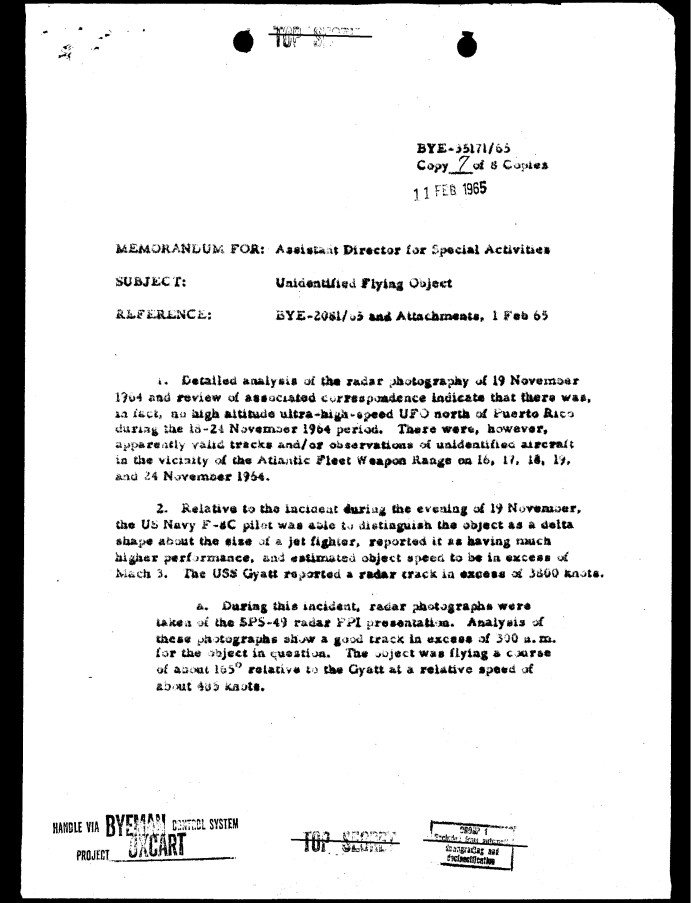 PDF
CIA · Caribbean Sea
CIA-UAP-D022, Unidentified Flying Object Reported near Puerto Rico, 1965
This file contains Central Intelligence Agency (CIA) memoranda exchanged between the Assistant Director for Special Activities (AD/SA) and the Assistant Director for Scientific Intelligence (AD/SI) regarding an incident allegedly involving unidentified aircraft in the vicinity of Puerto Rico. The AD/SI was then-responsible for analyzing foreign scientific advancements and technological threats, such as Soviet nuclear, chemical, and ballistic missile capabilities. The AD/SA managed the CIA’s classified overhead reconnaissance operations, including the deployment of advanced aircraft like the U-2 and A-12 OXCART. Together, these offices ensured the United States could both gather critical intelligence over contested territories and accurately evaluate the technical capabilities of foreign adversaries during the Cold War. The memoranda refer to an incident on November 19, 1964, in which a U.S. Naval aviator described observing an unidentified object as “delta-shaped, about the size of a jet fighter.” The pilot visually estimated the object’s velocity as Mach 3 (approximately 2,200 mph). A corresponding track from an AN/SPS-49 radar system aboard a U.S. Navy guided missile destroyer in the area, USS Gyatt, measured the object’s speed at 3,800 knots (approximately 4,373 mph). The memoranda indicate that, in the opinion of the AD/SI, the object was conceivably associated with foreign intelligence gathering activities, citing active missile testing within the AFWR, or Atlantic Fleet Weapons Range, as being an attractive reconnaissance target. The AD/SA and AD/SI also ruled out domestic experimental aircraft, such as the YF-12A OXCART, as a potential attribution.
Released July 10, 2026 · U.S. Department of War
14 records in this release
 PDF
FBI · Various
FBI-UAP-D014, Correspondence Relating to UFO Sightings, 1967, 1974
This file contains two pieces of correspondence. The first, dated 9/22/1967, relays a description of an incident provided by an eleven-year-old child in which they heard a “weird” noise and saw a “flash of light.” The second, dated 9/30/1974 and 10/10/1974, is an exchange of letters between the Federal Bureau of Investigation (FBI) and Mr. Larry Bryant regarding an “alleged April 8, 1954 sighting of an occupied unidentified flying object (UFO).” The FBI’s response to Mr. Bryant’s inquiry indicated that it maintained no record of such an event, and that, circa 1974, the Bureau does not collect information regarding UFO sightings.
 PDF
DoD / AARO · Various
DOW-UAP-D097, Project Sign Progress Report, 1948
This file contains an initial report from the Air Materiel Command regarding Project Sign. Project Sign was a 1948-1949 U.S. Air Force program to investigate the nature and origin of unidentified flying objects (UFO). The report details 100 UFO sightings from 1947-1948. The file also contains an article excerpted from “The Aeroplane,” an aviation-focused periodical magazine published between 1911 and 1968, titled “The Biology of the Flying Saucer.”
 PDF
DoD / AARO · Various
DOW-UAP-D096, Correspondence Relating to Project Blue Book, 1955
This file contains correspondence relating to Project Blue Book, a 1952-1969 U.S. Air Force program to investigate the nature and origin of unidentified flying objects (UFO). The correspondence includes letters and memoranda sent between various departments and agencies of the U.S. Government, the Legislative Branch, and private citizens concerning UFO sightings and the research and findings of Project Blue Book.
 PDF
DoD / AARO · Various
DOW-UAP-D095, Joint U.S.-Canadian Aviation Projects and UFO Sighting Reports, 1954-1955
This file contains reports, memoranda, and correspondence concerning various then-developmental vertical take-off and landing (VTOL) aircraft. The file includes assessments of the experimental potential of the “Avro Project Y2,” a joint U.S.-Canadian near-circular VTOL aircraft that is similar in appearance to contemporary popular descriptions of unidentified flying objects (UFO). A 1954 memorandum opines that VTOL aircraft with a circular planform may be mistaken for UFOs to observers unfamiliar with such technologies. It also recommends that UFO reports in the vicinity of Soviet military operations or assets be re-examined to assess whether they may be attributable to previously unknown advanced VTOL aircraft of foreign design. The file also contains correspondence relating to a UFO incident involving a U.S. Air Force (USAF) KC-97 flying near Newfoundland, Canada in July 1955. A USAF committee found that the characteristics described in the report were inconsistent with those of known Soviet, American, or Canadian military systems. The committee was also “unable to explain the simultaneous ground radar returns and aircrew visual sightings.” It also contains correspondence relating to the potential value of data from incidental radar collection of meteors entering the atmosphere. USAF Air Research and Development Command recommended using that data to improve the performance of the AN/FPS-17 radar system. Finally, the file contains correspondence indicating support for the Communications Instructions for Reporting Vital Intelligence Sightings (CIRVIS) program, a joint U.S.-Canadian civil-military program to standardize reporting methods for unusual or unidentified airborne and maritime hazards and threats.
 PDF
DoD / AARO · Virginia
DOW-UAP-D094, Analysis of Flying Object Incidents in the United States, 1949
This file contains a U.S. Air Force (USAF) Air Intelligence Division study, “Analysis of Flying Object Incidents in the United States,” Study No. 203, dated 04/28/1949. The analysis includes an assessment of various reported unidentified flying object (UFO) incidents and theories to account for their nature and origin. Overall, the study assesses that “it appears that some object has been seen; however, the identification of that object cannot be readily accomplished.” The study offers that two “reasonable” origins might account for the phenomena: technologies of a domestic or foreign origin. It also suggests that, if foreign, it is prudent for the United States to assume that UFO observations are attributable to scientific, military, or intelligence activities of the Soviet Union, and, in that case, to take seriously the threat such objects may pose. The file also contains selected contemporary UFO reports and examples of experimental “flying wing” type aircraft planforms that might account for certain commonly reported UFO characteristics. AARO Comment: This file appears to be a later revision of the file contained in DOW-UAP-D093, whose content is substantively similar.
 PDF
DoD / AARO · Virginia
DOW-UAP-D093, Analysis of Flying Object Incidents in the United States, 1948
This file contains a U.S. Air Force (USAF) Air Intelligence Division study, “Analysis of Flying Object Incidents in the United States,” Study No. 203, dated 12/10/1948. The analysis includes an assessment of various reported unidentified flying object (UFO) incidents and theories to account for their nature and origin. Overall, the study assesses that “it appears that some object has been seen; however, the identification of that object cannot be readily accomplished.” The study offers that two “reasonable” origins might account for the phenomena: technologies of a domestic or foreign origin. It also suggests that, if foreign, it is prudent for the United States to assume that UFO observations are attributable to scientific, military, or intelligence activities of the Soviet Union, and, in that case, to take seriously the threat such objects may pose. The file also contains contemporary UFO reports and examples of experimental “flying wing” type aircraft planforms that might account for certain commonly reported UFO characteristics. AARO Comment: This file appears to be an earlier draft version of the file contained in DOW-UAP-D094, whose content is substantively similar.
 PDF
DoD / AARO · Various
DOW-UAP-D092, Department of the Air Force Committee to Review Project Bluebook, 1966-1967
This file documents the 1966-1967 deliberations and recommendations of the U.S. Air Force (USAF) Scientific Advisory Board’s Ad Hoc Committee to Review Project Blue Book. Project Blue Book was a 1952-1969 USAF program to investigate the nature and origin of unidentified flying objects (UFO). The Committee recommended that the USAF contract a scientific team composed of university-affiliated representatives to investigate selected UFO sightings. The USAF subsequently adopted the Committee’s recommendation.
 PDF
DoD / AARO · Atlantic Ocean
DOW-UAP-D091, Range Fouler Debrief, Atlantic Ocean, 2020
This document is a Range Fouler Debrief, a standardized reporting form the U.S. Navy uses to record the circumstances surrounding an unauthorized intrusion into controlled airspace during active military operations or training. These reports contain a narrative description of the observer’s experiences. This report accompanies the video titled “DOW-UAP-PR116.” A U.S. military operator reported observing an object, describing the phenomenon as “darker, maroonish color, approximately 12-15 feet in height.” The report describes the phenomenon “travel[ing] with the wind” and noted that it did not “maneuver or change direction.” It also describes the phenomenon as appearing as a “large, somewhat deformed balloon.” All descriptive and estimative language contained in this report reflects the reporter’s subjective interpretation at the time of the event. Such characterizations should not be interpreted as a conclusive indication of the presence or absence of any intrinsic object features or performance characteristics.
 PDF
DoD / AARO · Eastern United States
DOW-UAP-D090, Range Fouler Debrief, Eastern United States, 2019
This document is a Range Fouler Debrief, a standardized reporting form the U.S. Navy uses to record the circumstances surrounding an unauthorized intrusion into controlled airspace during active military operations or training. These reports contain a narrative description of the observer’s experiences. This report accompanies the video titled “DOW-UAP-PR112.” Five U.S. military-affiliated personnel reported observing an object “with flight characteristics unlike anything [the observer] had seen in 28 years [of service] for the U.S. Air Force and U.S. Navy. The report characterizes the phenomenon as “small” and “travelling in a straight line opposite [the platform’s] direction at high speed.” The reporter added that, “others with equal or more experience were also unsure as to what the object might be.” All descriptive and estimative language contained in this report reflects the reporter’s subjective interpretation at the time of the event. Such characterizations should not be interpreted as a conclusive indication of the presence or absence of any intrinsic object features or performance characteristics.
 PDF
DoD / AARO · Eastern United States
DOW-UAP-D089, Range Fouler Debrief, Eastern United States, 2020
This document is a Range Fouler Debrief, a standardized reporting form the U.S. Navy uses to record the circumstances surrounding an unauthorized intrusion into controlled airspace during active military operations or training. These reports contain a narrative description of the observer’s experiences. This report accompanies the video titled “DOW-UAP-PR106.” A U.S. military operator reported observing an object, describing it as “quite small” and as “continu[ing] in a constant direction.” The report characterizes the shape of the phenomenon as “indistinguishable,” with a metallic appearance and reflective underside. All descriptive and estimative language contained in this report reflects the reporter’s subjective interpretation at the time of the event. Such characterizations should not be interpreted as a conclusive indication of the presence or absence of any intrinsic object features or performance characteristics.
 PDF
Department of Energy · Texas
DOE-UAP-D005, Pantex Unidentified Object Incident Report, 2015
This file contains imagery and a report documenting the circumstances surrounding a September 1, 2015, incident involving an unidentified object intruding the airspace above the Pantex Plant near Amarillo, Texas. The Pantex Plant is a sensitive national security site that contains the primary facility for the assembly, disassembly, maintenance, and life-extension of nuclear weapons. Pages 5 and 6 of this report were originally released under the PURSUE initiative in a more redacted form on May 22, 2026. (See: DOE-UAP-D001, Enhanced Pantex Imagery)
 PDF
Department of Energy · New Mexico
DOE-UAP-D004, Los Alamos Conference on Aerial Phenomena, 1949
This document is a transcript of a 1949 conference held at Los Alamos Scientific Laboratory (now Los Alamos National Laboratory), Los Alamos, New Mexico. Attendees included several eminent scientists and physicists, many of whom had contributed to the development of the first nuclear weapons during the Manhattan Project. The purpose of the conference was to discuss and gather hypotheses to account for the nature and origin of a phenomenon involving “green fireballs” that had been reported over a period of several months in the vicinity of the laboratory. The group did not come to a consensus on a likely attribution for the phenomenon, though a leading hypothesis was that the observations may have been related to meteors entering the atmosphere at a shallow angle and high altitude. Dr. Edward Teller suggested that if not a “material body,” an “electron phenomenon” might be the cause, while Dr. Lincoln LaPaz, an expert specializing in meteorics, expressed that “nothing like this, to [his] knowledge, has ever been observed in the case of meteorite drops.”
 PDF
CIA
CIA-UAP-D021, Analysis of Unconventional Aircraft Sightings, 1955
Sections 1 and 2 of this memorandum document a 1955 analysis of reports of “flying saucers” or “unconventional aircraft,” referencing the incident described in observer debriefings contained within CIA-UAP-D020. The memo summarizes the incident as consisting of two lights rising vertically, then passing above the observers. The memo contains caveating language that suggests the author concluded that the reports, as described, did not indicate the presence of an “unconventional aircraft.” Section 3 cites a previous finding by Dr. [Howard] Robertson (of the 1953 Robertson Panel) that “almost all the sightings […] represented no threat to the U.S.” Section 4 discusses the state of then-current research into “saucer-like aircraft” under Project “Y,” a contemporary joint U.S.-Canadian aerospace development program.
 PDF
CIA · Azerbaijan
CIA-UAP-D020, Memorandum on Unconventional Aircraft Sightings, 1955
This memorandum summarizes a Central Intelligence Agency (CIA) debriefing of a group of four individuals who reported observing a “flying saucer” or “unconventional aircraft” in 1955. The group, which included U.S. Senator Richard Russell, a U.S. military service member, and two U.S. Government officials, reported observing a luminescent “greenish-yellow” phenomenon, as seen from aboard a train while traveling within the Soviet Union, in present-day Azerbaijan, between Baku and Tiflis (Tbilisi, Georgia). The document concludes by stating that the observation can “probably be explained as steep climbing aircraft or missiles,” and that “the evidence does not appear sufficiently firm to warrant the conclusion that the Soviets have developed […] a radically new type of aircraft.” The document “CIA-UAP-D021” contains a contemporary analysis of the incident.
Released June 12, 2026 · U.S. Department of War
53 records in this release
 PDF
DoD / AARO
USG-UAP-D001, Congressional, White House, UFO-related Constituent Correspondence, 1998
This collection of documents, primarily from 1998, contains draft and final correspondence from the White House and the offices of members of Congress responding to constituent inquiries about Unidentified Flying Objects, or “UFOs.” These inquiries cover a diverse range of topics, including alleged UFO sightings by NASA astronauts, questions regarding the authenticity of photos collected during U.S. missions to Mars, alleged improper withholding of information by the U.S. Government, questions regarding the appropriateness of “UFO-related” governmental spending, and calls for congressional hearings regarding the nature and existence of “UFOs.” The official responses consistently state that, circa 1998, the U.S. Government is not aware of evidence supporting the existence of extraterrestrial technology, and that NASA does not actively investigate “UFOs.” The collection includes references to materials of both confirmed and unconfirmed authenticity, as provided by constituents, as well as references to historical, scientific literature addressing specific “UFO” sighting claims.
 PDF
NASA · Low Earth Orbit
NASA-UAP-D022, Gemini 9 Debriefing, 1966
Gemini IX (renamed Gemini IX-A) was the seventh crewed flight of the Gemini series, launched on June 3, 1966. The mission’s primary objectives included a spacewalk and multiple scientific and medical experiments. This document, dated June 16, 1966, is a transcript of a NASA debriefing of astronauts Thomas Stafford and Eugene Cernan. Pages 2-5 of this document contain the astronauts’ accounts of their observations of “flashing lights” and “sparkles” during the mission.
 PDF
NASA · Cape Kennedy, Florida
NASA-UAP-D021, Gemini 7 Technical Debriefing, 1965
This document is a preliminary transcript derived from voice recordings of the Gemini 7 flight crew debriefing conducted December 19-21, 1965, at the Crew Quarters, Cape Kennedy, Florida. Lights and flashes are mentioned and there is discussion about having proper illumination for vehicle docking. Borman and Lovell discuss celestial and terrestrial observational anomalies and note sightings of Mercury, meteors, aurora, and lightning. They also discuss not being able to see any stars once the Sun comes up.
 PDF
NASA · Cape Kennedy, Florida
NASA-UAP-D020, Gemini 5 Technical Debriefing, Part II, 1965
This document is a preliminary transcript (Part II) derived from voice recordings of the Gemini 5 flight crew technical debriefing. NASA conducted this debriefing between August 30, 1965, and September 2, 1965, at the Crew Quarters, Cape Kennedy, Florida. Astronauts L. Gordon Cooper and Charles “Pete” Conrad described observing debris and “snow” and “all sorts of glittering pieces of this, that and the other thing” in the “Visual Sightings” section of the document (pages 157-220).
 PDF
NASA · Cape Kennedy, Florida
NASA-UAP-D019, Gemini 5 Technical Debriefing, Part I, 1965
This document is a preliminary transcript (Part I) derived from voice recordings of the Gemini 5 flight crew technical debriefing. NASA conducted this debriefing between August 30, 1965, and September 2, 1965, at the Crew Quarters, Cape Kennedy, Florida.
 PDF
NASA · Low Earth Orbit
NASA-UAP-D018, Gemini 4 Experiment Debriefing, 1967
Gemini IV was the second crewed mission of the Gemini series. Astronauts James McDivitt and Edward White successfully completed the four-day flight between June 3 and June 7, 1965. The mission included the first American spacewalk. This collection of documents contains a transcription of the astronauts recounting their observations of bright particles outside the spacecraft, dated circa June 25, 1967, on pages 78-81, and page 101.
 PDF
NASA · North Atlantic Ocean
NASA-UAP-D017, Preliminary Gemini 4 Crew Debriefing, Part II, 1965
This document is a preliminary transcript (Part II) derived from voice recordings of the Gemini 4 flight crew debriefing taken aboard the recovery ship, USS Wasp, on June 9, 1965. Part II of this document contains the “Visual Sightings” section of the debriefing (pages 196-224), where astronauts James McDivitt and Edward White describe their observations while aboard the spacecraft.
 PDF
NASA · North Atlantic Ocean
NASA-UAP-D016, Preliminary Gemini 4 Crew Debriefing, Part I, 1965
This document is a preliminary transcript (Part I) derived from voice recordings of the Gemini 4 flight crew debriefing taken aboard the recovery ship, USS Wasp, on June 9, 1965. Astronaut Ed White recounts seeing “sparkles” during the flight.
 PDF
NASA
NASA-UAP-D015, Astronaut Scientific Debriefings, 1962-1963
This file contains memoranda, correspondence, reports, and other materials relating to contemporary scientific interest in investigating the nature of luminous phenomena reported by astronauts John Glenn and Walter Schirra during spaceflight. This collection includes transcripts from NASA interviews and debriefings with both astronauts regarding those observations. It also contains details relating to scientific observations of atmospheric phenomena, including brief descriptions of luminous particles, experiences while aboard spacecraft, and circa 1955 theoretical analysis of meteoric particles entering the atmosphere. Pages 34-35, 55-56, 57-63, 64-113, and 122-127 feature content relevant to the PURSUE initiative.
 PDF
ODNI · Colorado Springs, Colorado, U.S.
ICA-UAP-D001, Analysis: Colorado Springs UAP Incident, 2022
This document contains analysis by an All-domain Anomaly Resolution Office (AARO) Intelligence Community (IC) partner to account for a 2022 incident involving an airborne object near Colorado Springs, Colorado. U.S. military service members reported the incident to AARO in 2023. AARO’s IC partner assessed, with low confidence, that the reported phenomenon, which observers characterized as resembling an “angular, non-symmetrical potato,” was attributable to sunlight backscattering, where sunlight reflecting from mountain snow cover illuminated the underside of low-altitude clouds. This low-confidence assessment contributes to AARO’s consideration of the incident, which remains unresolved as of June 2026.
 PDF
FBI · Washington State, United States
FBI-UAP-D013, Washington State ‘UFO’ Investigation, 1952-1960
This file details an investigation of various sightings of Unidentified Flying Objects (UFOs) in Washington state between July 1952 and August 1960. This file includes memoranda and correspondence between the Federal Bureau of Investigation and the U.S. Air Force regarding UFO sightings.
 PDF
FBI · New Jersey, United States
FBI-UAP-D012, Newark Field Office, 1952-1967
This file details a special inquiry by the Federal Bureau of Investigation’s Newark Field Office of various reported sightings of unidentified flying objects (UFOs) in and near New Jersey between August 1952 and January 1967. These files include memoranda and correspondence between the FBI and the U.S. Air Force regarding UFO sightings, as well as public correspondence concerning various UFO-focused groups.
 PDF
FBI
FBI-UAP-D011, D/FBI Correspondence Referral, 1949
This collection of documents contains correspondence between the Director of the Federal Bureau of Investigation (FBI), J. Edgar Hoover, and Rev. Charles Barnes concerning Barnes’ account of an incident potentially involving unidentified anomalous phenomena (UAP). Rev. Barnes described observing four beams of light “converging in the Cascade Mountains,” at an altitude of approximately 10,000 feet, with a “great explosion” visible at the convergence point of those beams for at least ten minutes. Director Hoover replied to Rev. Barnes thanking him for his letter and informing him that he had forwarded it to the Atomic Energy Commission (AEC). Director Hoover conveyed to the AEC that Rev. Barnes believed that the event may relate to a military or scientific experiment within the commission’s purview.
 PDF
FBI · Northeastern United States
FBI-UAP-D010, FD-302-71, “Northeastern Orb Sighting,” 2026
This document is an FBI FD-302, a form the Federal Bureau of Investigation uses to record interviews. This FD-302 records an interview with a U.S. person regarding their first-hand account of an incident potentially involving unidentified anomalous phenomena. The subject matter described in files FBI-UAP-D009 and FBI-UAP-D010 and depicted in the video footage FBI-UAP-PR004 corresponds to reports originating from the same general area in the northeastern United States.
 PDF
FBI · Northeastern United States
FBI-UAP-D009, FD-302-67, “Northeastern Orb Sighting,” 2026
This document is an FBI FD-302, a form the Federal Bureau of Investigation uses to record interviews. This FD-302 records a February 2026 interview with a U.S. person, in which they described incidents potentially involving unidentified anomalous phenomena. The subject matter described in files FBI-UAP-D009 and FBI-UAP-D010 and depicted in the video footage FBI-UAP-PR004 corresponds to reports originating from the same general area in the northeastern United States.
 PDF
FBI · Northeastern United States
FBI-UAP-D008, FD-1057-07, Northeastern United States, 2024
This document is an FBI FD-1057, a form the Federal Bureau of Investigation (FBI) uses to record investigative activity. This FBI FD-1057 documents a December 2024 site survey of a location where two FBI special agents had previously observed unidentified anomalous phenomena. The subject matter described in files FBI-UAP-D004 through FBI-UAP-D008 and depicted in the video footage FBI-UAP-PR001 through FBI-UAP-PR003 corresponds to reports originating from the same general area in the northeastern United States.
 PDF
FBI · Northeastern United States
FBI-UAP-D007, FD-1057-06, Northeastern United States, 2024
This document is an FBI FD-1057, a form the Federal Bureau of Investigation (FBI) uses to record investigative activity. This FBI FD-1057 documents first-hand observations made by two FBI special agents’ during the course of an ongoing investigation in November 2024. The subject matter described in files FBI-UAP-D004 through FBI-UAP-D008 and depicted in the video footage FBI-UAP-PR001 through FBI-UAP-PR003 corresponds to reports originating from the same general area in the northeastern United States.
 PDF
FBI · Northeastern United States
FBI-UAP-D006, FD-1057-05, Northeastern United States, 2024
This document is an FBI FD-1057, a form the Federal Bureau of Investigation (FBI) uses to record investigative activity. This FD-1057 documents a November 2024 site survey of a location where a U.S. person reported observing unidentified anomalous phenomena multiple times over the previous three years. The subject matter described in files FBI-UAP-D004 through FBI-UAP-D008 and depicted in the video footage FBI-UAP-PR001 through FBI-UAP-PR003 corresponds to reports originating from the same general area in the northeastern United States.
 PDF
FBI · Northeastern United States
FBI-UAP-D005, FD-1057-04, Northeastern United States, 2024
This document is an FBI FD-1057, a form the Federal Bureau of Investigation (FBI) uses to record investigative activity. This FD-1057 documents an October 2024 interview with a US person regarding several incidents potentially involving unidentified anomalous phenomena in the northeastern United States over the previous three years. The subject matter described in files FBI-UAP-D004 through FBI-UAP-D008 and depicted in the video footage FBI-UAP-PR001 through FBI-UAP-PR003 corresponds to reports originating from the same general area in the northeastern United States.
 PDF
FBI · Northeastern United States
FBI-UAP-D004, FD-1057-02, Northeastern United States, 2024
This document is an FBI FD-1057, a form the Federal Bureau of Investigation (FBI) uses to record investigative activity. This FD-1057 documents the FBI’s contact with a U.S. person in October 2024, during which FBI special agents collected video footage and gathered information regarding the circumstances surrounding its capture. The U.S. person captured the video footage in the same general location as the incidents described in documents. The subject matter described in files FBI-UAP-D004 through FBI-UAP-D008 and depicted in the video footage FBI-UAP-PR001 through FBI-UAP-PR003 corresponds to reports originating from the same general area in the northeastern United States.
 PDF
FBI · Colorado Springs, Colorado, U.S.
FBI-UAP-D003, Digital Rendering, Unresolved UAP Report, Colorado Springs, 2022
This image is an artistic interpretation of a 2022 incident potentially involving unidentified anomalous phenomena (UAP) reported near Colorado Springs, Colorado. This image is derived from the first-hand narrative description contained in “FBI-UAP-D002, FD-1057, Unresolved UAP Report, Colorado Springs, 2022”.
 PDF
FBI · Colorado Springs, Colorado, U.S.
FBI-UAP-D002, FD-1057, Unresolved UAP Report, Colorado Springs, 2022
This document is an FBI FD-1057, a form the Federal Bureau of Investigation (FBI) uses to record investigative activity. This FD-1057 contains a first-hand narrative description of unidentified anomalous phenomena (UAP) reported near Colorado Springs, Colorado. The interviewee provided this statement to FBI special agents to aid in producing a digital artistic interpretation of the incident.
 PDF
FBI · Colorado Springs, Colorado, U.S.
FBI-UAP-D001, FD-302, Unresolved UAP Report, Colorado Springs, 2022
This document is a Federal Bureau of Investigation (FBI) FD-302, a form the FBI uses to record interviews. This FD-302 contains a summary of an interview with a U.S. military service member in March 2025 regarding a February 2022 incident potentially involving unidentified anomalous phenomena (UAP). The individual described the phenomenon as being “bean shaped,” “matte white” or “off-white” in color, with a surface covered in “intersecting lines or ridges which formed an abstract polygon pattern.” The individual described the phenomenon as “motionless” and that “no sound could be heard coming from it.” FBI Note: AARO has since been in contact with the interviewee to conduct subsequent interviews to inform its analysis of this incident.
 PDF
DoD / AARO
DOW-UAP-D088, U.S. Air Force Analysis of Flying Objects in the United States, 101-172
Includes a "Check-List - Unidentified Flying Objects" that contains details about the incident. Many summaries also include witness lists or statements and other narrative reports or descriptions.
 PDF
DoD / AARO · United States
DOW-UAP-D087, U.S. Air Force Analysis of Flying Objects in the United States, 1-100
Includes a "Check-List - Unidentified Flying Objects" that contains details about the incident. Many summaries also include witness lists or statements and other narrative reports or descriptions.
 PDF
DoD / AARO
DOW-UAP-D086, USNavy-Report-of-Flying-Discs_1948
This document is a memorandum from the Commandant of the 5th Naval District, and it cites a memorandum related to "flying discs" from the Chief of Naval Operations. The memorandum requests that naval stations report incidents to the nearest Air Force command and to the Naval District Intelligence Office.
 PDF
DoD / AARO
DOW-UAP-D085_Transmission-of-CIA-Scientific-Advisory-Panel-Rept_1953
This file contains a copy of the CIA's 1953 "Report of the Scientific Panel on Unidentified Flying Objects" that was sent to the Secretary of Defense.
 PDF
DoD / AARO
DOW-UAP-D084, US Army-Flying-Saucer-Study_1949
This file contains an Evaluation Study of the Phenomenon (Flying Saucers) prepared at the request of the Plans & Operations Divisions of the General Staff, U.S. Army (P&O, GSUSA) to determine if the origin could be traced to natural phenomena or the activities of a foreign power.
 PDF
DoD / AARO · Westen United States
DOW-UAP-D083, Narrative Statement 5, Western United States Event, 2023
This memorandum presents the first-hand narrative from Witness 5 provided to the All-domain Anomaly Resolution Office (AARO). Witness 5 was one of several United States (U.S.) federal law enforcement special agents who reported observing unidentified anomalous phenomena (UAP) over a period of two days in October 2023 in the western United States.
 PDF
DoD / AARO · Westen United States
DOW-UAP-D082, Narrative Statement 4, Western United States Event, 2023
This memorandum presents the first-hand narrative from Witness 4 provided to the All-domain Anomaly Resolution Office (AARO). Witness 4 was one of several United States (U.S.) federal law enforcement special agents who reported observing unidentified anomalous phenomena (UAP) over a period of two days in October 2023 in the western United States.
 PDF
DoD / AARO · Westen United States
DOW-UAP-D081, Narrative Statement 3, Western United States Event, 2023
This memorandum presents the first-hand narrative from Witness 3 provided to the All-domain Anomaly Resolution Office (AARO). Witness 3 was one of several United States (U.S.) federal law enforcement special agents who reported observing unidentified anomalous phenomena (UAP) over a period of two days in October 2023 in the western United States.
 PDF
DoD / AARO · Westen United States
DOW-UAP-D080, Narrative Statement 2, Western United States Event, 2023
This memorandum presents the first-hand narrative from Witness 2 provided to the All-domain Anomaly Resolution Office (AARO). Witness 2 was one of several United States (U.S.) federal law enforcement special agents who reported observing unidentified anomalous phenomena (UAP) over a period of two days in October 2023 in the western United States.
 PDF
DoD / AARO · Westen United States
DOW-UAP-D079, Narrative Statement 1, Western United States Event, 2023
This memorandum presents the first-hand narrative from Witness 1 provided to the All-domain Anomaly Resolution Office (AARO). Witness 1 was one of several United States (U.S.) federal law enforcement special agents who reported observing unidentified anomalous phenomena (UAP) over a period of two days in October 2023 in the western United States.
 PDF
DoD / AARO · Westen United States
DOW-UAP-D078, Notional Map: Western United States Event
This image is a notional representation of four incidents reportedly involving unidentified anomalous phenomena in the western United States, as seen from above. This illustration depicts multiple incidents reported by U.S. federal law enforcement special agents over a period of several days in October 2023.
 PDF
DoD / AARO · Western United States
DOW-UAP-D077, AARO Unresolved Case Analysis Update: Western United States Event
This memorandum summarizes the All-domain Anomaly Resolution Office’s (AARO) ongoing analysis of a reported incident near a sensitive national security site in the western United States involving unidentified anomalous phenomena (UAP) over a period of two days in 2023. As of June 2026, the case remains unresolved.
 PDF
CIA · Australia
CIA-UAP-019, Australian Dept of Defense Scientific and Intel Aspects of the UFO Problem
Dated to 1971, an Australian review of the USAF Project Blue Book. This document was released by the National Archives of Australia.
 PDF
CIA · Hungary
CIA-UAP-018, Report of Unusual Flying Object Sightings and Attendant Scientific Activity
A 1955 report on a UFO sighting in Hungary. The information came from a letter between Hungarian relatives, living in the USA and Budapest. A more redacted version of the report has been available on CIA's public website.
 PDF
CIA · Harare, Zimbabwe
CIA-UAP-017, Placement on High Alert Due to Perceived Aggressive Foreign Posturing
A never before released July 2008 report on a UFO sighting at the Harare International Airport. Individuals debated if the sighting was an advanced reconnaissance device of a foreign government or of extraterrestrial origins.
 PDF
CIA · Ladakh, Nepal | Sikkim, India | Bhutam
CIA-UAP-016, Sightings of Unidentified Flying Objects in Ladakh, Nepal, Sikkim and Bhutan
A 1968 report about UFO sightings in Ladakh, Nepal, Sikkim and Bhutan. Seven UFO sightings are listed that took place between 19 Feb. to 25 Mar. 1968. A more redacted version of the report has been available on CIA's public website.
 PDF
CIA
CIA-UAP-015, Project Blue Book Special Report No. 14 (Analysis of Reports of Unidentified Aerial Objects)
This is the USAF Project Blue Book with a CIA cover sheet stating the document is "Official Record Copy." With the exception of the handwritten note on the first page, the content of this document has been available on CIA's public website.
 PDF
CIA
CIA-UAP-014, British activity in the Field of "Unidentified Flying Objects"
A December 1952 Memo on the activities the British are taking to identify UFOs. The memo references a UFO sighting at an RAF field seen by high officials and RAF pilots. A more redacted version of the memo has been available on CIA's public website.
 PDF
CIA · Budapest, Hungary
CIA-UAP-013, Report of Unusual Flying Object Sightings and Attendant Scientific Activity
This 1956 CIA Information Report describes flying object sightings reported by a Budapest-based sub-source, including a sketch showing the objects' suspected formation and flight path between Budapest and Moscow. A more redacted version of this report has been available on CIA's public website.
 PDF
CIA
CIA-UAP-012, Combating Fatigue In Crewmembers
This November 1976 CIA Foreign Intelligence Information Report summarizes Soviet Aeroflot's involvement in aerospace medical research, including their methods for combating crew fatigue through physical conditioning, automated biological testing equipment that measures vital signs in 1-3 minutes, and discussions about UFO phenomena with a Soviet radiation biologist. A more redacted version of this report has been available on CIA's public website.
 PDF
CIA · USSR
CIA-UAP-011, The Sary Shagan Weapons Testing Range
This CIA Intelligence Information Report from December 1973 provides information on the Soviet Sary Shagan Weapons Testing Range, including details about its facilities, weapons systems (System-75 SA-2 and System-300/Aldan warheads), rumored laser weapon research, and unidentified aerial phenomenon observed at the site. A more redacted version of this report has been available on CIA's public website.
 PDF
CIA · USSR
CIA-UAP-010, Report on Conversations with Soviet Scientists on Subject of Unidentified Flying Objects in the USSR
This CIA document from August 1967 reports on conversations about UFO sightings with Soviet scientists during a US astrophysicist's trip to the USSR.
 PDF
CIA · Budapest, Hungary
CIA-UAP-009, Unknown Flying Objects Observed Over Budapest
This is a 1957 CIA Information Report regarding UFO sightings over Budapest. A more redacted version of this report has been available on CIA's public website.
 PDF
CIA
CIA-UAP-008, Speculative Paper By N Kardashev and A Sakharov on Charged Mass in Space at Conference on Origins Of Life, Armenia, 6-8 September 1971/Low Scientific Level Of Other Soviet Papers
This 1972 CIA Intelligence Information Report summarizes a US attendee's observations of a speculative paper regarding charged mass behavior in space presented by Soviet scientists N.S. Kardashev and A. Sakharov at a conference in Armenia. A more redacted version of this report has been available on CIA's public website.
 PDF
CIA
CIA-UAP-007, Current Status Of Unidentified Flying Objects (UFO) Project.
This December 1953 memorandum provides a status update on the Air Force's UFO project activities, including ongoing intelligence operations, equipment procurement for photographing UFOs, and Canada’s establishment of a "laboratory" for recording observable phenomena. A more redacted version of this memorandum has been available on CIA's public website.
 PDF
CIA · Baku, Azerbaijan
CIA-UAP-006, Sighting Of Unconventional Aircraft
This CIA information report from November 1955 describes a US national's eyewitness account of triangular aircraft with wing lights launch at a steep angle from an airfield near Baku, Azerbaijan on October 4, 1955. A redacted version of this report has been available on CIA's public website.
 PDF
CIA
CIA-UAP-005, German Scientist's Article on 'Flying Discs'
This 1950 CIA Information Report from Chile discusses a German scientist's article theorizing that "Flying Discs" could be explained as a new type of aircraft based on aerodynamic principles developed in German research facilities during and after WWI, using rotating cylinders or gas-turbines to create lift through boundary layer manipulation, rather than conventional wings. A redacted version of this report has been available on CIA's public website.
 PDF
CIA
CIA-UAP-004, CASE 17708 (CLOSED) and DR. Leon Davidson
This 1958 CIA memorandum discussing a phone conversation with Dr. Leon Davidson regarding concerns about a destroyed "space message and its transmitter." A redacted version of this memorandum has been available on CIA's public website.
 PDF
CIA
CIA-UAP-003, The Central Intelligence Agency and Overhead Reconnaissance; The U-2 and OXCART Programs, 1954-1974
This CIA History Staff document chronicles the complete history of the U-2 and OXCART (A-12) high-altitude reconnaissance aircraft programs from 1954 to 1974, detailing their development, operations over the Soviet Union and other targets worldwide, the famous downing of Francis Gary Powers in 1960, organizational reforms following that incident, and the eventual transfer of operations from CIA to Air Force control. A more redacted version of this document has been available on CIA's public website.
 PDF
CIA
CIA-UAP-002, Scientific Advisory Panel on Unidentified Flying Objects, Report, 1952-1953
This file contains correspondence and reports dated 1952–1953 from the Scientific Advisory Panel on Unidentified Flying Objects, convened by the CIA’s Office of Scientific Intelligence. The panel’s primary conclusion was that “flying saucers” did not pose a direct physical threat to the national security of the United States. The panel found no evidence that these phenomena were attributable to hostile foreign artifacts or indicated a need to revise existing scientific concepts. However, the panel identified a significant indirect threat stemming from the public’s fascination with the subject. The panel concluded that the high volume of reports, encouraged by a "sensationalist press," could overwhelm and clog vital intelligence and communication channels, potentially distracting from genuine threats. Furthermore, they warned that a “morbid national psychology” could be exploited by adversaries to incite “hysterical behavior and harmful distrust of duly constituted authority.” To mitigate these risks, the panel recommended an official policy of “debunking” to “strip the UFO subject of its mystery,” alongside a training initiative for military personnel to better recognize and filter out misidentified objects, thereby reducing communication “noise” and allowing the national security apparatus to focus on more "legitimate defense concerns."
Released May 22, 2026 · U.S. Department of War
6 records in this release
 PDF
ODNI · Western United States
ODNI-UAP-D001, USPER Narrative, Senior USIC Official
This document is a first-hand account written by a currently serving (May 2026) senior U.S. intelligence official. The official was part of a team investigating reports of unusual noises and sightings of unidentified anomalous phenomena in and near a sensitive U.S. military facility in late 2025. From the official’s vantage point as a helicopter passenger, the official recounts encountering unidentified “glowing orbs” both at close range and at a distance. The account describes an apparent high-speed object moving low to the ground, which appeared to split in two and accelerate away in two different directions. It also describes numerous higher-altitude “orbs,” some of which the official assessed to be in close proximity to the helicopter. This account is accompanied by infrared imagery taken during the same exercise by other federal officials from the ground, originally released on war.gov/UFO on May 8, 2026.
 PDF
DoD / AARO · New Mexico
DOW-UAP-D017, UAP Reported at Sandia Base, 1948-1950
This file contains 116 pages of documentation from the Armed Forces Special Weapons Program (AFSWP) – the direct, post-World War II successor to the Manhattan Project – and from the U.S. Air Force – relating to a series of sightings and investigations in Sandia, New Mexico, from 1948-1950. This file contains 209 sightings of “green orbs,” “discs,” and “fireballs” reported near the military base. Witnesses reported unidentified anomalous phenomena (UAP) maneuvering, flying out of sight, disappearing, or exploding. The documents also include the results of contemporary investigations into residual copper powder found in some areas where sightings were reported. A few of these investigations became the basis for Project Grudge, which collected reports of unidentified flying objects from various other military installations – also included in this collection.
 PDF
Department of Energy · New Mexico
DOE-UAP-D003, Pajarito Astronomers Invitation, 1986
A letter to the members of the Pajarito Astronomers club regarding an upcoming meeting featuring a presentation from a Los Alamos National Laboratory-affiliated physicist, Dr. John Warren, titled “Why Should a Scientist be Concerned about UFOs?” The referenced event was not officially hosted by Los Alamos. The laboratory has no record of the subject matter discussed at the meeting.
 PDF
Department of Energy
DOE-UAP-D002, James Tuck Correspondence, 1970s
Personal correspondence to and from James Tuck, a Los Alamos National Laboratory-affiliated physicist, regarding his interest in unidentified anomalous phenomena circa 1970s.
 PDF
Department of Energy
DOE-UAP-D001, Enhanced PANTEX Imagery
A Pantex Unidentified Object Incident Report that includes an enhanced image from ground surveillance radar tower.
 PDF
CIA · USSR
CIA-UAP-D001, Intelligence Information Report, USSR, 1973
This document is a Central Intelligence Agency (CIA) intelligence information report (IIR) that describes human intelligence gathering activities in the Union of Soviet Socialist Republics (USSR). This report characterizes its content as informational, not as finally evaluated intelligence. In section 14 of this document, the source describes an incident occurring in summer of 1973, where he allegedly observed an airborne, luminous, bright green, unidentified object. The source described concentric circles forming around the phenomenon over a period of several minutes, before it dissipated. The source also stated that no sound attended the observation. The source offered no opinion on the nature of the phenomenon and was unable to provide further details regarding the incident.
Released May 8, 2026 · U.S. Department of War
116 records in this release
 PDF
DoD / AARO · Western United States
Western US Event
This document is a summary of statements by seven US PERSONs employed by the federal government who separately reported observing several unidentified anomalous phenomena in the western United States over the course of two days in 2023. The summary notes the US PERSONS reported four distinct categories of experiences, including observing “orbs launching other orbs” at a distance, observing a large stationary glowing orb at close estimated range, pursuing a large phenomenon near the ground, and observing a large, seemingly transparent phenomenon, reported to being akin to a “translucent kite.” Although there is no technical data directly associated with this report, contextual factors — such as these events sharing features with others reported to the All-domain Anomaly Resolution Office (AARO), the reporters’ credibility, and the potentially anomalous nature of the events themselves — combine to make this report among the most compelling within AARO’s current holdings.
 PDF
FBI · United States
USPER Statement about UAP Sighting
This is an FBI 302 interview conducted with a senior US intelligence official regarding his first-hand account of a UAP encounter at a US military facility. USPER relayed to FBI agents that he and other federal and state personnel conducted searches to where orbs had been previously seen. After searching the area with a helicopter, they found a “super-hot” orb hovering over the ground. The orb is reported to have travelled for 20 miles at a speed too fast for the helicopter in pursuit. An additional “swarm” of lights were seen moving in all directions. A total of four or five additional orbs were seen shortly thereafter for a short time, flaring up and then down. This pattern of four or five orbs flaring up, then down continued over the next thirty minutes across the area.
 PDF
Department of State · Mexico
State Department UAP Cable 5, Mexico, September 16, 2003
On September 12, 20023 the Mexican Congress heard testimony on UAP from experts related to the debate about an Aerial Space Protection Law, which, if approved, would make Mexico the first country to formally acknowledge the presence of alien life on earth. Experts asked legislators to recognize UAP, guarantee airspace security, and allow UAP to be studied. They presented to alleged alien corpses and videos of Mexican pilot’s encounters with fast-moving flying objects during flight. Disagreement about the efficacy and validity of the purported alien corpses.
 PDF
Department of State · Turkmenistan
State Department UAP Cable 4, Ashgabat, Turkmenistan, November 5, 2004
UFOlogists of Turkmenistan has gained a positive reputation as a reliable partner for the United States in Turkmenistan to the bemusement of the cable’s author in the build up of civil society organizations within the country. The reputation has become earned because everyone in Turkmenistan, apparently, “is interested in UFOs.”
 PDF
Department of State · Georgia
State Department UAP Cable 3, Tbilisi, Georgia, October 30, 2001
On October 28-29, there was an incident alleged by the Georgian Foreign Ministry that Russian aircraft had violated Georgian airspace and bombed areas of the Kodori Gorge. Russians denied any of the claims and said that it could have been UFOs. Cable authors note that Russians typically engage in the “bold lie” when they wish to conceal actions.
 PDF
Department of State · Kazakhstan
State Department UAP Cable 2, Kazakhstan, January 31, 1994
This document is a U.S. Department of State diplomatic cable from the U.S. Embassy in Dushanbe, Tajikistan to the Secretary of State in Washington, D.C. on January 31, 1994. On January 27, 1994 one Tajik pilot and three American citizens encountered an UAP flying a 747 jet at 41,000 feet over Kazakhstan. Object was a bright light of enormous intensity and approached over the horizon to the east at great speed and a much higher altitude. Several pictures were taken of the craft making 90 degree turns, doing corkscrews and maneuvering in circles a great rates of speed. Object was reported as resembling a bullet in flight. Visual estimation of the contrails were at 100,000 feet, which was too high to leave contrails by ordinary aircraft.
 PDF
Department of State · Papua New Guinea
State Department UAP Cable 1, Papua New Guinea, January 28, 1985
This document is a U.S. Department of State diplomatic cable from the U.S. Embassy in Port Moresby, Papua New Guinea to USCINCPAC (United States Indo-Pacific Command) at Honolulu, HI on January 28, 1985. The cable reports that the U.S. Embassy to Papua New Guinea received an inquiry from the host nation’s intelligence services regarding reports of high-altitude, high-speed aircraft in Papua New Guinean airspace on the evening of January 24, 1985. The cable refers to a representative of the local intelligence services as “NIO,” or National Intelligence Officer, throughout. The NIO relayed to U.S. diplomatic personnel that residents had been “frightened by overflights, which led to the provincial premier’s calling of a public meeting on the subject.” The NIO also stated there had been “various reports of unidentified aerial phenomena the night of January 24, including fast-moving objects with lights, contrails, and noise.” The NIO assessed these reports as credible based upon the testimony of an Air Niugini pilot who said that their radar had “picked up aircraft flying south to north at high altitude and high speed.” The cable concludes by characterizing the information provided by the NIO as “very sketchy.” It also sought clarification from U.S. INDOPACOM on the presence or absence of U.S. military aircraft within Papua New Guinean airspace on the night in question.
 PDF
NASA
NASA-UAP-D7, Skylab Techincal Crew Debriefing 1973
Launched on May 14, 1973, Skylab was the United States’ first laboratory in space. From 1973 to 1974, the station was visited by three crews. This document contains excerpts from all three crews to visit the station. In the first excerpt taken from Skylab 1/2 [first crew] Technical Debriefing from June 30, 1973, highlights crew observations of light flashes. The second excerpt taken from Skylab 1/3 Technical Crew Debriefing from October 4, 1973, highlights two observations—a satellite in similar orbit and another object with a “reddish hue to it.” The final excerpt taken from the Skylab 1/4 Technical Crew Debriefing from February 22, 1974, highlights an observation of flashing lights outside Skylab. • Skylab 2 crew observation: o Page 23-20. [Science Pilot for Skylab 2, Joesph Kerwin] “We saw light flashes. I think all of us saw them. I saw them most often when I was in the sack at night with my eyes closed but awake naturally. They tended to wax and wane in frequency.” • Skylab 3 crew observations: o Page 7-4. [Science Pilot for Skylab 3, Owen Garriott] “We saw that satellite about a week before splashdown. That was one of the most unusual things that we saw and I guess Jack [Lousma] noticed it looking out the window. This bright reddish object was out there and we tracked it for about 5 or 10 minutes. It was obviously a satellite in a very similar orbit to our own.” o Page 20-1. [Science Pilot for Skylab 3, Owen Garriott] “Jack [Lousma] first noticed this rather large red star out the wardroom window. Upon close examination, it was much brighter than Jupiter or any of the other planets. It had a reddish hue to it, even though it was well above the horizon.” • Skylab 4 crew observation o Page 7-8. [Commander for Skylab 4, Gerald P. Carr] “One other area of unusual events that we reported on the dump tapes was that on occasion we saw some lights flashing outside with very a definite motion relative to ours. We presumed that they were other pieces of Skylab, or possibly other satellites.”
 PDF
NASA
NASA-UAP-D6, Apollo 17 Technical Crew Debriefing, 1973
Apollo 17 was the ninth crewed U.S. mission to the Moon, and the sixth to land Astronauts on the lunar surface. This document is an excerpt from the Apollo 17 Technical Crew Debriefing on January 4, 1973, in which astronaut Harrison Schmitt reported seeing light flashes. • Page 24-4. [Lunar Module Pilot Harrison Schmitt]: “We had light flashes just about continuously during the whole flight when we were dark adapted. I had one which I thought was a flash on the lunar surface. That one period of time when we had the blindfolds on for the ALFMED [Apollo Light Flash Moving Emulsion Detector] experiment there were just no visible flashes, although that evening, that night, before I went to sleep, I noticed that I was seeing the light flashes again.”
 PDF
NASA
NASA-UAP-D5, Apollo 17 Crew Debriefing for Science, 1973
Apollo 17 was the ninth crewed U.S. mission to the Moon, and the sixth to land Astronauts on the lunar surface. This document is an excerpt from the Apollo 17 Crew Debriefing for Science on January 8, 1973, in which Dick Henry, co-investigator on the ultraviolet experiment on Apollo 17, discusses seeing results that were unexpected. • Pages 119-120. “One of the most exciting results of X-ray astronomy was the fact that an X-ray background was observed over the sky that nobody had expected, and part of this is the gamma-ray background that Dr. Trombka talked about. In the UV, nobody knows, but you never know until you look. You do have to deal with this background of stars that we know is there. So, we did look at a large number of different points at high galactic latitudes, both north and south. The spectrum that we see is above this dark count. In other words, this abnormally high dark current did not, in fact, interfere with that experiment. The spectrum that we see looks like the spectrum of the hot star; however, we know that there were no hot stars within our field of view. Therefore, the most conservative interpretation, I think, is that what we're seeing is light from hot stars in the galactic plane going up out of the plane and reflecting off interstellar dust. There are certain characteristics of the spectrum, though, that don't fit that theory, and it's at least possible that this is extragalactic radiation. I'm looking forward very much to the detailed computer study of this, but it's going to take a long time.”
 PDF
NASA
NASA-UAP-D4, Apollo 11 Technical Crew Debriefing, 1969
Apollo 11 was the third crewed mission to the Moon and the first to land Astronauts on the lunar surface. This document is an excerpt from the Apollo 11 Technical Crew Debriefing (Volumes 1 and 2) from July 31, 1969. The document highlights three observations: one, an object on the way out to the Moon; two, flashes of light inside the cabin; and three, a sighting on the return trip of a bright light tentatively assumed by the crew to be a laser. • Page 6-33 (Vol. 1). [Lunar Module Pilot for Apollo 11, Buzz Aldrin]: “The first unusual thing that we saw I guess was 1 day out or something pretty close to the moon. It had a sizeable dimension to it, so we put the monocular on it.” The crew speculated that it could have been the S-IVB stage of the Saturn V launch vehicle. • Page 6-37 (Vol. 1). [Lunar Module Pilot for Apollo 11, Buzz Aldrin] “The other observation that I made accumulated gradually. I don’t know whether I saw it the first night, but I’m sure I saw it the second night. I was trying to go to sleep with all the lights out. I observed what I thought were little flashes inside the cabin, spaced a couple of minutes apart…” • Page 21-1 (Vol. 2). [Lunar Module Pilot for Apollo 11, Buzz Aldrin] “I observed what appeared to be a fairly bright light source which we tentatively ascribed to a possible laser.”
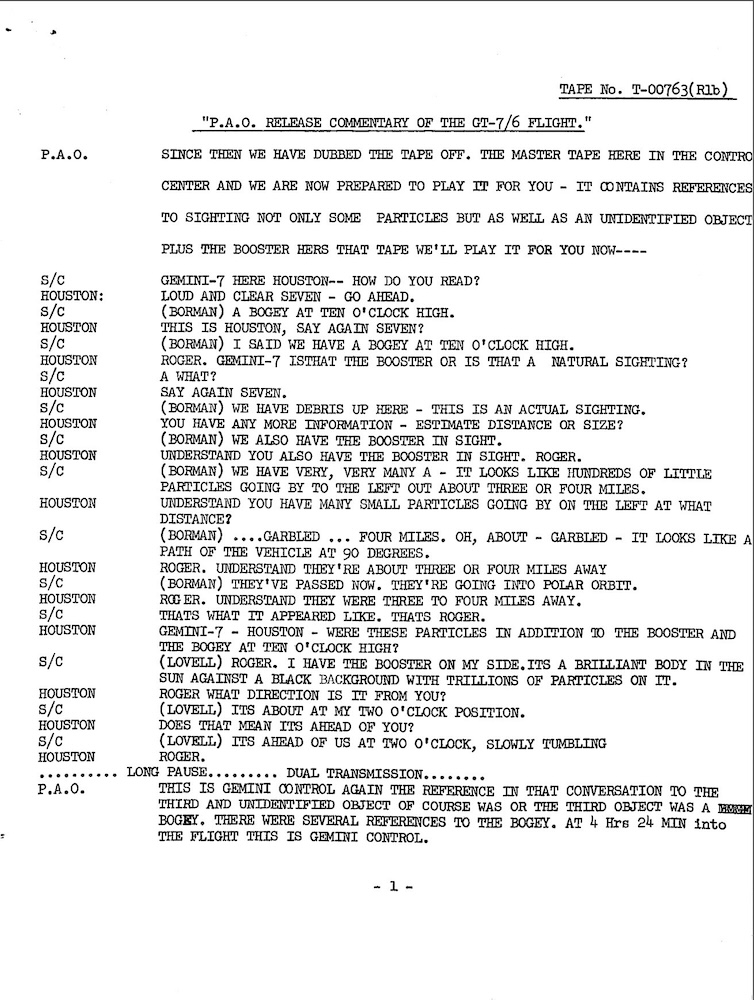 PDF
NASA · Low Earth Orbit
NASA-UAP-D3, Gemini 7 Transcript, 1965
Gemini 7 was the tenth crewed American spaceflight. This document is a transcript of communications between the flight crew, Astronauts James “Jim” Lovell and Frank Borman, and the Manned Flight Center (now known as Johnson Space Center) in Houston, Texas. The transcript begins with Borman’s report of a “bogey,” contemporary nomenclature for an unknown aircraft, as well as a debris field. Borman described the debris field as consisting of “very, very many […] hundreds of little particles.” He estimated the particles’ distance from the spacecraft to be four miles. Lovell described observing a “brilliant body in the sun against a black background with trillions of particles on it.” This document also includes handwritten notes documenting the encounter, annotated with the phrase “UFO Sighting by Borman” in the top right corner.
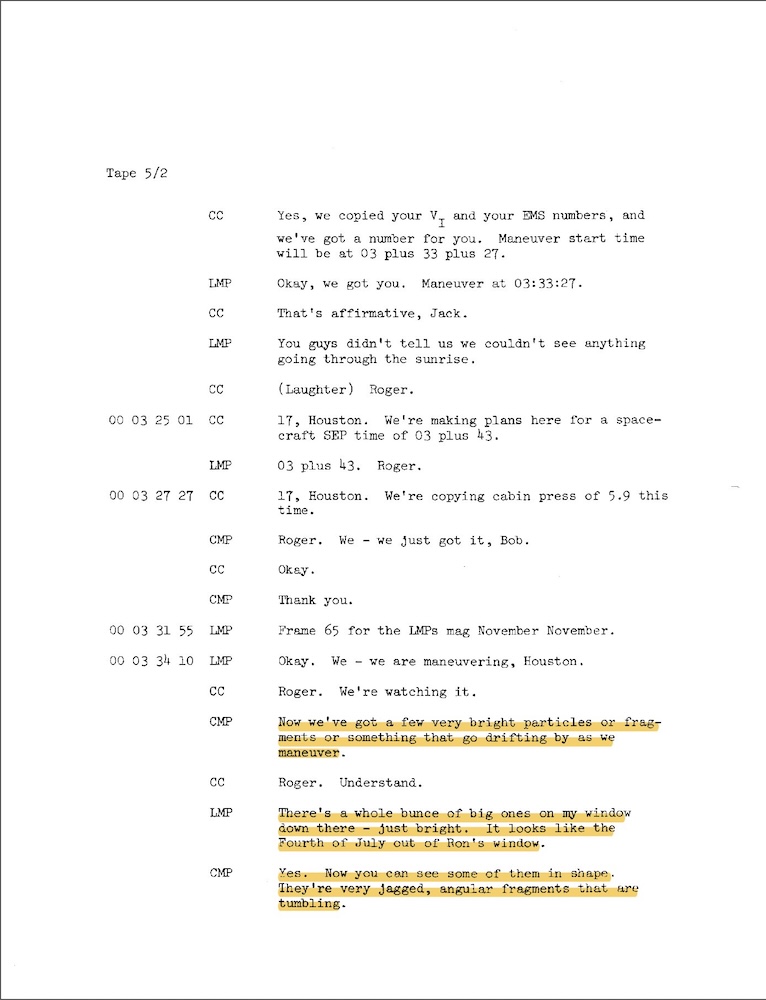 PDF
NASA · Moon
NASA-UAP-D2, Apollo 17 Transcript, 1972
Apollo 17 was the ninth crewed U.S. mission to the Moon, and the sixth to land astronauts on the lunar surface. This document is an excerpt from the Apollo 17 Technical Air-to-Ground Voice Transcription, December 1972, highlighting three periods in which astronauts reported observing unidentified phenomenon: a nine minute period on the first day, a three hour period on the second day, and a six minute period on the third day. • Day 00, Hour 03, Minute 34, Second 10 through Day 00, Hour 03, Minute 42, Second 29: o Command Module Pilot (CMP), Ronald Evans, reported observing “very bright particles or fragments” drifting and “tumbling” near the spacecraft as it maneuvered. Lunar Module Pilot (LMP), Harrison “Jack” Schmitt, described the phenomenon as looking “like the Fourth of July.” The astronauts speculated that the phenomenon may be attributable to ice or paint fragments dislodging from a separated component of the spacecraft (S-IVB) but characterized that assessment as a “wild guess.” • Day 02, Hour 18, Minute 42, Second 34 through Day 02, Hour 21, Minute 07, Second 05: o Mission Commander, Eugene A. Cernan, reported difficulty sleeping and described having observed “some sets of the streaks.” He also described an intense light flashing between his eyes, describing its intensity as comparable to that of a train headlight and characterizing it as “imposing.” Over the next three hours, Cernan described observing several flashing, rotating phenomenon that he assessed as corresponding to physical objects in space rather than a purely optical phenomenon. LMP Schmitt also reported observing similar phenomenon, though he again assessed the source of his observation to be a separated rocket stage (S-IVB). At 02:20:55:22, Cernan reported observing two additional distant flashing objects, though he assessed them as Spacecraft/Lunar Module Adapter panels (SLA panel), another separated component of the Saturn V rocket. • Day 03, Hour 15, Minute 33, Second 25 through Day 03, Hour 15, Minute 39, Second 46: o At 03:15:38:09, LMP Schmitt exclaimed that he had observed a flash on the lunar surface north of Grimaldi (crater).
 PDF
NASA · Moon
NASA-UAP-D1, Apollo 12 Transcript, 1969
Apollo 12 was the fourth crewed U.S. mission to the Moon and the second to land astronauts on the lunar surface. This document is an excerpt from the Apollo 12 Technical Air-to-Ground Voice Transcription, November 1969, highlighting two periods in which astronauts reported observing unidentified phenomenon: a one hour period on the fifth day, and a two minute period on the sixth day. These transcripts contain contemporaneous observations by the flight crew reacting to unidentified phenomenon. • Day 05, Hour 19, Minute 14, Second 58 through Day 05, Hour 20, Minute 12, Second 14: o At 05:19:27:25, the pilot of the Lunar Module (LMP-LM), Astronaut Alan L. Bean, described observing particles and flashes of light “sailing off in space” via the onboard Alignment Optical Telescope (AOT). He characterized these phenomenon as “escaping the Moon.” • Day 06, Hour 00, Minute 21, Second 42 through Day 06, Hour 00, Minute 23, Second 33: o Mission Commander, Charles “Pete” Conrad, described observing floating debris outside the lunar module, which had been illuminated by the module’s onboard tracking light. At 06:00:21:51, Conrad assessed that the tracking light had burnt out because he could no longer see the debris from the module.
 PDF
FBI · United States
FBI September 2023 Sighting - Serial 5
This is an FBI 302 interview conducted with a US citizen regarding their first-hand account of a UAP encounter at a US test site. USPER described a "bright light over the horizon."
 PDF
FBI · United States
FBI September 2023 Sighting - Serial 4
This is an FBI 302 interview conducted with a US citizen regarding their first-hand account of a UAP encounter at a US test site. USPER described an object "metallic/gray in color."
 PDF
FBI · United States
FBI September 2023 Sighting - Serial 3
This is an FBI 302 interview conducted with a US citizen regarding their first-hand account of a UAP encounter at a US test site. USPER described an object "metallic bronze in color."
 PDF
FBI · United States
FBI September 2023 Sighting - Composite Sketch
Actual site photo with FBI Lab rendered graphic overlay depicting corroborating eyewitness reports from September 2023 of an apparent ellipsoid bronze metallic object materializing out of a bright light in the sky, 130-195 feet in length, and disappearing instantaneously.
 PDF
FBI · Western United States
FBI Photo B9
The Federal Bureau of Investigation (FBI) submitted a report of an unidentified anomalous phenomenon (UAP) to the All-domain Anomaly Resolution Office (AARO) consisting of a still image derived from a U.S. military system in 2025. The original imagery was altered with redactions before being submitted to AARO. An accompanying mission report was not provided. The operator reported that they were unable to positively identify the UAP. The date in the image is incorrect due to system date/time not being set. Narrative Description: The monochrome image displays a grainy texture with a central crosshair reticle. A small, dark, circular object is visible just below and to the left of the center of the reticle. The background appears to show an indistinct mountain range. This narrative description is provided for informational purposes only. Readers should not interpret any part of this description as reflecting an analytical judgment, investigative conclusion, or factual determination regarding the described event’s validity, nature, or significance.
 PDF
FBI · Western United States
FBI Photo B8
The Federal Bureau of Investigation (FBI) submitted a report of an unidentified anomalous phenomenon (UAP) to the All-domain Anomaly Resolution Office (AARO) consisting of a still image derived from a U.S. military system in 2025. The original imagery was altered with redactions before being submitted to AARO. An accompanying mission report was not provided. The operator reported that they were unable to positively identify the UAP. The date in the image is incorrect due to system date/time not being set. Narrative Description: The monochrome image displays a grainy texture with a central crosshair reticle. A small, dark, circular object is visible just right of the center of the reticle in the top right quadrant. The background shows an indistinct mountain range. This narrative description is provided for informational purposes only. Readers should not interpret any part of this description as reflecting an analytical judgment, investigative conclusion, or factual determination regarding the described event’s validity, nature, or significance.
 PDF
FBI · Western United States
FBI Photo B7
The Federal Bureau of Investigation (FBI) submitted a report of an unidentified anomalous phenomenon (UAP) to the All-domain Anomaly Resolution Office (AARO) consisting of a still image derived from a U.S. military system in 2025. The original imagery was altered with redactions before being submitted to AARO. An accompanying mission report was not provided. The operator reported that they were unable to positively identify the UAP. The date in the image is incorrect due to system date/time not being set. Narrative Description: The monochrome image displays a grainy texture with a central crosshair reticle. A dark object, consistent in appearance with a helicopter, is visible in the upper right quadrant. A second, smaller, dark circular object is visible below the reticle. The background is indistinct. This narrative description is provided for informational purposes only. Readers should not interpret any part of this description as reflecting an analytical judgment, investigative conclusion, or factual determination regarding the described event’s validity, nature, or significance.
 PDF
FBI · Western United States
FBI Photo B6
The Federal Bureau of Investigation (FBI) submitted a report of an unidentified anomalous phenomenon (UAP) to the All-domain Anomaly Resolution Office (AARO) consisting of a still image derived from a U.S. military system in 2025. The original imagery was altered with redactions before being submitted to AARO. An accompanying mission report was not provided. The operator reported that they were unable to positively identify the UAP. The date in the image is incorrect due to system date/time not being set. Narrative Description: The monochrome image displays a grainy texture with a central crosshair reticle. A dark, structured object with an appendage on its left side is visible just at the top of the reticle. A second, smaller, dark circular object is visible below the reticle in the bottom right quadrant. This narrative description is provided for informational purposes only. Readers should not interpret any part of this description as reflecting an analytical judgment, investigative conclusion, or factual determination regarding the described event’s validity, nature, or significance.
 PDF
FBI · Western United States
FBI Photo B5
The Federal Bureau of Investigation (FBI) submitted a report of an unidentified anomalous phenomenon (UAP) to the All-domain Anomaly Resolution Office (AARO) consisting of a still image derived from a U.S. military system in 2025. The original imagery was altered with redactions before being submitted to AARO. An accompanying mission report was not provided. The operator reported that they were unable to positively identify the UAP. The date in the image is incorrect due to system date/time not being set. Narrative Description: The monochrome image displays a grainy texture with a central crosshair reticle. No distinct objects are clearly visible within the central area of the frame. The background shows an indistinct formation, possibly a mountain range. This narrative description is provided for informational purposes only. Readers should not interpret any part of this description as reflecting an analytical judgment, investigative conclusion, or factual determination regarding the described event’s validity, nature, or significance.
 PDF
FBI · Western United States
FBI Photo B4
The Federal Bureau of Investigation (FBI) submitted a report of an unidentified anomalous phenomenon (UAP) to the All-domain Anomaly Resolution Office (AARO) consisting of a still image derived from a U.S. military system in 2025. The original imagery was altered with redactions before being submitted to AARO. An accompanying mission report was not provided. The operator reported that they were unable to positively identify the UAP. The date in the image is incorrect due to system date/time not being set. Narrative Description: The monochrome image displays a grainy texture with a central crosshair reticle. A small, dark, circular object is visible in the center right quadrant, close to the center of the frame. An indistinct, possibly natural, landscape is visible in the background. This narrative description is provided for informational purposes only. Readers should not interpret any part of this description as reflecting an analytical judgment, investigative conclusion, or factual determination regarding the described event’s validity, nature, or significance.
 PDF
FBI · Western United States
FBI Photo B3
The Federal Bureau of Investigation (FBI) submitted a report of an unidentified anomalous phenomenon (UAP) to the All-domain Anomaly Resolution Office (AARO) consisting of a still image derived from a U.S. military system in 2025. The original imagery was altered with redactions before being submitted to AARO. An accompanying mission report was not provided. The operator reported that they were unable to positively identify the UAP. The date in the image is incorrect due to system date/time not being set. Narrative Description: The monochrome image displays a grainy texture with a central crosshair reticle. A small, dark, circular object is visible just to the right of the center of the reticle. The background appears to show an indistinct mountain range or cloud formation. This narrative description is provided for informational purposes only. Readers should not interpret any part of this description as reflecting an analytical judgment, investigative conclusion, or factual determination regarding the described event’s validity, nature, or significance.
 PDF
FBI · Western United States
FBI Photo B24
The Federal Bureau of Investigation (FBI) submitted a report of an unidentified anomalous phenomenon (UAP) to the All-domain Anomaly Resolution Office (AARO) consisting of a still image derived from a U.S. military system in 2025. The original imagery was altered with redactions before being submitted to AARO. An accompanying mission report was not provided. The operator reported that they were unable to positively identify the UAP. The date in the image is incorrect due to system date/time not being set. Narrative Description: The monochrome image displays a grainy texture with a simplified central crosshair. A single dark, irregular-shaped object is visible just above the center of the reticle. This narrative description is provided for informational purposes only. Readers should not interpret any part of this description as reflecting an analytical judgment, investigative conclusion, or factual determination regarding the described event’s validity, nature, or significance.
 PDF
FBI · Western United States
FBI Photo B23
The Federal Bureau of Investigation (FBI) submitted a report of an unidentified anomalous phenomenon (UAP) to the All-domain Anomaly Resolution Office (AARO) consisting of a still image derived from a U.S. military system in 2025. The original imagery was altered with redactions before being submitted to AARO. An accompanying mission report was not provided. The operator reported that they were unable to positively identify the UAP. The date in the image is incorrect due to system date/time not being set. Narrative Description: The monochrome image displays a grainy texture with a simplified central crosshair. A single dark, elongated object is visible near the edge of the reticle to the right of center. This narrative description is provided for informational purposes only. Readers should not interpret any part of this description as reflecting an analytical judgment, investigative conclusion, or factual determination regarding the described event’s validity, nature, or significance.
 PDF
FBI · Western United States
FBI Photo B22
The Federal Bureau of Investigation (FBI) submitted a report of an unidentified anomalous phenomenon (UAP) to the All-domain Anomaly Resolution Office (AARO) consisting of a still image derived from a U.S. military system in 2025. The original imagery was altered with redactions before being submitted to AARO. An accompanying mission report was not provided. The operator reported that they were unable to positively identify the UAP. The date in the image is incorrect due to system date/time not being set. Narrative Description: The monochrome image displays a grainy texture with a simplified central crosshair. Two small, dark, elongated objects are visible near the center of the frame in the upper right quadrant.This narrative description is provided for informational purposes only. Readers should not interpret any part of this description as reflecting an analytical judgment, investigative conclusion, or factual determination regarding the described event’s validity, nature, or significance.
 PDF
FBI · Western United States
FBI Photo B21
The Federal Bureau of Investigation (FBI) submitted a report of an unidentified anomalous phenomenon (UAP) to the All-domain Anomaly Resolution Office (AARO) consisting of a still image derived from a U.S. military system in 2025. The original imagery was altered with redactions before being submitted to AARO. An accompanying mission report was not provided. The operator reported that they were unable to positively identify the UAP. The date in the image is incorrect due to system date/time not being set. Narrative Description: The monochrome image displays a grainy texture with a central crosshair reticle. One to two small, dark, objects are visible just above and to the right of the center of the reticle. This narrative description is provided for informational purposes only. Readers should not interpret any part of this description as reflecting an analytical judgment, investigative conclusion, or factual determination regarding the described event’s validity, nature, or significance.
 PDF
FBI · Western United States
FBI Photo B20
The Federal Bureau of Investigation (FBI) submitted a report of an unidentified anomalous phenomenon (UAP) to the All-domain Anomaly Resolution Office (AARO) consisting of a still image derived from a U.S. military system in 2025. The original imagery was altered with redactions before being submitted to AARO. An accompanying mission report was not provided. The operator reported that they were unable to positively identify the UAP. The date in the image is incorrect due to system date/time not being set. Narrative Description: The monochrome image displays a grainy texture with a central crosshair reticle. One to two small, dark, objects are visible just above and to the right of the center of the reticle. This narrative description is provided for informational purposes only. Readers should not interpret any part of this description as reflecting an analytical judgment, investigative conclusion, or factual determination regarding the described event’s validity, nature, or significance.
 PDF
FBI · Western United States
FBI Photo B2
The Federal Bureau of Investigation (FBI) submitted a report of an unidentified anomalous phenomenon (UAP) to the All-domain Anomaly Resolution Office (AARO) consisting of a still image derived from a U.S. military system in 2025. The original imagery was altered with redactions before being submitted to AARO. An accompanying mission report was not provided. The operator reported that they were unable to positively identify the UAP. The date in the image is incorrect due to system date/time not being set. Narrative Description: The monochrome image displays a grainy texture with a central crosshair reticle. A small, dark, circular object is visible in the upper right quadrant. The background shows an indistinct mountain range or cloud formation. This narrative description is provided for informational purposes only. Readers should not interpret any part of this description as reflecting an analytical judgment, investigative conclusion, or factual determination regarding the described event’s validity, nature, or significance.
 PDF
FBI · Western United States
FBI Photo B19
The Federal Bureau of Investigation (FBI) submitted a report of an unidentified anomalous phenomenon (UAP) to the All-domain Anomaly Resolution Office (AARO) consisting of a still image derived from a U.S. military system in 2025. The original imagery was altered with redactions before being submitted to AARO. An accompanying mission report was not provided. The operator reported that they were unable to positively identify the UAP. The date in the image is incorrect due to system date/time not being set. Narrative Description: The monochrome image displays a grainy texture with a central crosshair reticle. A small cluster of dark pixels, forming an object, is visible at the exact center of the reticle. This narrative description is provided for informational purposes only. Readers should not interpret any part of this description as reflecting an analytical judgment, investigative conclusion, or factual determination regarding the described event’s validity, nature, or significance.
 PDF
FBI · Western United States
FBI Photo B18
The Federal Bureau of Investigation (FBI) submitted a report of an unidentified anomalous phenomenon (UAP) to the All-domain Anomaly Resolution Office (AARO) consisting of a still image derived from a U.S. military system in 2025. The original imagery was altered with redactions before being submitted to AARO. An accompanying mission report was not provided. The operator reported that they were unable to positively identify the UAP. The date in the image is incorrect due to system date/time not being set. Narrative Description: The monochrome image displays a grainy texture with a simplified central crosshair. Two small, dark, elongated objects are visible near the center of the frame in the lower left quadrant. This narrative description is provided for informational purposes only. Readers should not interpret any part of this description as reflecting an analytical judgment, investigative conclusion, or factual determination regarding the described event’s validity, nature, or significance.
 PDF
FBI · Western United States
FBI Photo B17
The Federal Bureau of Investigation (FBI) submitted a report of an unidentified anomalous phenomenon (UAP) to the All-domain Anomaly Resolution Office (AARO) consisting of a still image derived from a U.S. military system in 2025. The original imagery was altered with redactions before being submitted to AARO. An accompanying mission report was not provided. The operator reported that they were unable to positively identify the UAP. The date in the image is incorrect due to system date/time not being set. Narrative Description: The monochrome image displays a grainy texture with a simplified central crosshair. Two small, dark, circular objects are visible near the center of the frame. This narrative description is provided for informational purposes only. Readers should not interpret any part of this description as reflecting an analytical judgment, investigative conclusion, or factual determination regarding the described event’s validity, nature, or significance.
 PDF
FBI · Western United States
FBI Photo B16
The Federal Bureau of Investigation (FBI) submitted a report of an unidentified anomalous phenomenon (UAP) to the All-domain Anomaly Resolution Office (AARO) consisting of a still image derived from a U.S. military system in 2025. The original imagery was altered with redactions before being submitted to AARO. An accompanying mission report was not provided. The operator reported that they were unable to positively identify the UAP. The date in the image is incorrect due to system date/time not being set. Narrative Description: The monochrome image displays a grainy texture with a simplified central crosshair. Two dark, irregular-shaped objects are visible just right of the center in the upper right quadrant. This narrative description is provided for informational purposes only. Readers should not interpret any part of this description as reflecting an analytical judgment, investigative conclusion, or factual determination regarding the described event’s validity, nature, or significance.
 PDF
FBI · Western United States
FBI Photo B15
The Federal Bureau of Investigation (FBI) submitted a report of an unidentified anomalous phenomenon (UAP) to the All-domain Anomaly Resolution Office (AARO) consisting of a still image derived from a U.S. military system in 2025. The original imagery was altered with redactions before being submitted to AARO. An accompanying mission report was not provided. The operator reported that they were unable to positively identify the UAP. The date in the image is incorrect due to system date/time not being set. Narrative Description: The monochrome image displays a grainy texture with a simplified central crosshair. Two small, dark, circular objects are visible near the center of the frame in the upper right quadrant. This narrative description is provided for informational purposes only. Readers should not interpret any part of this description as reflecting an analytical judgment, investigative conclusion, or factual determination regarding the described event’s validity, nature, or significance.
 PDF
FBI · Western United States
FBI Photo B14
The Federal Bureau of Investigation (FBI) submitted a report of an unidentified anomalous phenomenon (UAP) to the All-domain Anomaly Resolution Office (AARO) consisting of a still image derived from a U.S. military system in 2025. The original imagery was altered with redactions before being submitted to AARO. An accompanying mission report was not provided. The operator reported that they were unable to positively identify the UAP. The date in the image is incorrect due to system date/time not being set. Narrative Description: The monochrome image displays a grainy texture with a simplified central crosshair. Two small, dark, circular objects are visible near the center of the frame. A digital artifact or distortion is visible along the edge of the redaction box in the lower right quadrant. This narrative description is provided for informational purposes only. Readers should not interpret any part of this description as reflecting an analytical judgment, investigative conclusion, or factual determination regarding the described event’s validity, nature, or significance.
 PDF
FBI · Western United States
FBI Photo B13
The Federal Bureau of Investigation (FBI) submitted a report of an unidentified anomalous phenomenon (UAP) to the All-domain Anomaly Resolution Office (AARO) consisting of a still image derived from a U.S. military system in 2025. The original imagery was altered with redactions before being submitted to AARO. An accompanying mission report was not provided. The operator reported that they were unable to positively identify the UAP. The date in the image is incorrect due to system date/time not being set. Narrative Description: The monochrome image displays a grainy texture with a simplified central crosshair. Two small, dark, elongated objects are visible near the center of the frame in the bottom right quadrant. This narrative description is provided for informational purposes only. Readers should not interpret any part of this description as reflecting an analytical judgment, investigative conclusion, or factual determination regarding the described event’s validity, nature, or significance.
 PDF
FBI · Western United States
FBI Photo B12
The Federal Bureau of Investigation (FBI) submitted a report of an unidentified anomalous phenomenon (UAP) to the All-domain Anomaly Resolution Office (AARO) consisting of a still image derived from a U.S. military system in 2025. The original imagery was altered with redactions before being submitted to AARO. An accompanying mission report was not provided. The operator reported that they were unable to positively identify the UAP. The date in the image is incorrect due to system date/time not being set. Narrative Description: The monochrome image displays a grainy texture with a central crosshair reticle. A small, dark, circular object is visible in the upper right quadrant of the frame. The background shows an indistinct mountain range.This narrative description is provided for informational purposes only. Readers should not interpret any part of this description as reflecting an analytical judgment, investigative conclusion, or factual determination regarding the described event’s validity, nature, or significance.
 PDF
FBI · Western United States
FBI Photo B11
The Federal Bureau of Investigation (FBI) submitted a report of an unidentified anomalous phenomenon (UAP) to the All-domain Anomaly Resolution Office (AARO) consisting of a still image derived from a U.S. military system in 2025. The original imagery was altered with redactions before being submitted to AARO. An accompanying mission report was not provided. The operator reported that they were unable to positively identify the UAP. The date in the image is incorrect due to system date/time not being set. Narrative Description: The monochrome image displays a grainy texture with a central crosshair reticle. A small, dark, circular object is visible in the upper right quadrant of the frame. The background appears to show an indistinct mountain range. This narrative description is provided for informational purposes only. Readers should not interpret any part of this description as reflecting an analytical judgment, investigative conclusion, or factual determination regarding the described event’s validity, nature, or significance.
 PDF
FBI · Western United States
FBI Photo B10
The Federal Bureau of Investigation (FBI) submitted a report of an unidentified anomalous phenomenon (UAP) to the All-domain Anomaly Resolution Office (AARO) consisting of a still image derived from a U.S. military system in 2025. The original imagery was altered with redactions before being submitted to AARO. An accompanying mission report was not provided. The operator reported that they were unable to positively identify the UAP. The date in the image is incorrect due to system date/time not being set. Narrative Description: The monochrome image displays a grainy texture with a central crosshair reticle. A small, dark, circular object is visible just to the top right quadrant of the center of the reticle. The background shows an indistinct mountain range.This narrative description is provided for informational purposes only. Readers should not interpret any part of this description as reflecting an analytical judgment, investigative conclusion, or factual determination regarding the described event’s validity, nature, or significance.
 PDF
FBI · Western United States
FBI Photo B1
The Federal Bureau of Investigation (FBI) submitted a report of an unidentified anomalous phenomenon (UAP) to the All-domain Anomaly Resolution Office (AARO) consisting of a still image derived from a U.S. military system in 2025. The original imagery was altered with redactions before being submitted to AARO. An accompanying mission report was not provided. The operator reported that they were unable to positively identify the UAP. The date in the image is incorrect due to system date/time not being set. Narrative Description: The monochrome image displays a grainy texture with a central crosshair reticle. A small, dark, circular object is visible in the upper right quadrant, near the center of the frame. The background appears to show an indistinct mountain range or cloud formation.This narrative description is provided for informational purposes only. Readers should not interpret any part of this description as reflecting an analytical judgment, investigative conclusion, or factual determination regarding the described event’s validity, nature, or significance.
 PDF
DoD / AARO · Iraq
DOW-UAP-PR20, Unresolved UAP Report, Kuwait, May 2022
The United States Central Command submitted a report of an unidentified anomalous phenomenon (UAP) to the All-domain Anomaly Resolution Office (AARO) consisting of a still image derived from a U.S. military system in 2022. The original reporter digitally altered the imagery by adding a red line encircling an area of interest before submitting it to AARO. An accompanying mission report, DoW-UAP-D12, described the UAP as moving from north to northeast. The operator reported that they were unable to positively identify the UAP. Image Description: The image contains an encircled, elongated area of contrast in the top left quarter. The area of contrast increases in intensity along its length from top left to bottom right. This image description is provided for informational purposes only. Readers should not interpret any part of this description as reflecting an analytical judgment, investigative conclusion, or factual determination regarding the described event’s validity, nature, or significance.
 PDF
DoD / AARO · Mediterranean Sea
DOW-UAP-D8, Mission Report, Djibouti, 2025
This document is a Mission Report (MISREP), a standardized reporting form the U.S. Military uses to record the circumstances surrounding its operations. U.S. military services often use MISREPs to report Unidentified Anomalous Phenomena (UAP) to AARO. The GENTEXT, or “general text” section of these reports often contains important qualitative, contextual information, distinguishing it from the more quantitative, or numerical, data found elsewhere in the report. A U.S. military operator reported observing two “white hot UAPs.” The reporter estimated the UAP’s speed as approximately 240 nautical miles per hour (276 mph). All descriptive and estimative language contained in this report reflects the reporter’s subjective interpretation at the time of the event. Such characterizations should not be interpreted as a conclusive indication of the presence or absence of any intrinsic object features or performance characteristics.
 PDF
DoD / AARO · Gulf of Aden
DOW-UAP-D75, Mission Report, Gulf of Aden, July 2024
This document is a Mission Report (MISREP), a standardized reporting form the U.S. Military uses to record the circumstances surrounding its operations. U.S. military services often use MISREPs to report Unidentified Anomalous Phenomena (UAP) to AARO. The GENTEXT, or “general text” section of these reports often contains important qualitative, contextual information, distinguishing it from the more quantitative, or numerical, data found elsewhere in the report. A U.S. military operator reported observing one UAP on July 14, 2024. The observer reported that the UAP maintained a “straight flight path at same altitude”. The report notes that the UAP’s “speed was faster than flying speed,” and the operator assessed the object as “benign.” The operator reported following the UAP “till the distance became too far.” All descriptive and estimative language contained in this report reflects the reporter’s subjective interpretation at the time of the event. Such characterizations should not be interpreted as a conclusive indication of the presence or absence of any intrinsic object features or performance characteristics.
 PDF
DoD / AARO · Syria
DOW-UAP-D74, Mission Report, Syria, November 2023
This document is a Mission Report (MISREP), a standardized reporting form the U.S. Military uses to record the circumstances surrounding its operations. U.S. military services often use MISREPs to report Unidentified Anomalous Phenomena (UAP) to AARO. The GENTEXT, or “general text” section of these reports often contains important qualitative, contextual information, distinguishing it from the more quantitative, or numerical, data found elsewhere in the report. A U.S. military operator reported observing one UAP “shaped as a bouncy ball.” The observer described the UAP as traveling “~424kn (483 mph) consistently for at least 7mins.” The reporter described the UAP approaching from the south. The operator assessed the object as “benign.” All descriptive and estimative language contained in this report reflects the reporter’s subjective interpretation at the time of the event. Such characterizations should not be interpreted as a conclusive indication of the presence or absence of any intrinsic object features or performance characteristics.
 PDF
DoD / AARO
DOW-UAP-D7, Mission Report, Arabian Gulf, 2020
This document is a Mission Report (MISREP), a standardized reporting form the U.S. Military uses to record the circumstances surrounding its operations. U.S. military services often use MISREPs to report Unidentified Anomalous Phenomena (UAP) to AARO. The GENTEXT, or “general text” section of these reports often contains important qualitative, contextual information, distinguishing it from the more quantitative, or numerical, data found elsewhere in the report. A U.S. military operator reported observing a UAP, describing it as “look[ing] like a balloon.” The report describes the UAP as “traveling with the winds at approximately 31,000 ft.” The visually tracked the UAP via onboard infrared sensor. All descriptive and estimative language contained in this report reflects the reporter’s subjective interpretation at the time of the event. Such characterizations should not be interpreted as a conclusive indication of the presence or absence of any intrinsic object features or performance characteristics.
 PDF
DoD / AARO · Persian Gulf
DOW-UAP-D65, Mission Report, Persian Gulf, July 2020
This document is a Mission Report (MISREP), a standardized reporting form the U.S. Military uses to record the circumstances surrounding its operations. U.S. military services often use MISREPs to report Unidentified Anomalous Phenomena (UAP) to AARO. The GENTEXT, or “general text” section of these reports often contains important qualitative, contextual information, distinguishing it from the more quantitative, or numerical, data found elsewhere in the report. A U.S. military operator reported encountering three separate UAP on July 16, 2020, at 1830Z, 1920Z, and 2345Z. All descriptive and estimative language contained in this report reflects the reporter’s subjective interpretation at the time of the event. Such characterizations should not be interpreted as a conclusive indication of the presence or absence of any intrinsic object features or performance characteristics.
 PDF
DoD / AARO · Iran
DOW-UAP-D64, Mission Report, Iran, November 2020
This document is a Mission Report (MISREP), a standardized reporting form the U.S. Military uses to record the circumstances surrounding its operations. U.S. military services often use MISREPs to report Unidentified Anomalous Phenomena (UAP) to AARO. The GENTEXT, or “general text” section of these reports often contains important qualitative, contextual information, distinguishing it from the more quantitative, or numerical, data found elsewhere in the report. A U.S. military operator reported observing two UAP on November 2, 2020, at 2143Z and at 2148Z. The first observation occurred at an unknown altitude. The reporter described the second UAP’s direction of travel as proceeding to the northwest. All descriptive and estimative language contained in this report reflects the reporter’s subjective interpretation at the time of the event. Such characterizations should not be interpreted as a conclusive indication of the presence or absence of any intrinsic object features or performance characteristics.
 PDF
DoD / AARO · Strait of Hormuz
DOW-UAP-D63, Mission Report, Strait of Hormuz, October 2020
This document is a Mission Report (MISREP), a standardized reporting form the U.S. Military uses to record the circumstances surrounding its operations. U.S. military services often use MISREPs to report Unidentified Anomalous Phenomena (UAP) to AARO. The GENTEXT, or “general text” section of these reports often contains important qualitative, contextual information, distinguishing it from the more quantitative, or numerical, data found elsewhere in the report. A U.S. military operator reported observing a UAP. All descriptive and estimative language contained in this report reflects the reporter’s subjective interpretation at the time of the event. Such characterizations should not be interpreted as a conclusive indication of the presence or absence of any intrinsic object features or performance characteristics.
 PDF
DoD / AARO · Strait of Hormuz
DOW-UAP-D62, Mission Report, Strait of Hormuz, September 2020
This document is a Mission Report (MISREP), a standardized reporting form the U.S. Military uses to record the circumstances surrounding its operations. U.S. military services often use MISREPs to report Unidentified Anomalous Phenomena (UAP) to AARO. The GENTEXT, or “general text” section of these reports often contains important qualitative, contextual information, distinguishing it from the more quantitative, or numerical, data found elsewhere in the report. A U.S. military operator reported observing one UAP at an estimated altitude of 1,800 feet. All descriptive and estimative language contained in this report reflects the reporter’s subjective interpretation at the time of the event. Such characterizations should not be interpreted as a conclusive indication of the presence or absence of any intrinsic object features or performance characteristics.
 PDF
DoD / AARO · Persian Gulf
DOW-UAP-D61, Mission Report, Persian Gulf, August 2020
This document is a Mission Report (MISREP), a standardized reporting form the U.S. Military uses to record the circumstances surrounding its operations. U.S. military services often use MISREPs to report Unidentified Anomalous Phenomena (UAP) to AARO. The GENTEXT, or “general text” section of these reports often contains important qualitative, contextual information, distinguishing it from the more quantitative, or numerical, data found elsewhere in the report. A U.S. military operator reported observing a “formation of unknown flying objects” traveling northeast to northwest along the coast for approximately two minutes. The report notes that light cloud coverage “prevented the continuous tracking of the formation.” All descriptive and estimative language contained in this report reflects the reporter’s subjective interpretation at the time of the event. Such characterizations should not be interpreted as a conclusive indication of the presence or absence of any intrinsic object features or performance characteristics.
 PDF
DoD / AARO · Persian Gulf
DOW-UAP-D60, Mission Report, Persian Gulf, August 2020
This document is a Mission Report (MISREP), a standardized reporting form the U.S. Military uses to record the circumstances surrounding its operations. U.S. military services often use MISREPs to report Unidentified Anomalous Phenomena (UAP) to AARO. The GENTEXT, or “general text” section of these reports often contains important qualitative, contextual information, distinguishing it from the more quantitative, or numerical, data found elsewhere in the report. A U.S. military operator reported observing one UAP. The report describes the UAP as “transiting” and notes it had “no impact to mission.” The report also states that “dense cloud coverage intermittently impacted FMV collection.” All descriptive and estimative language contained in this report reflects the reporter’s subjective interpretation at the time of the event. Such characterizations should not be interpreted as a conclusive indication of the presence or absence of any intrinsic object features or performance characteristics.
 PDF
DoD / AARO · Pacific Ocean
DOW-UAP-D6, Mission Report, Arabian Gulf, 2020
This document is a Mission Report (MISREP), a standardized reporting form the U.S. Military uses to record the circumstances surrounding its operations. U.S. military services often use MISREPs to report Unidentified Anomalous Phenomena (UAP) to AARO. The GENTEXT, or “general text” section of these reports often contains important qualitative, contextual information, distinguishing it from the more quantitative, or numerical, data found elsewhere in the report. A U.S. military operator reported observing a UAP. All descriptive and estimative language contained in this report reflects the reporter’s subjective interpretation at the time of the event. Such characterizations should not be interpreted as a conclusive indication of the presence or absence of any intrinsic object features or performance characteristics.
 PDF
DoD / AARO
DOW-UAP-D58, Range Fouler Debrief, NA, October 2020
This document is a Range Fouler Debrief, a standardized reporting form the U.S. Navy uses to record the circumstances surrounding an unauthorized intrusion into controlled airspace during active military operations or training. These reports contain a narrative description of the observer’s experiences. A U.S. military operator reported an encounter with a group of two UAP. The operator described the UAP as “balloon-shaped,” metallic, and reflective, characterizing them as “2x red blinking strobes.” The report states that “one range fouler was circling around the other.” All descriptive and estimative language contained in this report reflects the reporter’s subjective interpretation at the time of the event. Such characterizations should not be interpreted as a conclusive indication of the presence or absence of any intrinsic object features or performance characteristics.
 PDF
DoD / AARO · Gulf of Aden
DOW-UAP-D57, Range Fouler Reporting Form, Gulf of Aden, September 2020
This document is a Range Fouler Reporting Form, a standardized reporting form the U.S. Navy uses to record the circumstances surrounding an unauthorized intrusion into controlled airspace during active military operations or training. These reports contain a narrative description of the observer’s experiences. A U.S. military operator reported tracking a “round, cold object” over the Gulf of Aden for eight minutes via “black hot” IR sensor, making the UAP appear “bright white.” The report states that the UAP was “traveling 168 degrees at 277 mph” and “made a few abrupt directional changes” during the encounter. All descriptive and estimative language contained in this report reflects the reporter’s subjective interpretation at the time of the event. Such characterizations should not be interpreted as a conclusive indication of the presence or absence of any intrinsic object features or performance characteristics.
 PDF
DoD / AARO · Arabian Sea
DOW-UAP-D56, Range Fouler Debrief, Arabian Sea, August 2020
This document is a Range Fouler Debrief Form, a standardized reporting form the U.S. Navy uses to record the circumstances surrounding an unauthorized intrusion into controlled airspace during active military operations or training. These reports contain a narrative description of the observer’s experiences. A U.S. military operator reported an encounter with a group of three “unidentified small air contacts” over the North Arabian Sea. The reporter described the UAP as having “wings/airframe” structure, and as initially bearing on a westerly heading. The operator tracked one UAP before losing sight of it behind a cloud. Upon regaining contact, the operator reported observing two additional UAP to the east of the first. The report states that all three objects then “appeared to maintain their relative course, speed, and altitude.” All descriptive and estimative language contained in this report reflects the reporter’s subjective interpretation at the time of the event. Such characterizations should not be interpreted as a conclusive indication of the presence or absence of any intrinsic object features or performance characteristics.
 PDF
DoD / AARO · Syria
DOW-UAP-D55, Mission Report, Syria, November 2016
This document is a mission briefing summarizing an observation of Unidentified Anomalous Phenomena (UAP) by a U.S. military platform near Latakia, Syria. A U.S. military pilot flying a P-8A aircraft reported observing an object via the aircraft’s EO/IR sensor, which they characterized as appearing to be in “sea skim mode,” traveling at approximately 500 knots (575 mph) on a southeasterly heading. The P-8A lost visual contact with the object after two minutes. All descriptive and estimative language contained in this report reflects the reporter’s subjective interpretation at the time of the event. Such characterizations should not be interpreted as a conclusive indication of the presence or absence of any intrinsic object features or performance characteristics.
 PDF
DoD / AARO · Mediterranean Sea
DOW-UAP-D54, Mission Report, Mediterranean Sea, NA
This document is a Mission Report (MISREP), a standardized reporting form the U.S. Military uses to record the circumstances surrounding its operations. U.S. military services often use MISREPs to report Unidentified Anomalous Phenomena (UAP) to AARO. The GENTEXT, or “general text” section of these reports often contains important qualitative, contextual information, distinguishing it from the more quantitative, or numerical, data found elsewhere in the report. A U.S. military operator reported observing one UAP. The report describes the UAP as a “triangular and metallic UAP.” The reporter estimated the UAP’s altitude as 24,989 feet and speed as 168 knots (193mph). All descriptive and estimative language contained in this report reflects the reporter’s subjective interpretation at the time of the event. Such characterizations should not be interpreted as a conclusive indication of the presence or absence of any intrinsic object features or performance characteristics.
 PDF
DoD / AARO
DOW-UAP-D52, Email Correspondance, NA, August 2024
This document is email correspondence describing the content of a mission report and requesting clarification on its content. All descriptive and estimative language contained in this report reflects the reporter’s subjective interpretation at the time of the event. Such characterizations should not be interpreted as a conclusive indication of the presence or absence of any intrinsic object features or performance characteristics.
 PDF
DoD / AARO · Pacific Time Zone
DOW-UAP-D51, Email Correspondence, Pacific Time Zone, March 2023
This document is email correspondence describing the content of a mission report and requesting clarification on its content. All descriptive and estimative language contained in this report reflects the reporter’s subjective interpretation at the time of the event. Such characterizations should not be interpreted as a conclusive indication of the presence or absence of any intrinsic object features or performance characteristics.
 PDF
DoD / AARO
DOW-UAP-D50, Email Correspondence, INDOPACOM, April 2025
This document is email correspondence describing the content of a mission report and requesting clarification on its content. All descriptive and estimative language contained in this report reflects the reporter’s subjective interpretation at the time of the event. Such characterizations should not be interpreted as a conclusive indication of the presence or absence of any intrinsic object features or performance characteristics.
 PDF
DoD / AARO · Mediterranean Sea
DOW-UAP-D5, Mission Report, Arabian Gulf, 2020
This document is a Mission Report (MISREP), a standardized reporting form the U.S. Military uses to record the circumstances surrounding its operations. U.S. military services often use MISREPs to report Unidentified Anomalous Phenomena (UAP) to AARO. The GENTEXT, or “general text” section of these reports often contains important qualitative, contextual information, distinguishing it from the more quantitative, or numerical, data found elsewhere in the report. A U.S. military operator reported observing two UAP traveling at an estimated speed of 278 knots (320 mph. The observer reported that the UAP “increased speed and changed direction towards the south.” All descriptive and estimative language contained in this report reflects the reporter’s subjective interpretation at the time of the event. Such characterizations should not be interpreted as a conclusive indication of the presence or absence of any intrinsic object features or performance characteristics.
 PDF
DoD / AARO
DOW-UAP-D49, Launch Summary, Vandenberg AFB, 2000
This report summarizes the historical record of launches occurring at Vandenberg Air Force Base between 1958 and 2000.
 PDF
DoD / AARO
DOW-UAP-D48, Department of the Air Force Report, 1996
This report describes the Modeling of Unlikely Space-Booster Failures in Risk Calculations, documenting historical launch failure modes and recommending corrective actions to address them using novel modelling techniques.
 PDF
DoD / AARO · Arabian Sea
DOW-UAP-D44, Range Fouler Reporting Form, Gulf of Aden, October 2020
This document is a Range Fouler Reporting Form, a standardized reporting form the U.S. Navy uses to record the circumstances surrounding an unauthorized intrusion into controlled airspace during active military operations or training. These reports contain a narrative description of the observer’s experiences. A U.S. military operator reported observing a “round, cold object” via infrared sensor, traveling at 319 degrees (northwest) at approximately 20 mph. The report describes the UAP making “abrupt directional changes” during the event. All descriptive and estimative language contained in this report reflects the reporter’s subjective interpretation at the time of the event. Such characterizations should not be interpreted as a conclusive indication of the presence or absence of any intrinsic object features or performance characteristics.
 PDF
DoD / AARO · Arabian Gulf
DOW-UAP-D42, Range Fouler Debrief, Japan, 2023
This document is a Range Fouler Debrief Form, a standardized reporting form the U.S. Navy uses to record the circumstances surrounding an unauthorized intrusion into controlled airspace during active military operations or training. These reports contain a narrative description of the observer’s experiences. A U.S. military operator reported observing an “object fly through the screen.” The observer described a second object surpassing the first, at a higher speed. The report describes a total of three UAP “moving amongst each other.” All descriptive and estimative language contained in this report reflects the reporter’s subjective interpretation at the time of the event. Such characterizations should not be interpreted as a conclusive indication of the presence or absence of any intrinsic object features or performance characteristics.
 PDF
DoD / AARO
DOW-UAP-D4, Mission Report, Arabian Gulf, 2020
This document is a Mission Report (MISREP), a standardized reporting form the U.S. Military uses to record the circumstances surrounding its operations. U.S. military services often use MISREPs to report Unidentified Anomalous Phenomena (UAP) to AARO. The GENTEXT, or “general text” section of these reports often contains important qualitative, contextual information, distinguishing it from the more quantitative, or numerical, data found elsewhere in the report. A U.S. military operator reported observing a UAP traveling at an estimated speed of 321 knots (369 mph). The observer reported that the UAP “increased speed and changed direction towards the east.” All descriptive and estimative language contained in this report reflects the reporter’s subjective interpretation at the time of the event. Such characterizations should not be interpreted as a conclusive indication of the presence or absence of any intrinsic object features or performance characteristics.
 PDF
DoD / AARO · Persian Gulf
DOW-UAP-D38, Range Fouler Debrief, Middle East, May 2020
This document is a Range Fouler Debrief, a standardized reporting form the U.S. Navy uses to record the circumstances surrounding an unauthorized intrusion into controlled airspace during active military operations or training. These reports contain a narrative description of the observer’s experiences. A U.S. military operator reported observing a “solid white object [fly] through the [field-of-view]. The reporter described the UAP as making erratic [movements] above the water. All descriptive and estimative language contained in this report reflects the reporter’s subjective interpretation at the time of the event. Such characterizations should not be interpreted as a conclusive indication of the presence or absence of any intrinsic object features or performance characteristics.
 PDF
DoD / AARO · Aegean Sea
DOW-UAP-D35, Mission Report, Greece, October 2023
This document is a Mission Report (MISREP), a standardized reporting form the U.S. Military uses to record the circumstances surrounding its operations. U.S. military services often use MISREPs to report Unidentified Anomalous Phenomena (UAP) to AARO. The GENTEXT, or “general text” section of these reports often contains important qualitative, contextual information, distinguishing it from the more quantitative, or numerical, data found elsewhere in the report. A U.S. military operator reported observing a UAP “flying just above the surface of the ocean.” The report describes the UAP as “[flying] straight above the ocean towards lands.” All descriptive and estimative language contained in this report reflects the reporter’s subjective interpretation at the time of the event. Such characterizations should not be interpreted as a conclusive indication of the presence or absence of any intrinsic object features or performance characteristics.
 PDF
DoD / AARO · Aegean Sea
DOW-UAP-D33, Mission Report, Greece, October 2023
This document is a Mission Report (MISREP), a standardized reporting form the U.S. Military uses to record the circumstances surrounding its operations. U.S. military services often use MISREPs to report Unidentified Anomalous Phenomena (UAP) to AARO. The GENTEXT, or “general text” section of these reports often contains important qualitative, contextual information, distinguishing it from the more quantitative, or numerical, data found elsewhere in the report. A U.S. military operator reported observing a UAP “flying just above the surface of the ocean.” The report describes the UAP as taking “multiple 90-degree turns at an estimated 80 mph.” All descriptive and estimative language contained in this report reflects the reporter’s subjective interpretation at the time of the event. Such characterizations should not be interpreted as a conclusive indication of the presence or absence of any intrinsic object features or performance characteristics.
 PDF
DoD / AARO · Syria
DOW-UAP-D32, Mission Report, Syria, October 2024
This document is a Mission Report (MISREP), a standardized reporting form the U.S. Military uses to record the circumstances surrounding its operations. U.S. military services often use MISREPs to report Unidentified Anomalous Phenomena (UAP) to AARO. The GENTEXT, or “general text” section of these reports often contains important qualitative, contextual information, distinguishing it from the more quantitative, or numerical, data found elsewhere in the report. A U.S. military operator reported observing a “misshapen and uneven ball of white light,” describing multiple “glares or light” emanating from an “unknown origin.” The reporter described the UAP as a “light/glare halo effect” at the top of the Full-Motion Video (FMV) feed. All descriptive and estimative language contained in this report reflects the reporter’s subjective interpretation at the time of the event. Such characterizations should not be interpreted as a conclusive indication of the presence or absence of any intrinsic object features or performance characteristics.
 PDF
DoD / AARO
DOW-UAP-D3, Mission Report, Arabian Gulf, 2020
This document is a Mission Report (MISREP), a standardized reporting form the U.S. Military uses to record the circumstances surrounding its operations. U.S. military services often use MISREPs to report Unidentified Anomalous Phenomena (UAP) to AARO. The GENTEXT, or “general text” section of these reports often contains important qualitative, contextual information, distinguishing it from the more quantitative, or numerical, data found elsewhere in the report. A U.S. military operator reported observing a “line of dots followed by a trailing dot.” All descriptive and estimative language contained in this report reflects the reporter’s subjective interpretation at the time of the event. Such characterizations should not be interpreted as a conclusive indication of the presence or absence of any intrinsic object features or performance characteristics.
 PDF
DoD / AARO · Iraq
DOW-UAP-D28, Mission Report, Iraq, September 2024
This document is a Mission Report (MISREP), a standardized reporting form the U.S. Military uses to record the circumstances surrounding its operations. U.S. military services often use MISREPs to report Unidentified Anomalous Phenomena (UAP) to AARO. The GENTEXT, or “general text” section of these reports often contains important qualitative, contextual information, distinguishing it from the more quantitative, or numerical, data found elsewhere in the report. While conducting a weapons calibration test, U.S. military operators reported observing a lens flare via MX-20 and MX-25 IR sensors after firing an AGM-176 Griffin air-to-surface missile. The operators described the source of the flare as a UAP moving through the aircraft’s sensor’s field-of-view at a high rate of speed. The reporter assessed that the flare was associated with “a significant heat source.” All descriptive and estimative language contained in this report reflects the reporter’s subjective interpretation at the time of the event. Such characterizations should not be interpreted as a conclusive indication of the presence or absence of any intrinsic object features or performance characteristics.
 PDF
DoD / AARO · Gulf of Oman
DOW-UAP-D27, Mission Report, United Arab Emirates, October 2023
This document is a Mission Report (MISREP), a standardized reporting form the U.S. Military uses to record the circumstances surrounding its operations. U.S. military services often use MISREPs to report Unidentified Anomalous Phenomena (UAP) to AARO. The GENTEXT, or “general text” section of these reports often contains important qualitative, contextual information, distinguishing it from the more quantitative, or numerical, data found elsewhere in the report. A U.S. military operator reported observing one UAP at an estimated altitude of approximately 24,000 feet. The observer estimated the UAP’s speed as 163 knots (187 mph). All descriptive and estimative language contained in this report reflects the reporter’s subjective interpretation at the time of the event. Such characterizations should not be interpreted as a conclusive indication of the presence or absence of any intrinsic object features or performance characteristics.
 PDF
DoD / AARO · Mediterranean Sea
DOW-UAP-D25, Mission Report, Greece, January 2024
This document is a Mission Report (MISREP), a standardized reporting form the U.S. Military uses to record the circumstances surrounding its operations. U.S. military services often use MISREPs to report Unidentified Anomalous Phenomena (UAP) to AARO. The GENTEXT, or “general text” section of these reports often contains important qualitative, contextual information, distinguishing it from the more quantitative, or numerical, data found elsewhere in the report. A U.S. military operator reported observing one UAP, estimating its speed as “approximately 434 knots (499 mph)”. The observer described the UAP as diamond-shaped, with a non-maneuvering probe at the bottom. The observer noted that the UAP was only visible when viewed via an onboard Short-Wave Infrared (SWIR) sensor. The observer reported that the event occurred over a duration of approximately two minutes. All descriptive and estimative language contained in this report reflects the reporter’s subjective interpretation at the time of the event. Such characterizations should not be interpreted as a conclusive indication of the presence or absence of any intrinsic object features or performance characteristics.
 PDF
DoD / AARO · Persian Gulf
DOW-UAP-D23, Mission Report, United Arab Emirates, October 2023
This document is a Mission Report (MISREP), a standardized reporting form the U.S. Military uses to record the circumstances surrounding its operations. U.S. military services often use MISREPs to report Unidentified Anomalous Phenomena (UAP) to AARO. The GENTEXT, or “general text” section of these reports often contains important qualitative, contextual information, distinguishing it from the more quantitative, or numerical, data found elsewhere in the report. A U.S. military operator reported observing one UAP. All descriptive and estimative language contained in this report reflects the reporter’s subjective interpretation at the time of the event. Such characterizations should not be interpreted as a conclusive indication of the presence or absence of any intrinsic object features or performance characteristics.
 PDF
DoD / AARO · Iraq
DOW-UAP-D20, Mission Report, Iraq, 2023
This document is a Mission Report (MISREP), a standardized reporting form the U.S. Military uses to record the circumstances surrounding its operations. U.S. military services often use MISREPs to report Unidentified Anomalous Phenomena (UAP) to AARO. The GENTEXT, or “general text” section of these reports often contains important qualitative, contextual information, distinguishing it from the more quantitative, or numerical, data found elsewhere in the report. A U.S. military operator reported observing “several bright objects maneuvering quickly” west to east northeast. The operator reported achieving a track on the UAP via an onboard targeting pod for approximately 20 seconds. The report describes that UAP then dimmed and disappeared from the targeting pod. All descriptive and estimative language contained in this report reflects the reporter’s subjective interpretation at the time of the event. Such characterizations should not be interpreted as a conclusive indication of the presence or absence of any intrinsic object features or performance characteristics.
 PDF
DoD / AARO · Syria
DOW-UAP-D19, Mission Report, Syria, February 21, 2023
This document is a Mission Report (MISREP), a standardized reporting form the U.S. Military uses to record the circumstances surrounding its operations. U.S. military services often use MISREPs to report Unidentified Anomalous Phenomena (UAP) to AARO. The GENTEXT, or “general text” section of these reports often contains important qualitative, contextual information, distinguishing it from the more quantitative, or numerical, data found elsewhere in the report. A U.S. military operator reported observing one “possible balloon” at approximately 2,100 feet. All descriptive and estimative language contained in this report reflects the reporter’s subjective interpretation at the time of the event. Such characterizations should not be interpreted as a conclusive indication of the presence or absence of any intrinsic object features or performance characteristics.
 PDF
DoD / AARO · Iraq
DOW-UAP-D18, Mission Report, Iraq, December 2022
This document is a Mission Report (MISREP), a standardized reporting form the U.S. Military uses to record the circumstances surrounding its operations. U.S. military services often use MISREPs to report Unidentified Anomalous Phenomena (UAP) to AARO. The GENTEXT, or “general text” section of these reports often contains important qualitative, contextual information, distinguishing it from the more quantitative, or numerical, data found elsewhere in the report. A U.S. military operator reported observing one “possible UAP” flying from west to east. The observer did not pursue the UAP. All descriptive and estimative language contained in this report reflects the reporter’s subjective interpretation at the time of the event. Such characterizations should not be interpreted as a conclusive indication of the presence or absence of any intrinsic object features or performance characteristics.
 PDF
DoD / AARO · Syria
DOW-UAP-D16, Mission Report, Syria, July 2022
This document is a Mission Report (MISREP), a standardized reporting form the U.S. Military uses to record the circumstances surrounding its operations. U.S. military services often use MISREPs to report Unidentified Anomalous Phenomena (UAP) to AARO. The GENTEXT, or “general text” section of these reports often contains important qualitative, contextual information, distinguishing it from the more quantitative, or numerical, data found elsewhere in the report. A U.S. military operator reported observing one UAP move from north to south, with a total duration of under one minute. All descriptive and estimative language contained in this report reflects the reporter’s subjective interpretation at the time of the event. Such characterizations should not be interpreted as a conclusive indication of the presence or absence of any intrinsic object features or performance characteristics.
 PDF
DoD / AARO · Syria
DOW-UAP-D14, Mission Report, Iraq, May 2022
This document is a Mission Report (MISREP), a standardized reporting form the U.S. Military uses to record the circumstances surrounding its operations. U.S. military services often use MISREPs to report Unidentified Anomalous Phenomena (UAP) to AARO. The GENTEXT, or “general text” section of these reports often contains important qualitative, contextual information, distinguishing it from the more quantitative, or numerical, data found elsewhere in the report. A U.S. military operator reported observing one UAP flying north to northeast. The observer reported following the UAP for as long as possible but was unable to positively identify it. All descriptive and estimative language contained in this report reflects the reporter’s subjective interpretation at the time of the event. Such characterizations should not be interpreted as a conclusive indication of the presence or absence of any intrinsic object features or performance characteristics.
 PDF
DoD / AARO · Iraq
DOW-UAP-D12, Mission Report, Iraq, May 2022
This document is a Mission Report (MISREP), a standardized reporting form the U.S. Military uses to record the circumstances surrounding its operations. U.S. military services often use MISREPs to report Unidentified Anomalous Phenomena (UAP) to AARO. The GENTEXT, or “general text” section of these reports often contains important qualitative, contextual information, distinguishing it from the more quantitative, or numerical, data found elsewhere in the report. A U.S. military operator reported observing one UAP flying north to northeast. The observer reported following the UAP for as long as possible but was unable to positively identify it. All descriptive and estimative language contained in this report reflects the reporter’s subjective interpretation at the time of the event. Such characterizations should not be interpreted as a conclusive indication of the presence or absence of any intrinsic object features or performance characteristics.
 PDF
DoD / AARO · Iraq
DOW-UAP-D10, Mission Report, Middle East, May 2022
This document is a Mission Report (MISREP), a standardized reporting form the U.S. Military uses to record the circumstances surrounding its operations. U.S. military services often use MISREPs to report Unidentified Anomalous Phenomena (UAP) to AARO. The GENTEXT, or “general text” section of these reports often contains important qualitative, contextual information, distinguishing it from the more quantitative, or numerical, data found elsewhere in the report. A U.S. military operator reported observing “5x UAP fly across the screen.” The report continues by describing one of those observations as a “possible missile” and the remaining four as “possible birds.” All descriptive and estimative language contained in this report reflects the reporter’s subjective interpretation at the time of the event. Such characterizations should not be interpreted as a conclusive indication of the presence or absence of any intrinsic object features or performance characteristics.
 PDF
FBI
65_HS1-834228961_62-HQ-83894_SUB_A
The FBI's 62-HQ-83894 case file includes investigative records, eyewitness testimonies, and public reports concerning Unidentified Flying Objects and flying discs documented between June 1947 and July 1968. The records include high-profile incident accounts, photographic evidence from sites like Oak Ridge, TN, and technical proposals regarding potential propulsion systems. Additional topics include convention programs, researcher accounts, and extensive media coverage from the period. This file is partially posted on FBI vault with more redactions and some pages missing. Included here is the complete case file with several newly declassified pages and only minor redactions.
 PDF
FBI
65_HS1-834228961_62-HQ-83894_Serial_449
The FBI's 62-HQ-83894 case file includes investigative records, eyewitness testimonies, and public reports concerning Unidentified Flying Objects and flying discs documented between June 1947 and July 1968. The records include high-profile incident accounts, photographic evidence from sites like Oak Ridge, TN, and technical proposals regarding potential propulsion systems. Additional topics include convention programs, researcher accounts, and extensive media coverage from the period. This file is partially posted on FBI vault with more redactions and some pages missing. Included here is the complete case file with several newly declassified pages and only minor redactions.
 PDF
FBI
65_HS1-834228961_62-HQ-83894_Serial_438
The FBI's 62-HQ-83894 case file includes investigative records, eyewitness testimonies, and public reports concerning Unidentified Flying Objects and flying discs documented between June 1947 and July 1968. The records include high-profile incident accounts, photographic evidence from sites like Oak Ridge, TN, and technical proposals regarding potential propulsion systems. Additional topics include convention programs, researcher accounts, and extensive media coverage from the period. This file is partially posted on FBI vault with more redactions and some pages missing. Included here is the complete case file with several newly declassified pages and only minor redactions.
 PDF
FBI
65_HS1-834228961_62-HQ-83894_Serial_403
The FBI's 62-HQ-83894 case file includes investigative records, eyewitness testimonies, and public reports concerning Unidentified Flying Objects and flying discs documented between June 1947 and July 1968. The records include high-profile incident accounts, photographic evidence from sites like Oak Ridge, TN, and technical proposals regarding potential propulsion systems. Additional topics include convention programs, researcher accounts, and extensive media coverage from the period. This file is partially posted on FBI vault with more redactions and some pages missing. Included here is the complete case file with several newly declassified pages and only minor redactions.
 PDF
FBI
65_HS1-834228961_62-HQ-83894_Serial_220
The FBI's 62-HQ-83894 case file includes investigative records, eyewitness testimonies, and public reports concerning Unidentified Flying Objects and flying discs documented between June 1947 and July 1968. The records include high-profile incident accounts, photographic evidence from sites like Oak Ridge, TN, and technical proposals regarding potential propulsion systems. Additional topics include convention programs, researcher accounts, and extensive media coverage from the period. This file is partially posted on FBI vault with more redactions and some pages missing. Included here is the complete case file with several newly declassified pages and only minor redactions.
 PDF
FBI
65_HS1-834228961_62-HQ-83894_Serial_164
The FBI's 62-HQ-83894 case file includes investigative records, eyewitness testimonies, and public reports concerning Unidentified Flying Objects and flying discs documented between June 1947 and July 1968. The records include high-profile incident accounts, photographic evidence from sites like Oak Ridge, TN, and technical proposals regarding potential propulsion systems. Additional topics include convention programs, researcher accounts, and extensive media coverage from the period. This file is partially posted on FBI vault with more redactions and some pages missing. Included here is the complete case file with several newly declassified pages and only minor redactions.
 PDF
FBI
65_HS1-834228961_62-HQ-83894_Serial_153
The FBI's 62-HQ-83894 case file includes investigative records, eyewitness testimonies, and public reports concerning Unidentified Flying Objects and flying discs documented between June 1947 and July 1968. The records include high-profile incident accounts, photographic evidence from sites like Oak Ridge, TN, and technical proposals regarding potential propulsion systems. Additional topics include convention programs, researcher accounts, and extensive media coverage from the period. This file is partially posted on FBI vault with more redactions and some pages missing. Included here is the complete case file with several newly declassified pages and only minor redactions.
 PDF
FBI
65_HS1-834228961_62-HQ-83894_Serial_130
The FBI's 62-HQ-83894 case file includes investigative records, eyewitness testimonies, and public reports concerning Unidentified Flying Objects and flying discs documented between June 1947 and July 1968. The records include high-profile incident accounts, photographic evidence from sites like Oak Ridge, TN, and technical proposals regarding potential propulsion systems. Additional topics include convention programs, researcher accounts, and extensive media coverage from the period. This file is partially posted on FBI vault with more redactions and some pages missing. Included here is the complete case file with several newly declassified pages and only minor redactions.
 PDF
FBI
65_HS1-834228961_62-HQ-83894_Section_9
The FBI's 62-HQ-83894 case file includes investigative records, eyewitness testimonies, and public reports concerning Unidentified Flying Objects and flying discs documented between June 1947 and July 1968. The records include high-profile incident accounts, photographic evidence from sites like Oak Ridge, TN, and technical proposals regarding potential propulsion systems. Additional topics include convention programs, researcher accounts, and extensive media coverage from the period. This file is partially posted on FBI vault with more redactions and some pages missing. Included here is the complete case file with several newly declassified pages and only minor redactions.
 PDF
FBI
65_HS1-834228961_62-HQ-83894_Section_8
The FBI's 62-HQ-83894 case file includes investigative records, eyewitness testimonies, and public reports concerning Unidentified Flying Objects and flying discs documented between June 1947 and July 1968. The records include high-profile incident accounts, photographic evidence from sites like Oak Ridge, TN, and technical proposals regarding potential propulsion systems. Additional topics include convention programs, researcher accounts, and extensive media coverage from the period. This file is partially posted on FBI vault with more redactions and some pages missing. Included here is the complete case file with several newly declassified pages and only minor redactions.
 PDF
FBI
65_HS1-834228961_62-HQ-83894_Section_7
The FBI's 62-HQ-83894 case file includes investigative records, eyewitness testimonies, and public reports concerning Unidentified Flying Objects and flying discs documented between June 1947 and July 1968. The records include high-profile incident accounts, photographic evidence from sites like Oak Ridge, TN, and technical proposals regarding potential propulsion systems. Additional topics include convention programs, researcher accounts, and extensive media coverage from the period. This file is partially posted on FBI vault with more redactions and some pages missing. Included here is the complete case file with several newly declassified pages and only minor redactions.
 PDF
FBI
65_HS1-834228961_62-HQ-83894_Section_6
The FBI's 62-HQ-83894 case file includes investigative records, eyewitness testimonies, and public reports concerning Unidentified Flying Objects and flying discs documented between June 1947 and July 1968. The records include high-profile incident accounts, photographic evidence from sites like Oak Ridge, TN, and technical proposals regarding potential propulsion systems. Additional topics include convention programs, researcher accounts, and extensive media coverage from the period. This file is partially posted on FBI vault with more redactions and some pages missing. Included here is the complete case file with several newly declassified pages and only minor redactions.
 PDF
FBI
65_HS1-834228961_62-HQ-83894_Section_5
The FBI's 62-HQ-83894 case file includes investigative records, eyewitness testimonies, and public reports concerning Unidentified Flying Objects and flying discs documented between June 1947 and July 1968. The records include high-profile incident accounts, photographic evidence from sites like Oak Ridge, TN, and technical proposals regarding potential propulsion systems. Additional topics include convention programs, researcher accounts, and extensive media coverage from the period. This file is partially posted on FBI vault with more redactions and some pages missing. Included here is the complete case file with several newly declassified pages and only minor redactions.
 PDF
FBI
65_HS1-834228961_62-HQ-83894_Section_4
The FBI's 62-HQ-83894 case file includes investigative records, eyewitness testimonies, and public reports concerning Unidentified Flying Objects and flying discs documented between June 1947 and July 1968. The records include high-profile incident accounts, photographic evidence from sites like Oak Ridge, TN, and technical proposals regarding potential propulsion systems. Additional topics include convention programs, researcher accounts, and extensive media coverage from the period. This file is partially posted on FBI vault with more redactions and some pages missing. Included here is the complete case file with several newly declassified pages and only minor redactions.
 PDF
FBI
65_HS1-834228961_62-HQ-83894_Section_3
The FBI's 62-HQ-83894 case file includes investigative records, eyewitness testimonies, and public reports concerning Unidentified Flying Objects and flying discs documented between June 1947 and July 1968. The records include high-profile incident accounts, photographic evidence from sites like Oak Ridge, TN, and technical proposals regarding potential propulsion systems. Additional topics include convention programs, researcher accounts, and extensive media coverage from the period. This file is partially posted on FBI vault with more redactions and some pages missing. Included here is the complete case file with several newly declassified pages and only minor redactions.
 PDF
FBI
65_HS1-834228961_62-HQ-83894_Section_2
The FBI's 62-HQ-83894 case file includes investigative records, eyewitness testimonies, and public reports concerning Unidentified Flying Objects and flying discs documented between June 1947 and July 1968. The records include high-profile incident accounts, photographic evidence from sites like Oak Ridge, TN, and technical proposals regarding potential propulsion systems. Additional topics include convention programs, researcher accounts, and extensive media coverage from the period. This file is partially posted on FBI vault with more redactions and some pages missing. Included here is the complete case file with several newly declassified pages and only minor redactions.
 PDF
FBI
65_HS1-834228961_62-HQ-83894_Section_10
The FBI's 62-HQ-83894 case file includes investigative records, eyewitness testimonies, and public reports concerning Unidentified Flying Objects and flying discs documented between June 1947 and July 1968. The records include high-profile incident accounts, photographic evidence from sites like Oak Ridge, TN, and technical proposals regarding potential propulsion systems. Additional topics include convention programs, researcher accounts, and extensive media coverage from the period. This file is partially posted on FBI vault with more redactions and some pages missing. Included here is the complete case file with several newly declassified pages and only minor redactions.
 PDF
FBI
65_HS1-834228961_62-HQ-83894_Section_1
The FBI's 62-HQ-83894 case file includes investigative records, eyewitness testimonies, and public reports concerning Unidentified Flying Objects and flying discs documented between June 1947 and July 1968. The records include high-profile incident accounts, photographic evidence from sites like Oak Ridge, TN, and technical proposals regarding potential propulsion systems. Additional topics include convention programs, researcher accounts, and extensive media coverage from the period. This file is partially posted on FBI vault with more redactions and some pages missing. Included here is the complete case file with several newly declassified pages and only minor redactions.
 PDF
FBI · Germany
65_HS1-101634279_100-DE-26505
An FBI report from 1957 detailing the interview with Wladyslaw Krasuski, who recounted seeing a large, circular, vertically-rising vehicle in 1944 Germany near a German military compound.
 PDF
FBI · Detroit, MI
65_HS1-101634279_100-DE-18221_Serial_844
An FBI memo from 1958 reporting a UFO sighting by a Detroit man who described a "circular object with a crystal-type dome," and recommending that the information be forwarded to "proper air force authorities."
 PDF
Department of State
59_64634_711.5612[7-2852
This two page memorandum, dated July 18, 1952, relates to increased reports of unidentified flying objects (UFOs). Included in the record are possible explanations of increased sightings, such as technological improvements, historical records of UFOs, and U.S. Air Force opinions on UFOs.
 PDF
Department of State
59_214434_SP 16 [7.18.1963]
This memorandum, dated July 18, 1963, from the Executive Office of the President, National Aeronautics and Space Council, relates to thoughts on the space alien race question. Included are details relating to plans if alien intelligence is discovered, expanding scientific knowledge, the possibility of life on Mars, and diplomatic policy.
 PDF
DoD / AARO
38_143685_box_Incident_Summaries_173-233
Each of these incident summaries includes a "Check-List - Unidentified Flying Objects" that contains details about the incident. Many summaries also include witness lists or statements and other narrative reports or descriptions.
 PDF
DoD / AARO
38_143685_box_Incident_Summaries_101-172
Each of these incident summaries includes a "Check-List - Unidentified Flying Objects" that contains details about the incident. Many summaries also include witness lists or statements and other narrative reports or descriptions.
 PDF
DoD / AARO
38_143685_box7_Incident_Summaries_1-100
Each of these incident summaries includes a "Check-List - Unidentified Flying Objects" that contains details about the incident. Many summaries also include witness lists or statements and other narrative reports or descriptions.
 PDF
DoD / AARO
342_HS1-416511228_319.1 Flying Discs 1949
This file primarily contains incident reports on Unidentified Flying Objects (UFOs) written in compliance with the 1948 Flight Service Regulation (FSR) 200-4. The incidents were witnessed by military sources, as well as well as by some Civilian Aviation Authority (CAA) ones. The reports typically include information such as dates, locations, weather, and altitude, plus detailed descriptions of appearance and movement. Some messages from the Military Air Transport Service (MATS) and Army Airways Communications System (AACS) are also included, as well as additional military intelligence reports, several diagrams, and a report from a weather station in Japan.
 PDF
DoD / AARO · Azerbaijan
341_110677_Numerical_File,_5-2500
Air Intelligence Information Report, 14 October 1955, Report of eye witness account of the ascent and flight of a unconventional aircraft in the trans-Caucasus region on the USSR.
 PDF
DoD / AARO · Netherlands
341_110448_Records_Relating_to_the_Collection_and_Dissemination_of_Intelligence_1948-1955-TS_CONT_No.2_2-5300-2-5399
An Air Force intelligence report from November 1948 relating to unidentified flying objects and flying saucers.
 PDF
DoD / AARO · Germany
331_120752_Numeric_Files_1944–1945_37153_German_Armament_Equipment_Documents
This file contains SHAEF messages and memorandums related to "night phenomena (foofighters)," flak rockets, unidentified cylindrical objects, and blinking lights. The documents include multiple references to the observations of the 415th Night Fighter Squadron.
 PDF
NASA
255_413270_UFO's_and_Defense_What_Should_we_Prepare_For
This file contains an independent report on UFOs written by the French association COMETA (previously published in the French magazine VDS in 1999), which details the results of a study by the Institute of Higher Studies for National Defence. The file also includes a letter from Carol Rosin in which she notes that she was spokesperson for von Braun during the last years of his life.
 PDF
DoD / AARO
18_6369445_General_1948_Vol_1
This file contains memorandums, correspondence, and forms related to the reporting of information on flying discs and investigations into sightings.
 PDF
DoD / AARO
18_100754_ General 1946-7_Vol_2
This file contains memorandums and correspondence related to flying disc/saucer sightings and that those are a matter of concern for the Air Materiel Command.