
Multi-Release · U.S. Department of War
PURSUE Declassified Archive
The Presidential Unsealing and Reporting System for UAP Encounters — a rolling declassification series from the U.S. Department of War. The archive includes the FBI 62-HQ-83894 case file, NASA Apollo / Mercury audio and lunar photography, DoE and CIA / ODNI records, and unresolved infrared sensor footage from CENTCOM, EUCOM, INDOPACOM, AFRICOM, and NORTHCOM. Originally released at war.gov/UFO.
Release
Agency
Showing 26 of 478 records.
Released October 23, 2026 · U.S. Department of War
26 records in this release
 PDF
DoD / AARO · Washington, D.C.
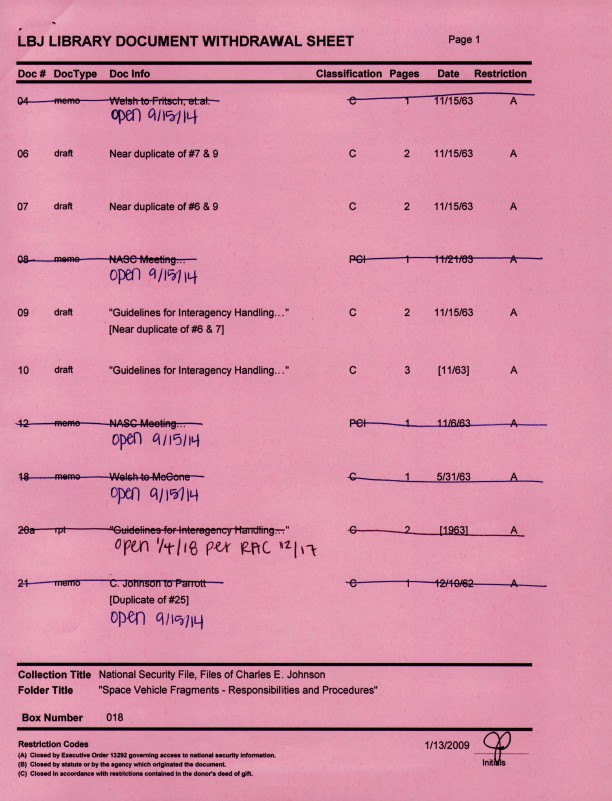
USG-UAP-D002, Interagency Correspondence Concerning Space Fragments, 1962-1964
This file contains a series of memoranda and correspondence exchanged among senior Executive Branch officials between October 2, 1962, and May 26, 1964, concerning the development of a policy framework and communications strategy for the recovery, handling, analysis, and disposition of materials associated with U.S. and foreign activities in space. Over the course of multiple drafts and revisions spanning nearly two years, the file documents efforts to establish jurisdictional boundaries based on the suspected origin and character of recovered material. In general, the proposed framework contemplated that material associated with a U.S. Department of Defense mission or equipment would be received, analyzed, and disposed of by the Department; that foreign space material would be turned over to the Department of Defense or the National Aeronautics and Space Administration (NASA), depending on the circumstances; and that the Department of State would coordinate with foreign governments to secure access to such material when recovered abroad. The correspondence also reflects efforts to assign responsibility for hazardous or radioactive materials to the Atomic Energy Commission. Various drafts alternated between assigning responsibility for handling materials whose origin could not be readily determined to the Department of Defense or to NASA. The correspondence also reflects concern with public perception regarding recovery activity and includes draft public statements describing the proposed framework. This public messaging included language designating NASA as the holding authority for foreign materials, while private correspondence described a parallel plan to exploit such materials for technical analysis. Ultimately, although these negotiations did not produce a settled policy framework, the correspondence illustrates interagency deliberations between senior officials in the context of the Space Race and the broader Cold War between the United States and the Soviet Union.
 PDF
DoD / AARO · Catalina Island, California
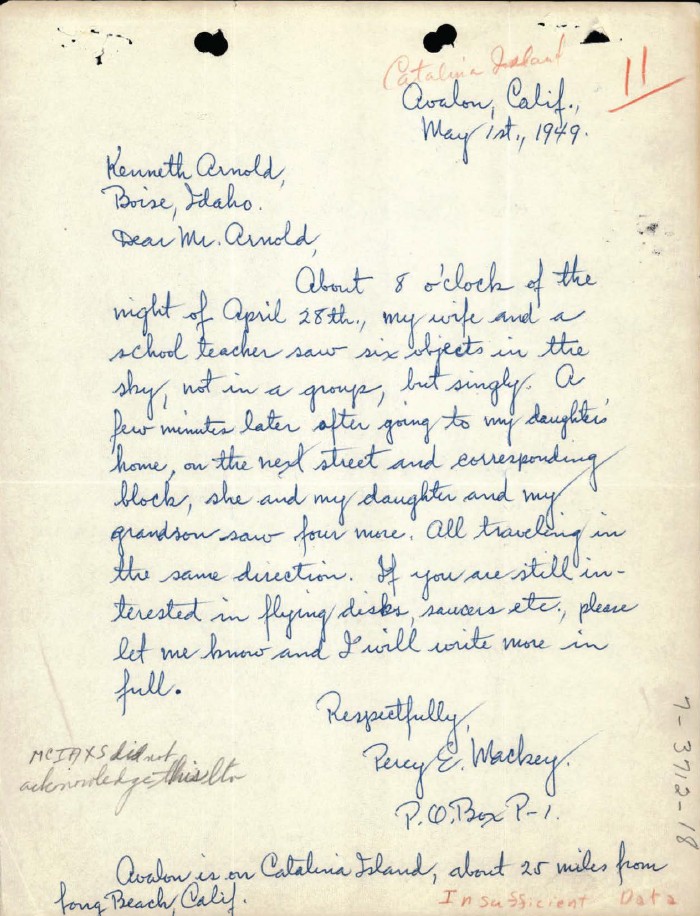
DOW-UAP-D181, Unresolved UAP Report, Catalina Island, 1949
This file contains correspondence from Mr. Percy Wackey of Avalon, California to Mr. Kenneth Arnold of Boise, Idaho. Mr. Wackey relayed that his wife and another individual reported observing six objects over Catalina Island on the night of April 28, 1949. A handwritten annotation and contemporary documentation associated with the letter indicate a conclusion by the U.S. Air Force that the incident lacked sufficient data for evaluation.
 PDF
DoD / AARO
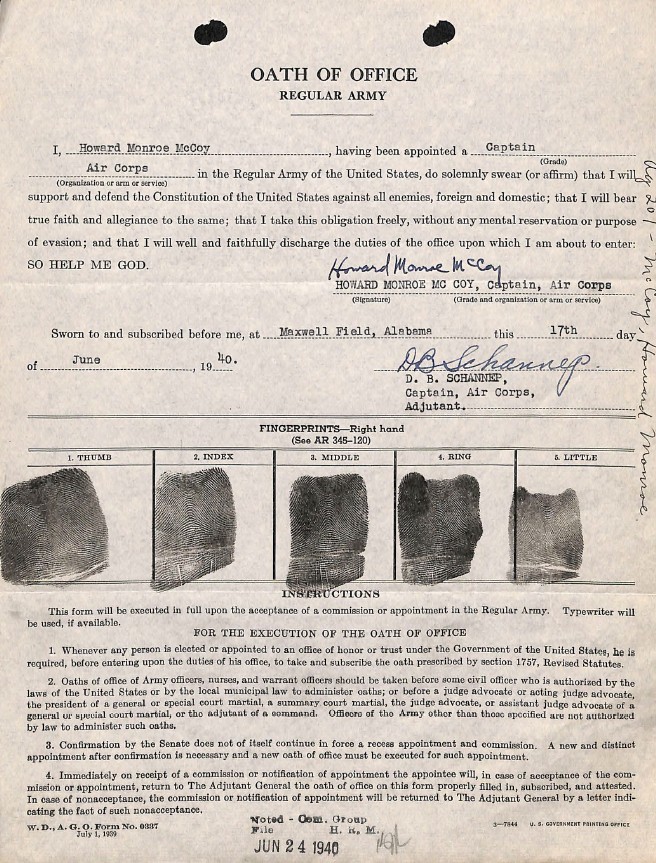
DOW-UAP-D180, Final Personnel Record for McCoy, Howard M., U.S. Air Force, 1954
This file contains the final personnel record of U.S. Air Force officer Howard M. McCoy, who left service as a Colonel, a senior field-grade officer responsible for significant operational and administrative duties. From December 1946 to August 1949, Colonel McCoy served as Deputy Commanding General for Intelligence (T-2), and later as Chief of the Intelligence Department, Headquarters, Air Materiel Command, at what is now known as Wright-Patterson Air Force Base. During his tenure, the Air Force initiated two significant studies centering on unidentified anomalous phenomena: Project SIGN and Project GRUDGE. He was among the senior Air Force intelligence officers involved in the early design, administration, and execution of those programs.
 PDF
DoD / AARO · Catalina Island, California
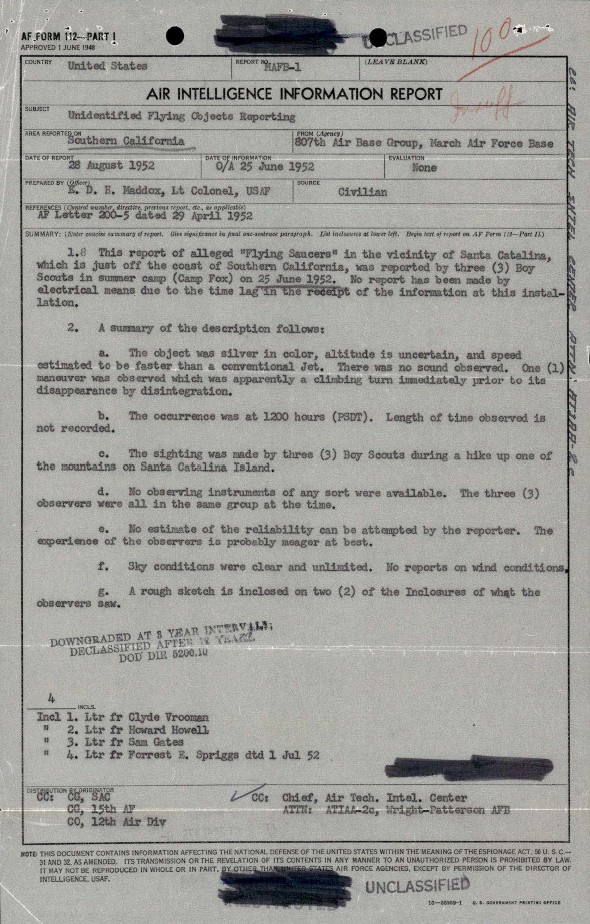
DOW-UAP-D179, Air Intelligence Information Report, Catalina Island, 1952
This file contains an Air Intelligence Information Report (AIIR), a standardized U.S. Air Force reporting form used to record raw information of potential intelligence value for later analysis. The form served as a primary vehicle for U.S. Air Force field intelligence collection throughout the early Cold War, until defense-wide reporting standards were established in the early 1960s. This AIIR records a June 25, 1952, incident over Catalina Island, California, in which three Boy Scouts attending a summer camp at Camp Fox reported observing silver “flying saucers” moving at an estimated speed faster than that of a conventional jet. The report also describes the object as climbing quickly before apparently disintegrating. A comment by the preparing officer indicated that no attempt was made to establish the reliability of the report and characterized the experience of the observers as “probably meager at best.” All descriptive and estimative language contained in this report reflects the reporter’s subjective interpretation at the time of the event. Such characterizations should not be interpreted as a conclusive indication of the presence or absence of any intrinsic object features or performance characteristics.
 PDF
DoD / AARO · Catalina Island, California
DOW-UAP-D178, Unresolved UAP Report, Catalina Island, 1953
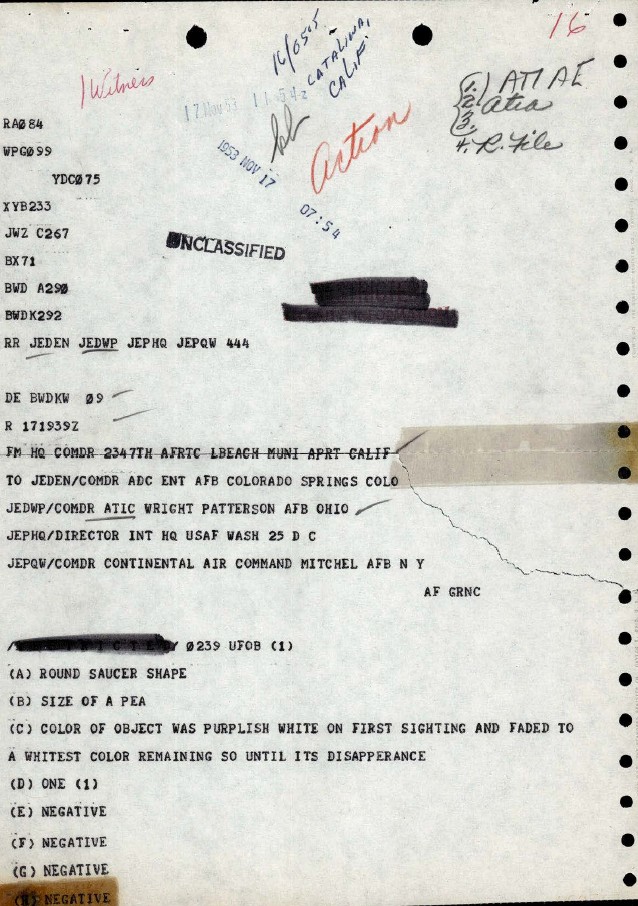
The file contains a report of a round, purplish-white object above Catalina Island on November 16, 1953. The report describes the object as remaining stationary, then moving northwest toward Los Angeles over approximately 10 minutes on a level flight path. The report characterizes the observer as fairly reliable due to his association with military jet aircraft activities while stationed at Long Beach Air Force Base, Los Angeles, CA. The report refers to an assessment by local astronomers that Jupiter provided a possible explanation.
 PDF
DoD / AARO · Catalina Island, California
DOW-UAP-D177, Unresolved UAP Report, Catalina Island, 1955
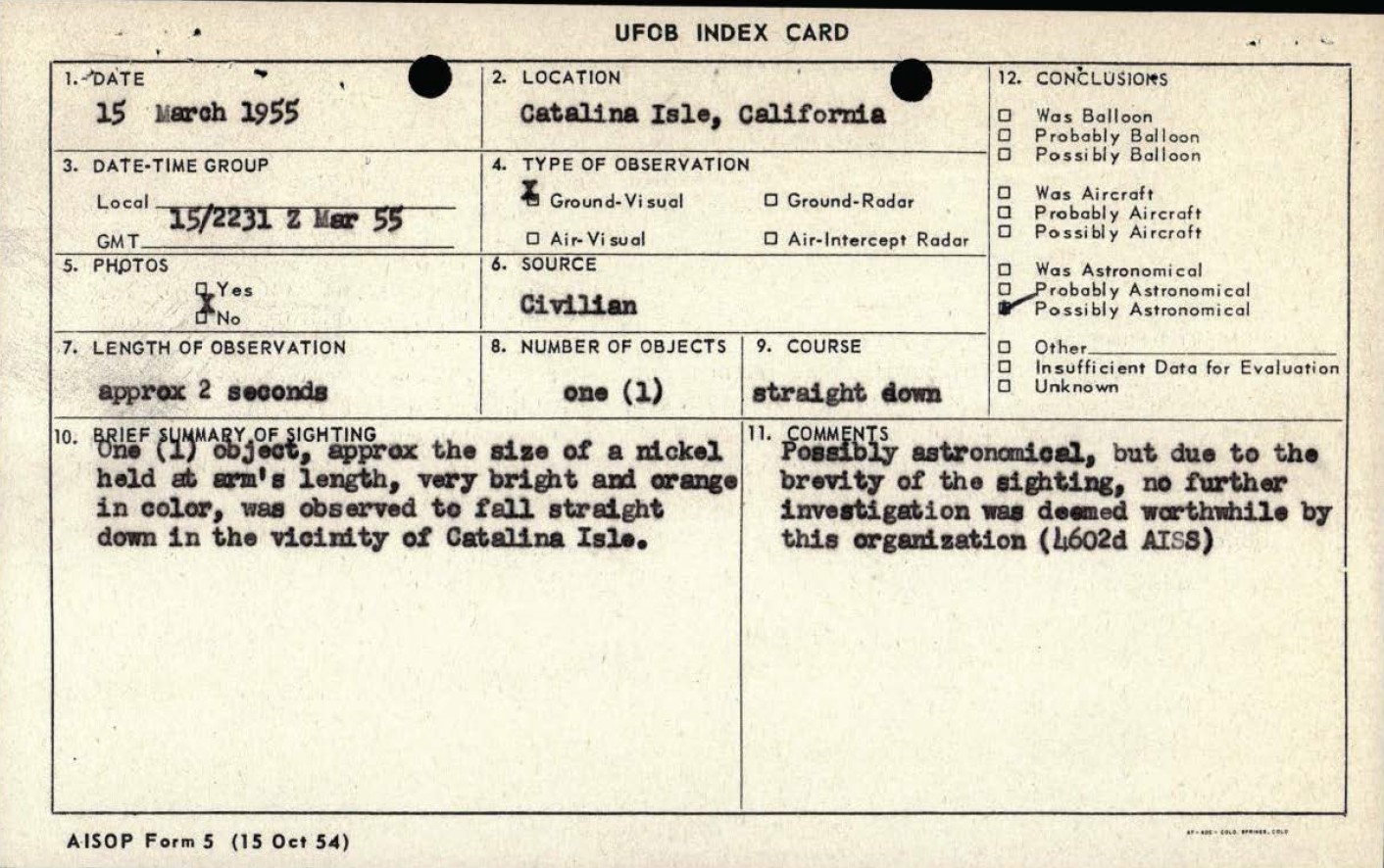
The file contains a report by Paul J. Carr of Avalon, California, who reported observing a bright orange object, approximately the size of a nickel held at arm’s length, on the evening of March 15, 1955. The provisional assessment associated with the report includes a comment from the preparing officer that the sighting is possibly astronomical, and that the incident did not warrant further investigation.
 PDF
DoD / AARO · Western United States
DOW-UAP-D176, Triangular UAP AARO Memorandum for Record, 2026
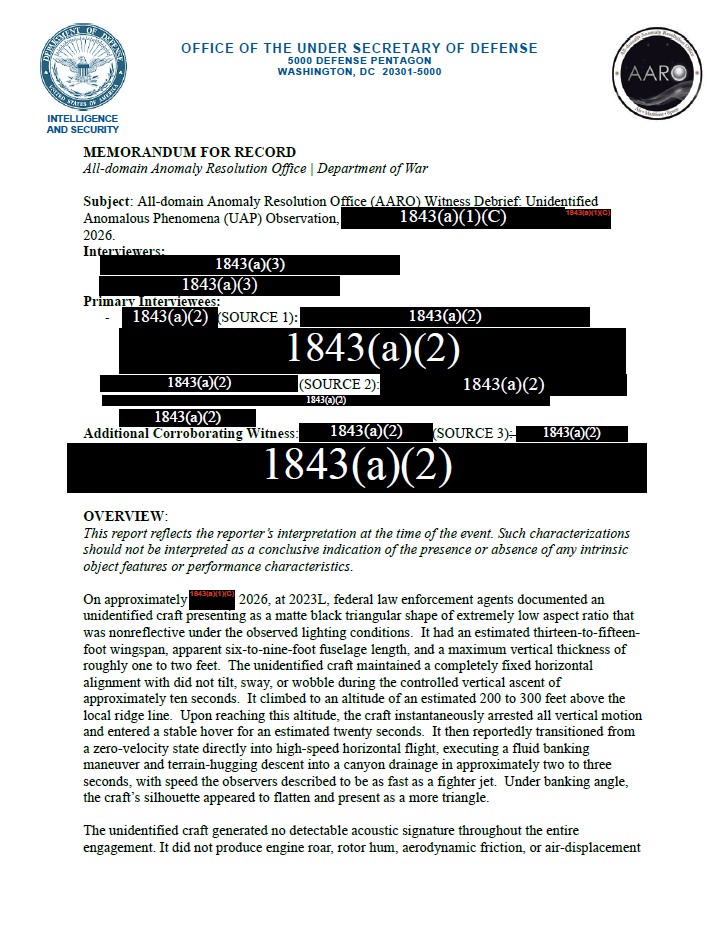
This document is a memorandum for record documenting an AARO witness debrief concerning reported unidentified anomalous phenomena (UAP) observations at a sensitive national security site in the western United States over two days in 2026. AARO considers this incident to warrant further investigation due to the close alignment of the phenomena’s reported morphological features and kinematic profiles with those of other reported incidents in the western United States region. The memorandum records an interview with two Federal Special Agents and incorporates a corroborating account from a third official positioned at a separate observation post. The memorandum describes a primary event in which the reporting individuals stated that a triangular object rose vertically, remained stationary, and then banked and descended into a canyon. It records their descriptions of the object’s shape, color, apparent thermal signature, perceived lack of conventional propulsion features, and absence of an associated audible signature. The memorandum further records a secondary observation on the following evening, and a subsequent ground search that found no visible debris or evidence of an impact in the accessible survey area. The file is an investigative record preserving witness accounts, chronology, and associated analytic support material developed by the All-domain Anomaly Resolution Office (AARO) and does not present a conclusive finding regarding the nature or origin of the reported object or objects. All descriptive and estimative language reported by the individuals interviewed reflects their subjective interpretations at the time of the event. Such characterizations should not be interpreted as a conclusive indication of the presence or absence of any intrinsic object features or performance characteristics.
 PDF
DoD / AARO · Las Vegas, Nevada
DOW-UAP-D175, BAASS Self-Assessment of UAP Analysis Capabilities, November 2010
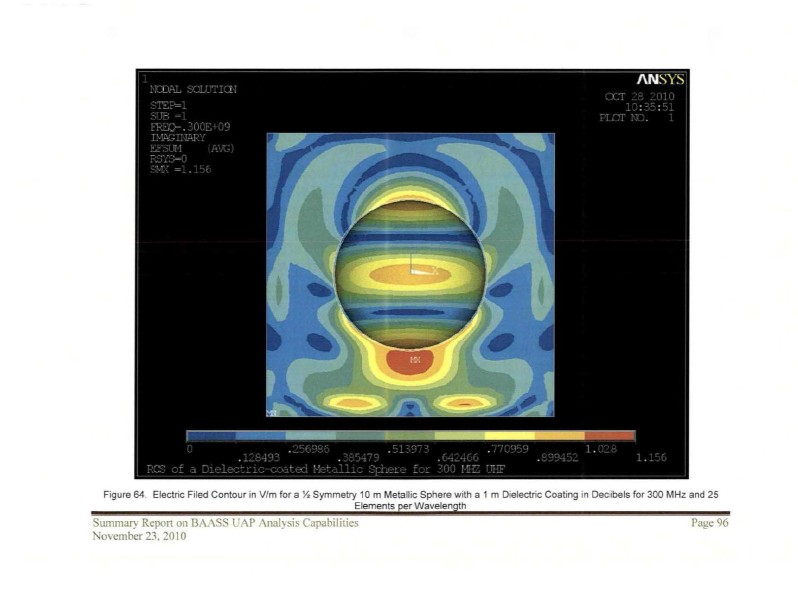
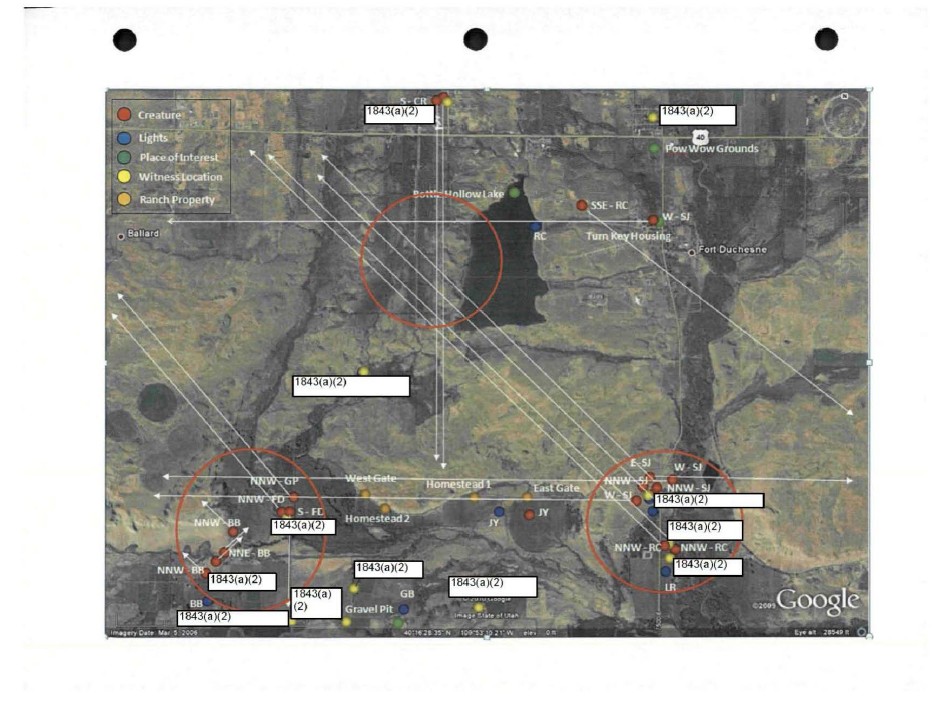
This document is an administrative, programmatic, or contractor-produced record related to the Advanced Aerospace Weapon System Applications Program (AAWSAP), a Defense Intelligence Agency (DIA)-administered program active from 2008 to 2012. AAWSAP’s official scope of work identified 12 technical research areas relating to potential aerospace threats over a time horizon of more than 40 years. As part of the broader program record, the file documents how AAWSAP was scoped, organized, tasked, funded, executed, or described at a particular point in time. This November 2010 Bigelow Aerospace Advanced Space Studies (BAASS) contractor-authored capability statement presents BAASS’s analysis as technically rigorous and strategically valuable. The document appears intended not only to describe BAASS’s analytical capabilities but also to reinforce the case for the organization’s continued relevance and for the continuation of AAWSAP. The document summarizes the company’s self-assessment of the suitability of its personnel, software, equipment, field sensor, and data warehousing capabilities for analyzing unidentified aerial phenomena (UAP) and unidentified submerged objects (USOs). It includes excerpted case findings and uses selected case studies and modeling exercises as demonstrations of BAASS’s analytical capabilities. The report describes BAASS as combining field collection resources, historical databases, and computational tools such as ANSYS Multiphysics to model UAP incidents through engineering and physics analysis, including work on radar cross section, fluid behavior, acoustics, and aerodynamic performance. It also presents BAASS’s in-house capabilities as supporting both threat assessment and the study of advanced aerospace technologies, while asserting that analysis of UAP performance characteristics could inform future developments in propulsion, stealth, detection, and weapons systems.
 PDF
DoD / AARO · Las Vegas, Nevada
DOW-UAP-D174, Utah Ranch Investigation Report, April 2010
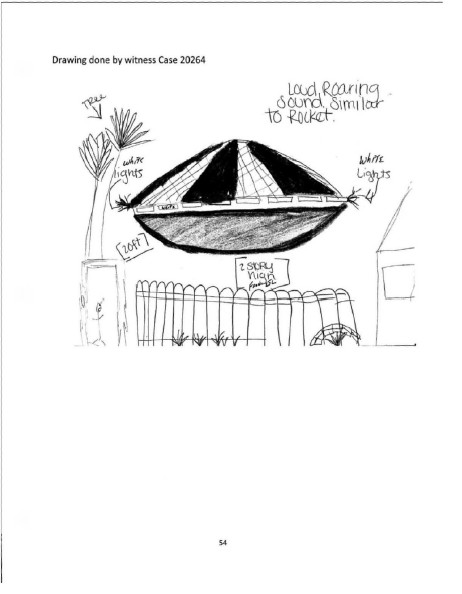
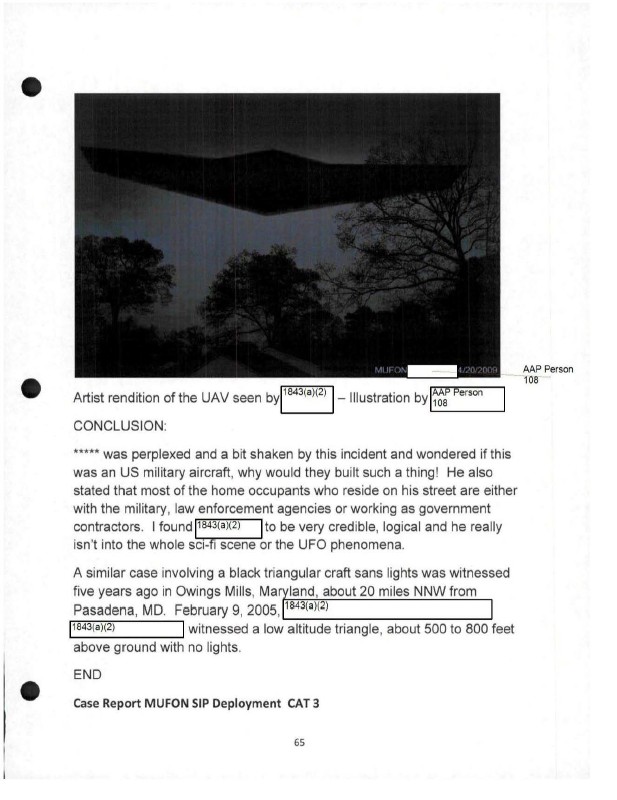
This document is an administrative, programmatic, or contractor-produced record related to the Advanced Aerospace Weapon System Applications Program (AAWSAP), a Defense Intelligence Agency (DIA)-administered program active from 2008 to 2012. AAWSAP’s official scope of work identified 12 technical research areas relating to potential aerospace threats over a time horizon of more than 40 years. As part of the broader program record, the file documents how AAWSAP was scoped, organized, tasked, funded, executed, or described at a particular point in time. This April 2010 Bigelow Aerospace Advanced Space Studies (BAASS) investigation report documents field deployments to a Utah property and surrounding communities during March and April 2010. The report states that BAASS personnel interviewed local residents, law enforcement officers, ranchers, business owners, and tribal community members about reported anomalous events; used handheld sensors to collect environmental measurements; planned plant-based biosensor experiments; and sought photographic, acoustic, and chemical evidence of purported anomalous phenomena. It also records extensive reported accounts involving “dog-like bipedal creatures,” orbs of light, “little people,” “prehistoric-looking” birds, among other phenomena, and states that BAASS intended to use interactive methods to attempt communication with the presumed source of reported anomalous activity.
 PDF
DoD / AARO · Las Vegas, Nevada
DOW-UAP-D173, BAASS Monthly Report, November 2009
This document is an administrative, programmatic, or contractor-produced record related to the Advanced Aerospace Weapon System Applications Program (AAWSAP), a Defense Intelligence Agency (DIA)-administered program active from 2008 to 2012. AAWSAP’s official scope of work identified 12 technical research areas relating to potential aerospace threats over a time horizon of more than 40 years. As part of the broader program record, the file documents how AAWSAP was scoped, organized, tasked, funded, executed, or described at a particular point in time. This November 2009 Bigelow Aerospace Advanced Space Studies (BAASS) progress report summarizes contractor activities for the period November 1–30, 2009. The report focuses on AAWSAP investigative activity based on information received via the Mutual UFO Network (MUFON), progress on investigations centering on a ranch in Utah, and a preliminary report on a “blue orb” incident. It also records BAASS’s continued emphasis on field investigation, case database expansion, and focused inquiry into events at the Utah ranch and surrounding area, including creation of a separate database for those incidents.
 PDF
DoD / AARO · Las Vegas, Nevada
DOW-UAP-D171, BAASS Monthly Report, June 2009
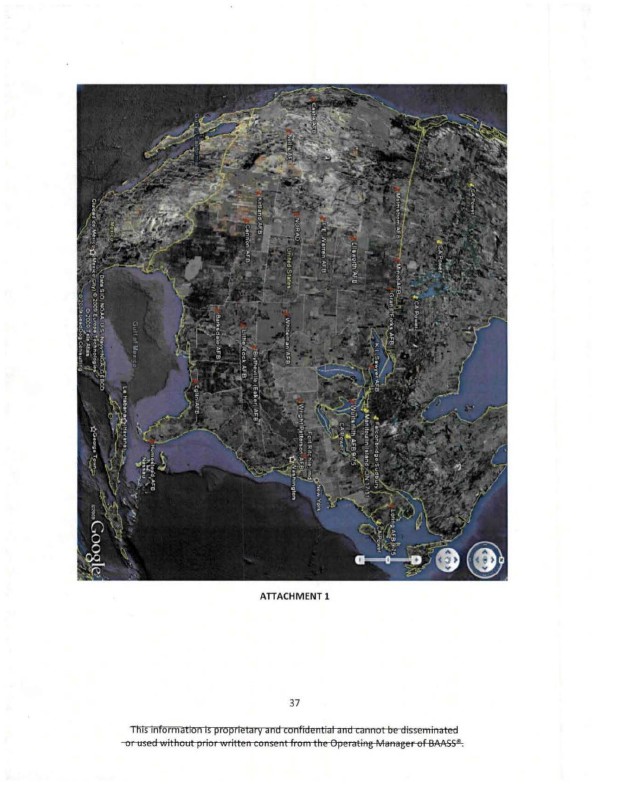
This document is an administrative, programmatic, or contractor-produced record related to the Advanced Aerospace Weapon System Applications Program (AAWSAP), a Defense Intelligence Agency (DIA)-administered program active from 2008 to 2012. AAWSAP’s official scope of work identified 12 technical research areas relating to potential aerospace threats over a time horizon of more than 40 years. As part of the broader program record, the file documents how AAWSAP was scoped, organized, tasked, funded, executed, or described at a particular point in time. This June 2009 Bigelow Aerospace Advanced Space Studies (BAASS) progress report summarizes contractor activities for the period June 1–30, 2009. The report addresses staffing growth, expansion into new facilities, progress on contracted technical papers, investigative activity based on information received via the Mutual UFO Network (MUFON), a BAASS deployment to Brazil, an update on “Project Northern Tier,” and continued review of UAP-related materials released by foreign governments. It also documents BAASS’s continued investment in field investigation capacity, foreign liaison-building, and UAP case acquisition, while recording BAASS’s proposal to reduce MUFON’s monthly stipend pending further performance review. Overall, the file reflects program activity, particularly in UAP reporting intake, foreign case investigation, and organizational expansion in support of those functions.
 PDF
DoD / AARO · Las Vegas, Nevada
DOW-UAP-D170, BAASS Monthly Report, April 2009
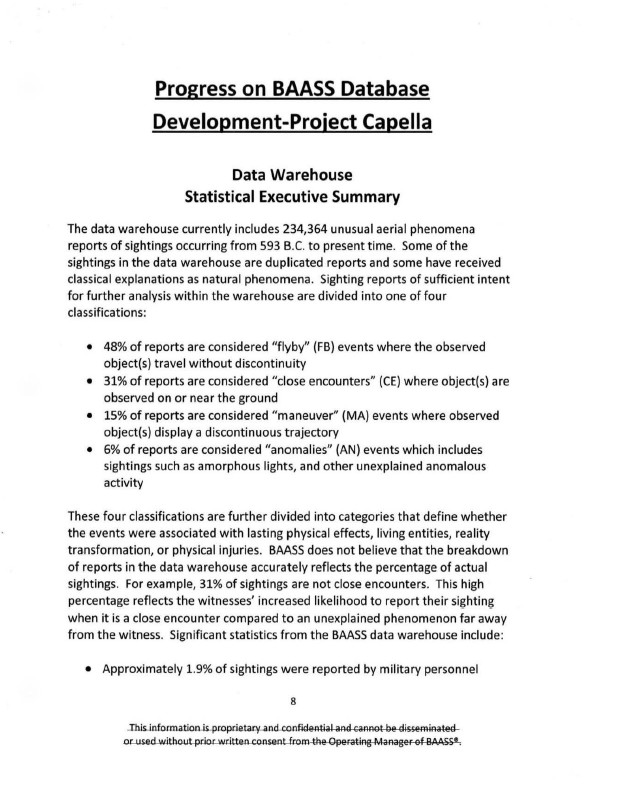
This document is an administrative, programmatic, or contractor-produced record related to the Advanced Aerospace Weapon System Applications Program (AAWSAP), a Defense Intelligence Agency (DIA)-administered program active from 2008 to 2012. AAWSAP’s official scope of work identified 12 technical research areas relating to potential aerospace threats over a time horizon of more than 40 years. As part of the broader program record, the file documents how AAWSAP was scoped, organized, tasked, funded, executed, or described at a particular point in time. This April 2009 Bigelow Aerospace Advanced Space Studies (BAASS) progress report summarizes contractor activities for the period April 1–30, 2009. The report addresses staffing and clearance processing, progress on contracted technical papers, BAASS’s purchase of unidentified anomalous phenomena (UAP) information from the Mutual UFO Network (MUFON), work on “Project Northern Tier,” and review of UAP-related materials released by several foreign governments. It also describes BAASS’s development of investigative and laboratory support capabilities, including a small deployable field investigation team and arrangements for potential future forensic and scientific analyses of materials obtained through MUFON reporting. Overall, the file documents ongoing program activity, particularly in UAP case acquisition, field investigation, and archival research.
 PDF
DoD / AARO · Las Vegas, Nevada
DOW-UAP-D169, BAASS Monthly Report, March 2009
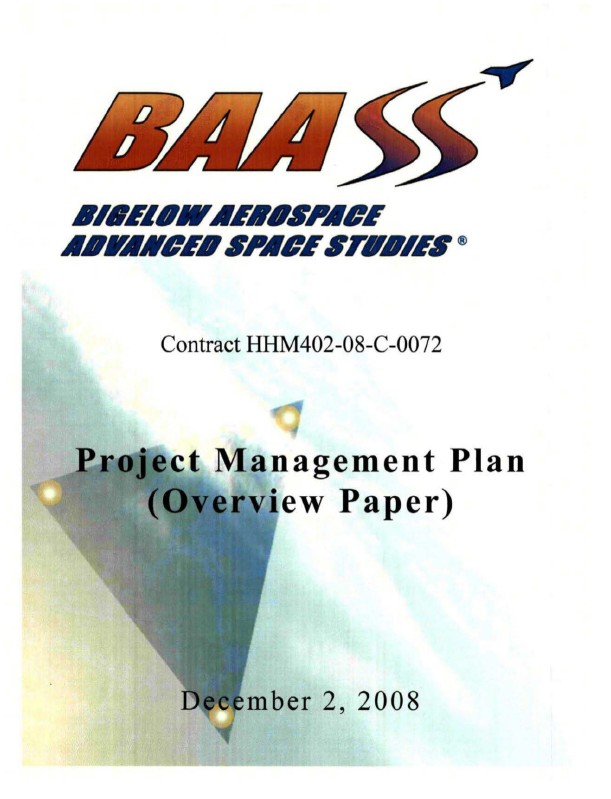
This document is an administrative, programmatic, or contractor-produced record related to the Advanced Aerospace Weapon System Applications Program (AAWSAP), a Defense Intelligence Agency (DIA)-administered program active from 2008 to 2012. AAWSAP’s official scope of work identified 12 technical research areas relating to potential aerospace threats over a time horizon of more than 40 years. As part of the broader program record, the file documents how AAWSAP was scoped, organized, tasked, funded, executed, or described at a particular point in time. This March 2009 Bigelow Aerospace Advanced Space Studies (BAASS) progress report summarizes contractor activities for the period March 1–31, 2009. The report addresses staffing and clearance processing, progress on contracted technical papers, development of advanced aerial phenomena databases, BAASS’s purchase of unidentified anomalous phenomena (UAP) information from the Mutual UFO Network (MUFON), efforts to become the Federal Aviation Administration’s official reporting point for unidentified anomalous phenomena (UAP), and review of UAP-related materials released by foreign governments. It also documents BAASS’s broader effort to establish centralized UAP collection and analysis capabilities, including database development, and external reporting pipelines. Overall, the file reflects ongoing program activity, particularly its emphasis on UAP reporting intake, reporting infrastructure, and archival or case-based analysis.
 PDF
DoD / AARO · Las Vegas, Nevada
DOW-UAP-D168, BAASS Project Management Plan, December 2008
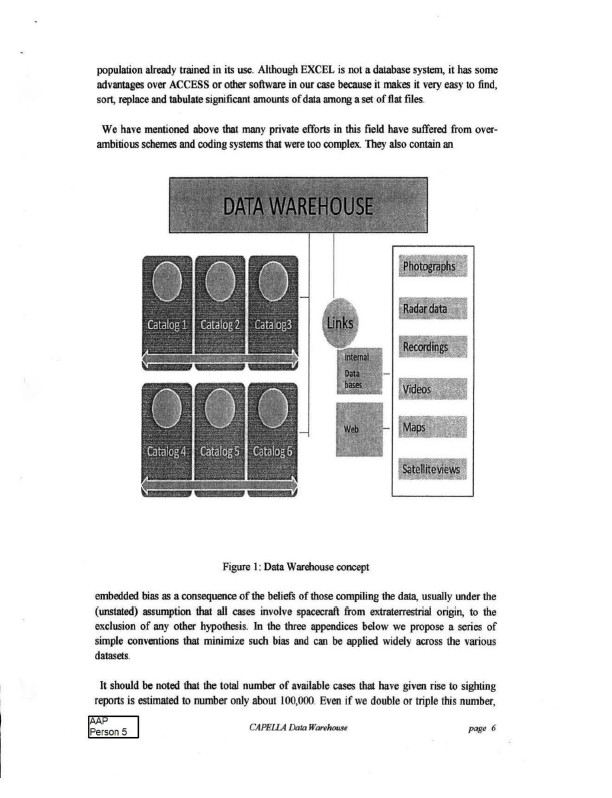
This document is an administrative, programmatic, or contractor-produced record related to the Advanced Aerospace Weapon System Applications Program (AAWSAP), a Defense Intelligence Agency (DIA)-administered program active from 2008 to 2012. AAWSAP’s official scope of work identified 12 technical research areas relating to potential aerospace threats over a time horizon of more than 40 years. As part of the broader program record, the file documents how AAWSAP was scoped, organized, tasked, funded, executed, or described at a particular point in time. This December 2008 Bigelow Aerospace Advanced Space Studies (BAASS) Project Management Plan is an overview paper setting out the contractor’s proposed strategy, priorities, and milestones for executing contract HHM402-08-C-0072 (AAWSAP). The plan states that BAASS would address the program’s 12 technical areas through a smaller number of selected projects, including initiatives focused on physics research, project cooperation with government-held information, academic engagement, database development, oral-history interviewing, and collection or review of materials described as excluded from Project Blue Book. The plan argues that the most productive approach would be to study “craft” or events already believed by BAASS to demonstrate novel behavior across the 12 technical areas, rather than concentrating primarily on then-current academic or industrial state-of-the-art research.
 PDF
DoD / AARO · San Fransisco, California
DOW-UAP-D167, Project Capella, December 2008
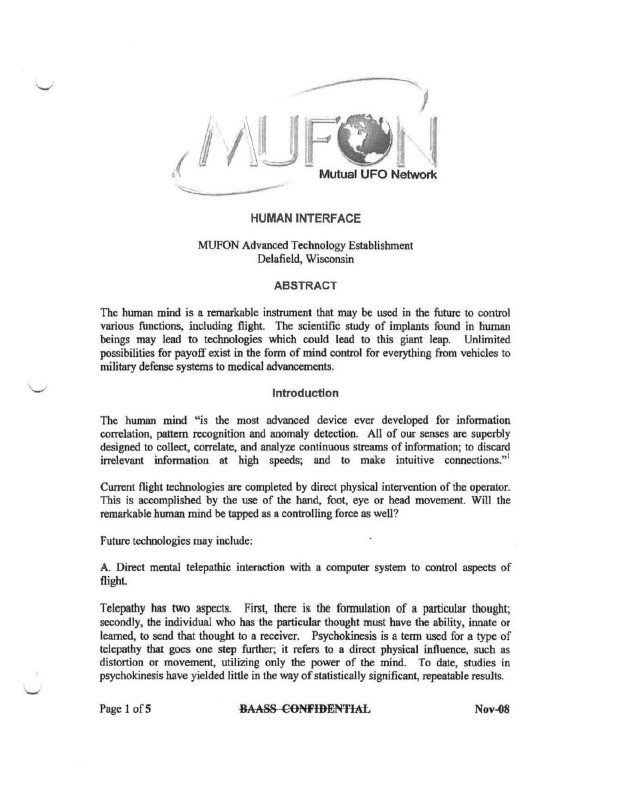
This document is an administrative, programmatic, or contractor-produced record related to the Advanced Aerospace Weapon System Applications Program (AAWSAP), a Defense Intelligence Agency (DIA)-administered program active from 2008 to 2012. AAWSAP’s official scope of work identified 12 technical research areas relating to potential aerospace threats over a time horizon of more than 40 years. As part of the broader program record, the file documents how AAWSAP was scoped, organized, tasked, funded, executed, or described at a particular point in time. This December 2008 report developed for Bigelow Aerospace Advanced Space Studies (BAASS) outlines Project Capella, a proposed data warehouse framework for the capture, processing, classification, and retrieval of information relating to “unusual” aerial phenomena and related anomalies. The report describes a methodology for integrating existing catalogues, standardizing classification and reliability measures, reviewing foreign and private databases, and building personnel and software capacity to support analysis, literature review, and potential future field investigations. It presents the project as a means of consolidating disparate historical and contemporary case materials into a structured research system capable of supporting multiple BAASS initiatives. By proposing a data architecture centered on unusual aerial phenomena and related anomalies, the document helped lay the groundwork for later BAASS efforts, seeking to formalize UAP-oriented data collection and analysis within BAASS’s execution of AAWSAP.
 PDF
DoD / AARO · Las Vegas, Nevada
DOW-UAP-D166, MUFON Reports Prepared for BAASS, November 2008
This document is an administrative, programmatic, or contractor-produced record related to the Advanced Aerospace Weapon System Applications Program (AAWSAP), a Defense Intelligence Agency (DIA)-administered program active from 2008 to 2012. AAWSAP’s official scope of work identified 12 technical research areas relating to potential aerospace threats over a time horizon of more than 40 years. As part of the broader program record, the file documents how AAWSAP was scoped, organized, tasked, funded, executed, or described at a particular point in time. This November 2008 compilation appears to be a set of technical materials prepared by the Mutual UFO Network (MUFON) for Bigelow Aerospace Advanced Space Studies (BAASS) under a separate supporting contract. The file presents MUFON-produced topical papers framed around AAWSAP’s technical research areas, including at least a paper on “Lift,” while treating historical and contemporary unidentified flying object or unidentified anomalous phenomena (UAP) reporting as a relevant source base for evaluating advanced aerospace capabilities.
 PDF
DoD / AARO
DOW-UAP-D164, Flying Object Report, Indiana, 1953
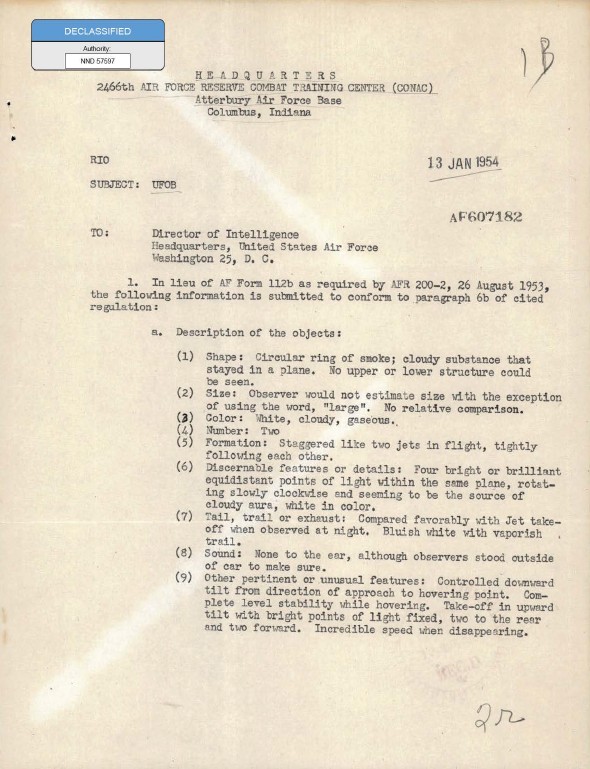
This document is a Flying Objects Report prepared in accordance with Air Force Regulation 200-2, which established guidance for reporting unidentified flying objects. The report records an incident near Seymour, Indiana, in which two civilian reporters stated that they observed two airborne objects while traveling by car. The report does not identify an exact event date; its weather assessment addresses conditions during the period December 8–15, 1953. The report describes the incident as consisting of a “brilliant moving light” and two large, white, cloudy or gaseous objects in a staggered formation. It further describes four bright points of light within each object and a bluish-white, vapor-like trail. The report describes the object kinematics as an in-line approach with a steady descent, a stationary interval of unreported duration, and a rapid departure along an abrupt upward angle toward the southwest. It records an estimated direct observation period of three to four minutes, with a total elapsed period of five to six minutes that included changes in the vehicle’s route. All descriptive and estimative language contained in this report reflects the reporter’s subjective interpretation at the time of the event. Such characterizations should not be interpreted as a conclusive indication of the presence or absence of any intrinsic object features or performance characteristics.
 PDF
DoD / AARO · Sweden
DOW-UAP-D163, Air Intelligence Information Report, Sweden, 1953
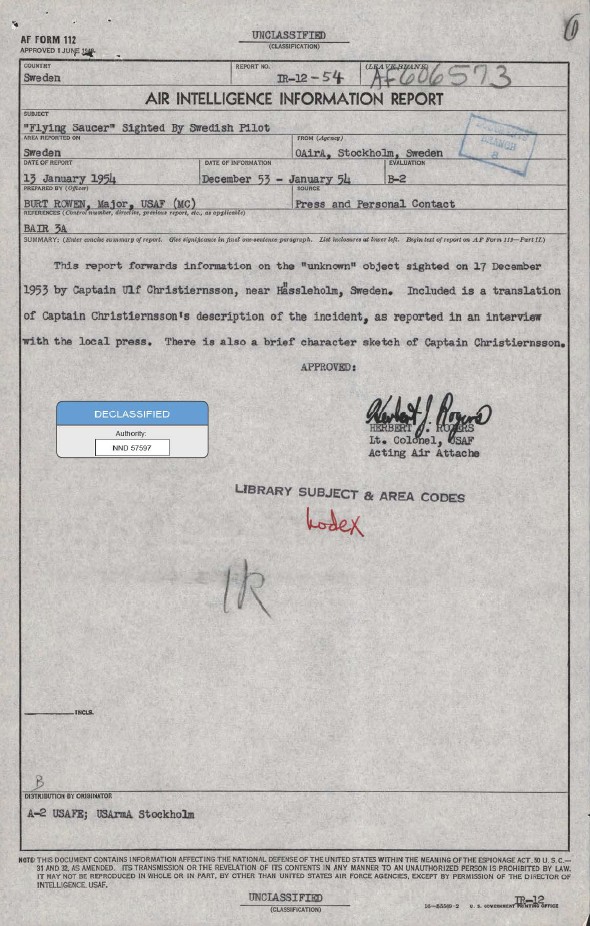
This document is an Air Intelligence Information Report (AIIR), a standardized U.S. Air Force reporting form used to record raw information of potential intelligence value for later analysis. The form served as a primary vehicle for U.S. Air Force field intelligence collection throughout the early Cold War, until defense-wide reporting standards were established in the early 1960s. This AIIR records a December 17, 1953, incident near Hässleholm, Sweden, translated from a local media report. At 1437 hours, Transair chief pilot Captain Ulf Christiernsson and crew chief Olle Johansson reported observing an object approaching their DC-3 from the opposite direction, approximately 600 meters (1,969 feet) below their aircraft, which was flying at about 2,150 meters (7,054 feet). The aircrew described a “shining metal spherical elliptical object” and estimated its speed as approximately the speed of sound. Christiernsson described the object as strongly metallic, nearly round, and slightly elliptical. He reported that it remained visible for six to seven seconds, produced no visible exhaust or condensation trail, and initially appeared to him to be a jet or possibly an unmanned “robot.” The Swedish Defense Staff reportedly identified no Swedish aircraft in the area at that time and stated that it would examine possible radar observations. The report also includes a brief character sketch of Christiernsson based on the account of a personal contact, who characterized him as “most untrustworthy,” and notes that Swedish authorities had begun an investigation into the incident. All descriptive and estimative language contained in this report reflects the reporter’s subjective interpretation at the time of the event. Such characterizations should not be interpreted as a conclusive indication of the presence or absence of any intrinsic object features or performance characteristics. AARO Comment: Based on the reported aircraft altitude and relative separation, the object’s reported altitude was approximately 1,550 meters (5,085 feet). Under standard atmospheric conditions, the speed of sound at that altitude is approximately 748 mph.
 PDF
DoD / AARO · Alaska
DOW-UAP-D162, Air Intelligence Information Report, Alaska, 1953
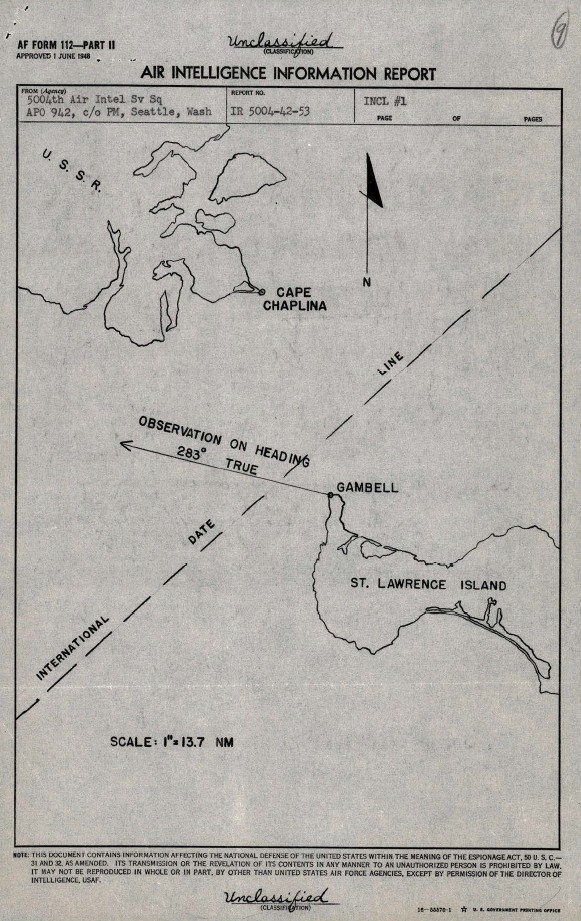
This document is an Air Intelligence Information Report (AIIR), a standardized U.S. Air Force reporting form used to record raw information of potential intelligence value for later analysis. The form served as a primary vehicle for U.S. Air Force field intelligence collection throughout the early Cold War, until defense-wide reporting standards were established in the early 1960s. This AIIR records a December 1, 1953, incident near St. Lawrence Island, Alaska, in which an Alaska National Guard sergeant residing on the island reported observing a stationary light on the horizon west of Gambell for approximately five minutes. The report states that the light was observed at a true heading of 283 degrees, appeared similar in color to a flashlight, and disappeared as though it had been turned off. The preparing officer further noted that an unidentified ship may have been the source of the light, though no definite conclusion could be reached as to its nature or origin. All descriptive and estimative language contained in this report reflects the reporter’s subjective interpretation at the time of the event. Such characterizations should not be interpreted as a conclusive indication of the presence or absence of any intrinsic object features or performance characteristics.
 PDF
DoD / AARO · Alaska
DOW-UAP-D161, Air Intelligence Information Report, Alaska, 1953
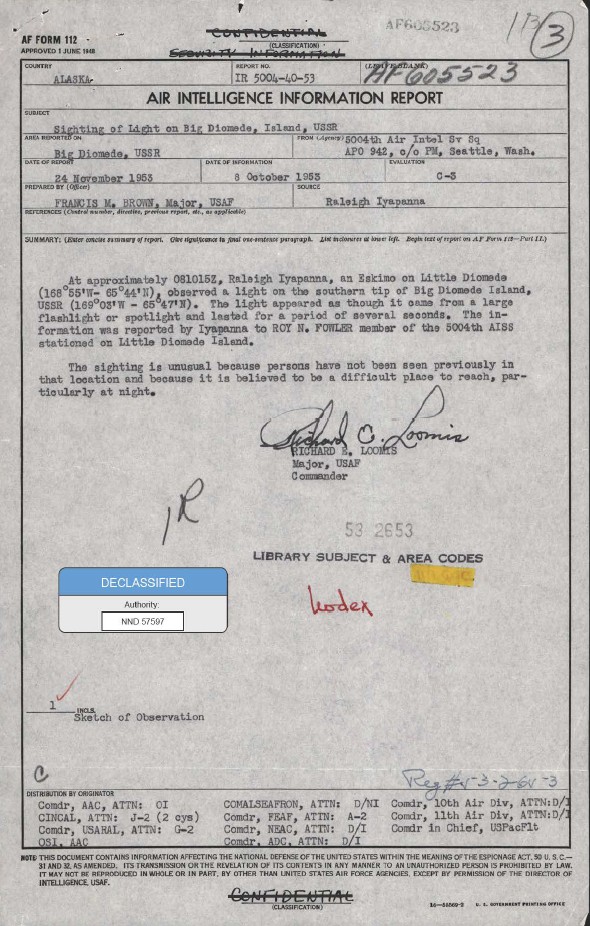
This document is an Air Intelligence Information Report (AIIR), a standardized U.S. Air Force reporting form used to record raw information of potential intelligence value for later analysis. The form served as a primary vehicle for U.S. Air Force field intelligence collection throughout the early Cold War, until defense-wide reporting standards were established in the early 1960s. This AIIR records an October 6, 1953, incident on Little Diomede, Alaska, in which a resident of the island reported observing a light on the southern tip of Big Diomede, U.S.S.R. The report states that the light lasted for several seconds and appeared as though it came from a large flashlight or spotlight. It further describes the light as about the size of a nickel coin held at arm’s length and about the same color as a burning match or dim flashlight. All descriptive and estimative language contained in this report reflects the reporter’s subjective interpretation at the time of the event. Such characterizations should not be interpreted as a conclusive indication of the presence or absence of any intrinsic object features or performance characteristics. AARO Comment: The Diomede Islands are situated in the Bering Strait between Alaska and Siberia and constitute the nearest point of territorial proximity between the United States and the former Soviet Union.
 PDF
DoD / AARO · Morocco
DOW-UAP-D160, Air Intelligence Information Report, Morocco, 1953
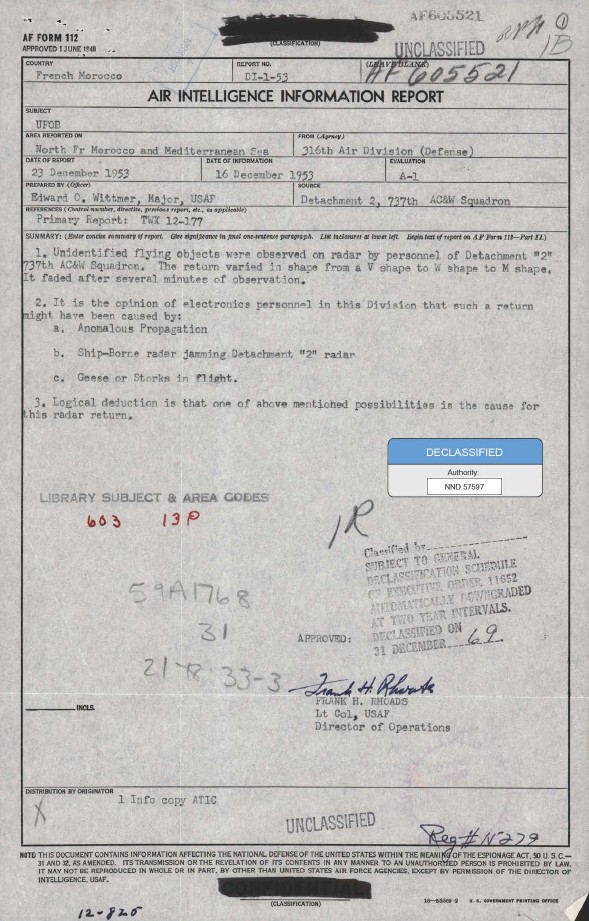
This document is an Air Intelligence Information Report (AIIR), a standardized U.S. Air Force reporting form used to record raw information of potential intelligence value for later analysis. The form served as a primary vehicle for U.S. Air Force field intelligence collection throughout the early Cold War, until defense-wide reporting standards were established in the early 1960s. This AIIR records a December 16, 1953, incident in northern French Morocco and the Mediterranean Sea area in which personnel of Detachment 2, 737th AC&W Squadron reported an unidentified radar return. The report states that the return varied in shape between “V,” “W,” and “M” configurations and faded after several minutes of observation. It further states that electronics personnel in the 316th Air Division believed the return might have been caused by anomalous propagation, ship-borne radar jamming, or geese or storks in flight, and concludes that one of those possibilities was the most likely explanation for the return. All descriptive and estimative language contained in this report reflects the reporter’s subjective interpretation at the time of the event. Such characterizations should not be interpreted as a conclusive indication of the presence or absence of any intrinsic object features or performance characteristics. AARO Comment: The 737th AC&W Squadron was a U.S. Air Force radar unit stationed in Saidia, Morocco, where it supported airborne early warning and air defense surveillance in coordination with French military forces.
 PDF
DoD / AARO · Germany
DOW-UAP-D159, Air Intelligence Information Report, Germany, 1953
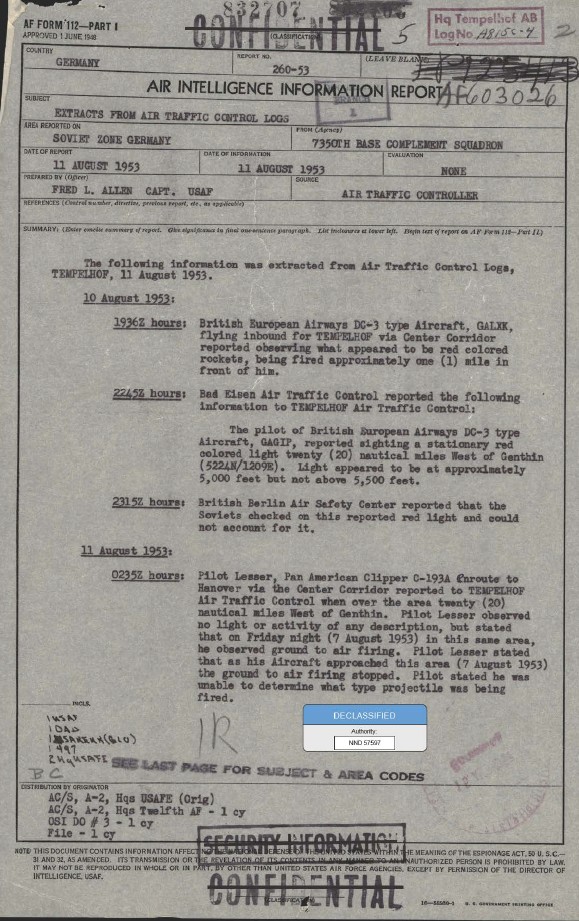
This document is an Air Intelligence Information Report (AIIR), a standardized U.S. Air Force reporting form used to record raw information of potential intelligence value for later analysis. The form served as a primary vehicle for U.S. Air Force field intelligence collection throughout the early Cold War, until defense-wide reporting standards were established in the early 1960s. This AIIR records a series of entries extracted from Tempelhof Airport air traffic control logs dated 10–11 August 1953 concerning aerial reports in the Soviet-occupied zone of Germany. The report states that a British European Airways DC-3 aircraft reported observing what the pilot described as red-colored rockets being fired approximately one mile in front of the aircraft while inbound to Tempelhof via the Center Corridor. It further states that the pilot of a second British European Airways DC-3 later reported a stationary, red-colored light approximately 20 nautical miles west of Genthin at an altitude of approximately 5,000 feet. The report also notes that British Berlin Air Safety Center stated that Soviet authorities had investigated the reported red light and could not account for it. A later Pan American pilot reported no corresponding light or activity when passing through the same area. All descriptive and estimative language contained in this report reflects the reporter’s subjective interpretation at the time of the event. Such characterizations should not be interpreted as a conclusive indication of the presence or absence of any intrinsic object features or performance characteristics.
 PDF
DoD / AARO · Canada
DOW-UAP-D158, Flying Object Report, Canada, 1953
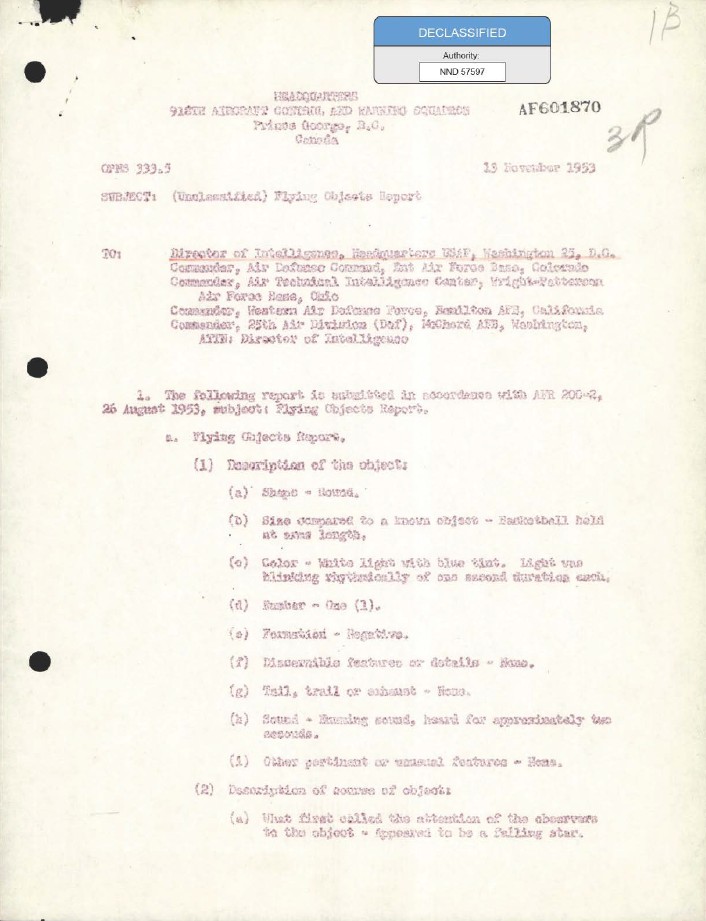
This document is a Flying Objects Report prepared in accordance with Air Force Regulation 200-2, which established guidance for reporting unidentified flying objects. This report records a November 13, 1953, incident in British Columbia, Canada, in which three U.S. Air Force servicemembers reported observing a round, blinking white light with a blue hue, initially described as resembling a falling star. The report describes the object’s motion as descending to an estimated altitude of 150 feet, remaining stationary for approximately 30 seconds, ascending vertically to an estimated altitude of 300 feet, remaining stationary for approximately 10 seconds, and then departing the observers’ field of view in a westerly direction while gaining altitude. All descriptive and estimative language contained in this report reflects the reporter’s subjective interpretation at the time of the event. Such characterizations should not be interpreted as a conclusive indication of the presence or absence of any intrinsic object features or performance characteristics.
 PDF
DoD / AARO · Italy
DOW-UAP-D157, Air Intelligence Information Report, Italy, 1952
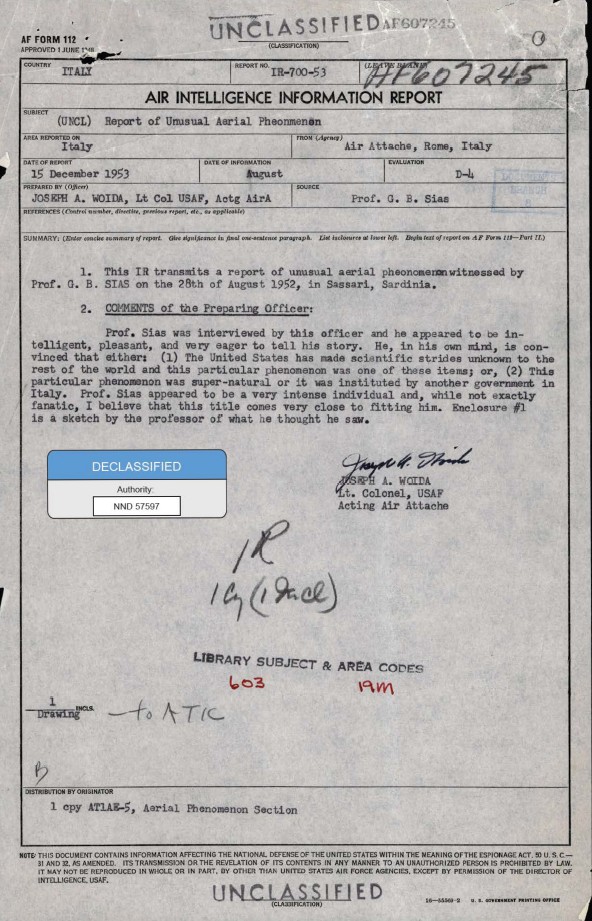
This document is an Air Intelligence Information Report (AIIR), a standardized U.S. Air Force reporting form used to record raw information of potential intelligence value for later analysis. The form served as a primary vehicle for U.S. Air Force field intelligence collection throughout the early Cold War, until defense-wide reporting standards were established in the early 1960s. This AIIR records an August 27, 1952, incident near Sassari, Italy, that was reported in the local Italian press the following day. The U.S. Air Attaché in Rome relayed the translated newspaper account to the Air Force in November 1953 and later interviewed the individual who made the initial report, Professor Giovanni Battista Sias. Sias described observing a brilliantly luminous sphere, slightly larger in apparent size than the full moon, with a green-blue color, silvery brightness, and metallic streaking on its right side. He reported that it moved from east to west at very high speed, intermittently disappearing and reappearing while leaving behind a narrow luminous trail or ribbon. The preparing officer characterized Professor Sias as intelligent, pleasant, and eager to share his account. All descriptive and estimative language contained in this report reflects the reporter’s subjective interpretation at the time of the event. Such characterizations should not be interpreted as a conclusive indication of the presence or absence of any intrinsic object features or performance characteristics.
 PDF
DoD / AARO · Guam
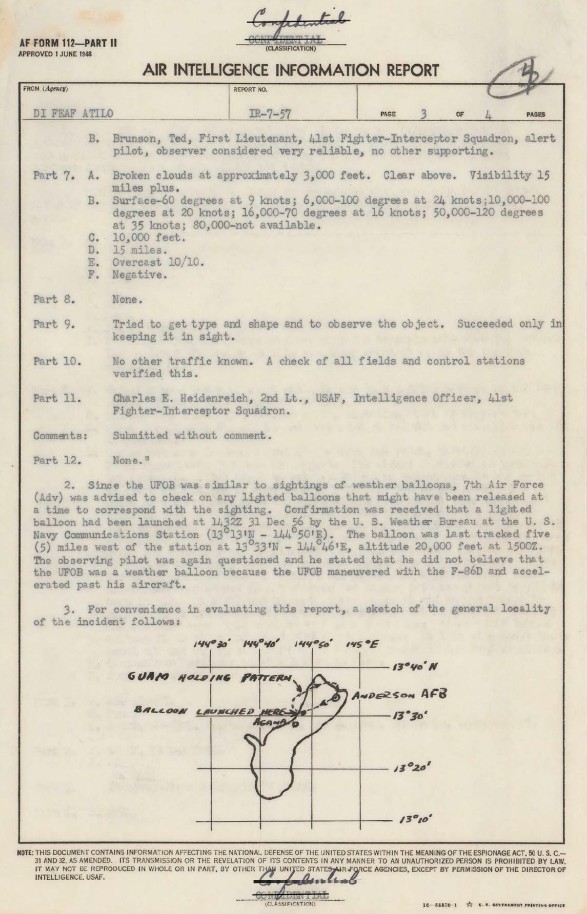
DOW-UAP-D156, Air Intelligence Information Report, Guam, 1956
This document is an Air Intelligence Information Report (AIIR), a standardized U.S. Air Force reporting form used to record raw information of potential intelligence value for later analysis. The form served as a primary vehicle for U.S. Air Force field intelligence collection throughout the early Cold War, until defense-wide reporting standards were established in the early 1960s. This AIIR records a December 31, 1956, incident in the vicinity of Guam in which the pilot of a U.S. Air Force F-86D aircraft reported observing an unidentified aerial blinking light. The report notes that a lighted weather balloon had been launched before the sighting and states that, if the balloon had malfunctioned and remained at a relatively low altitude, it could possibly explain the reported object. It also indicates that the preparing officer did not regard the balloon explanation as sufficient unless that condition applied. All descriptive and estimative language contained in this report reflects the reporter’s subjective interpretation at the time of the event. Such characterizations should not be interpreted as a conclusive indication of the presence or absence of any intrinsic object features or performance characteristics.
 PDF
DoD / AARO · Saudi Arabia
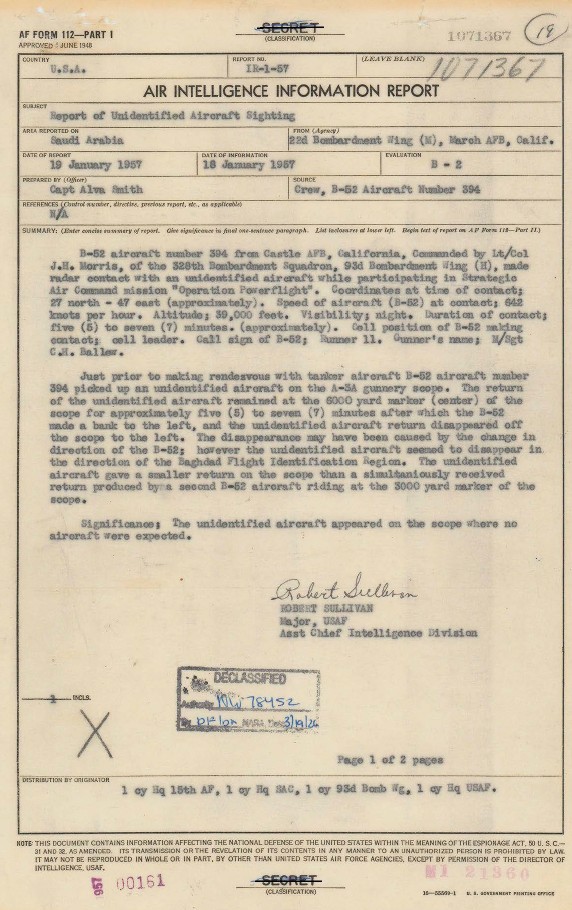
DOW-UAP-D155, Air Intelligence Information Report, Saudi Arabia, 1957
This document is an Air Intelligence Information Report (AIIR), a standardized U.S. Air Force reporting form used to record raw information of potential intelligence value for later analysis. The form served as a primary vehicle for U.S. Air Force field intelligence collection throughout the early Cold War, until defense-wide reporting standards were established in the early 1960s. This AIIR records a January 18, 1957, incident over Saudi Arabia in which the crew of a U.S. Air Force B-52 aircraft reported detecting an unidentified return on the aircraft’s gunnery scope for approximately five to seven minutes. The report characterizes the unidentified return as smaller than one produced by another B-52 operating in the area. All descriptive and estimative language contained in this report reflects the reporter’s subjective interpretation at the time of the event. Such characterizations should not be interpreted as a conclusive indication of the presence or absence of any intrinsic object features or performance characteristics.